Results by title
716 books match the query 'Literary Figures' and 3 start with u
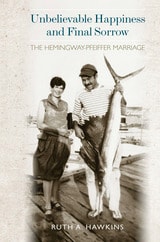
Unbelievable Happiness and Final Sorrow
The Hemingway-Pfeiffer MarriageRuth A. Hawkins
University of Arkansas Press, 2012
It was the glittering intellectual world of 1920s Paris expatriates in which Pauline Pfeiffer, a writer for Vogue, met Ernest Hemingway and his wife Hadley among a circle of friends that included Gertrude Stein, F. Scott Fitzgerald, John Dos Passos, and Dorothy Parker. Pauline grew close to Hadley but eventually forged a stronger bond with Hemingway himself; with her stylish looks and dedication to Hemingway's writing, Pauline became the source of "unbelievable happiness" for Hemingway and, by 1927, his second wife. Pauline was her husband's best editor and critic, and her wealthy family provided moral and financial support, including the conversion of an old barn to a dedicated writing studio at the family home in Piggott, Arkansas. The marriage lasted thirteen years, some of Hemingway's most productive, and the couple had two children. But the "unbelievable happiness" met with "final sorrow," as Hemingway wrote, and Pauline would be the second of Hemingway's four wives. Unbelievable Happiness and Final Sorrow paints a full picture of Pauline and the role she played in Ernest Hemingway's becoming one of our greatest literary figures.
[more]
Unspeakable
A Life beyond Sexual MoralityRachel Hope Cleves
University of Chicago Press, 2020
The sexual exploitation of children by adults has a long, fraught history. Yet how cultures have reacted to it is shaped by a range of forces, beliefs, and norms, like any other social phenomenon. Changes in how Anglo-American culture has understood intergenerational sex can be seen with startling clarity in the life of British writer Norman Douglas (1868–1952), who was a beloved and popular author, a friend of luminaries like Graham Greene, Aldous Huxley, and D.H. Lawrence, and an unrepentant and uncloseted pederast. Rachel Hope Cleves’s careful study opens a window onto the social history of intergenerational sex in the nineteenth and twentieth centuries, revealing how charisma, celebrity, and contemporary standards protected Douglas from punishment—until they didn’t.
Unspeakable approaches Douglas as neither monster nor literary hero, but as a man who participated in an exploitative sexual subculture that was tolerated in ways we may find hard to understand. Using letters, diaries, memoirs, police records, novels, and photographs—including sources by the children Douglas encountered—Cleves identifies the cultural practices that structured pedophilic behaviors in England, Italy, and other places Douglas favored. Her book delineates how approaches to adult-child sex have changed over time and offers insight into how society can confront similar scandals today, celebrity and otherwise.
Unspeakable approaches Douglas as neither monster nor literary hero, but as a man who participated in an exploitative sexual subculture that was tolerated in ways we may find hard to understand. Using letters, diaries, memoirs, police records, novels, and photographs—including sources by the children Douglas encountered—Cleves identifies the cultural practices that structured pedophilic behaviors in England, Italy, and other places Douglas favored. Her book delineates how approaches to adult-child sex have changed over time and offers insight into how society can confront similar scandals today, celebrity and otherwise.
[more]
Updike
America's Man of LettersWilliam H. Pritchard
University of Massachusetts Press, 2005
By the age of twenty-eight, John Updike had already been published in the three major forms—novel, poem, and short story—he would continue to explore with steadily expanding skill and authority. For the next four decades his literary career would realize itself primarily in these three forms, but also in essays, reviews, and memoirs, and in resourceful commentary on his own work—the stuff of many interviews and prefaces. In this book, William H. Pritchard offers not a biography, but an insightful portrait of the writer and his work.
[more]