458 books match the query 'Literature' and 8 start with u
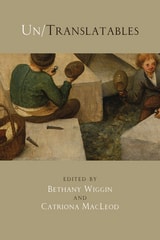
cover of Un/Translatables: New Maps for Germanic Literatures

Un/Translatables

New Maps for Germanic Literatures

Edited by Bethany Wiggin and Catriona MacLeod

Northwestern University Press, 2016
The term "Untranslatables" is rooted in two explorations of translation written originally in German: Walter Benjamin's now ubiquitous "The Task of the Translator" and Goethe's extensive notes to his "tradaptation" of mystical Persian poetry. The essays collected in Un/Translatables unite two inescapable interventions in contemporary translation discourses: the concept of "Untranslatables" as points of productive resistance, and the Germanic tradition as the primary dialogue partner for translation studies. The essays collected in the volume pursue the critical itineraries that would result if "Untranslatables," as discussed in Barbara Cassin's Dictionary of Untranslatables, were returned, productively estranged, to their original German context. Thus, these essays explore Untranslatables across Germanic literatures—German, Yiddish, Dutch, and Afrikaans—and follow trajectories into Hebrew, Arabic, Mandarin, Japanese, English, and Scots.
[more]
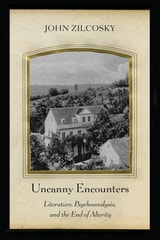
cover of Uncanny Encounters: Literature, Psychoanalysis, and the End of Alterity

Uncanny Encounters

Literature, Psychoanalysis, and the End of Alterity

John Zilcosky

Northwestern University Press, 2015

Winner of the Friedrich Wilhelm Bessel Research Award
Recipient, 2022 Guggenheim Fellowship


Around 1900, when the last blank spaces on their maps were filled, Europeans traveled to far-flung places hoping to find the spectacularly foreign. They discovered instead what Freud called, several years later, the uncannily familiar: disturbing reflections of themselves—either actual Europeans or Westernized natives. This experience was most extreme for German travelers, who arrived in the contact zones late, on the heels of other European colonialists, and it resulted not in understanding or tolerance but in an increased propensity for violence and destruction. The quest for a “virginal,” exotic existence proved to be ruined at its source, mirroring back to the travelers demonic parodies of their own worst aspects. In this strikingly original book, John Zilcosky demonstrates how these popular “uncanny” encounters influenced Freud’s—and the literary modernists’—use of the term, and how these encounters remain at the heart of our cross-cultural anxieties today.

[more]
cover of Under Review: Further Writings on Writers, 1946-1990

Under Review

Further Writings on Writers, 1946-1990

Anthony Powell

University of Chicago Press, 1994

"A splendid book. I cannot think of one so calculated to delight, intrigue, beguile, and inform. To pick up and browse through it . . . is like meeting some venerable old man of letters comfortably ensconced in his library, only to ready to reveal some pear of humor or wisdom about each of the writers he has chosen to deal with."—Kate Wharton, Evening Standard

"Powell is one of the great novelists of our time, much more interested in other people than in his own views and ideas. The result is that his extraordinary richness of act and detail also embodies a far more arresting and penetrating quantity of critical judgements on books, authors, fashions, developments, than are to be found in the theoretical pronouncement of modern academic criticism."—John Bayley, The Sunday Times

"These delightful reviews could be said to amount to a latter-day Brief Lives."—David Plante, Times Literary Supplement
[more]
cover of Unnatural Narratology: Extensions, Revisions, and Challenges

Unnatural Narratology

Extensions, Revisions, and Challenges

Edited by Jan Alber and Brian Richardson

The Ohio State University Press, 2020
Unnatural Narratology: Extensions, Revisions, and Challenges offers a number of developments, refinements, and defenses of key aspects of unnatural narrative studies. The first section applies unnatural narrative theory and analysis to ideologically charged areas such as feminism, postcolonial studies, cultural alterity, and subaltern discourse. The book goes on to engage with and intervene in theoretical debates in several areas of both critical theory and narrative theory, including affect studies, immersion, narration, character theory, frames, and theories of reception and interpretation. Antimimetic perspectives are also extended to additional fields, including autobiography, graphic narratives, drama and film, performance studies, and interactive gamebooks. Written by an international assemblage of distinguished and emerging narrative scholars and theorists, this collection promises to greatly enhance the study of narrative and further advance the frontiers of narrative theory.
[more]
cover of Unsettled Subjects: Restoring Feminist Politics to Poststructuralist Critique

Unsettled Subjects

Restoring Feminist Politics to Poststructuralist Critique

Susan Lurie

Duke University Press, 1997

During the 1980s much of the work of feminist theory aimed to fully account for issues of class, race, and sexuality that previously had been overlooked. Susan Lurie argues that this work tended to privilege questions of race and class at the expense of gender, and frequently, if inadvertently, left patriarchal power unquestioned. Developing a feminist model that keeps multiple political forces in view, Lurie returns to three literary feminists from earlier parts of the century: Ellen Glasgow, Zora Neale Hurston, and Elizabeth Bishop. As Lurie argues, each of these women shows that both resistance to male domination and alliances between different oppositional politics rely on recognizing how power regulates a subject’s multiple beliefs.
In her analysis, Lurie traces each author’s strategies for revealing and challenging the ways that patriarchal gender ideology profits from what is always plural and contested female subjectivity. Only such an inquiry, Lurie demonstrates, can explain the impasses that have steered poststructuralist feminism away from gender as a category of analysis and can point toward the models necessary for a more complete feminist critique of patriarchal power.
[more]
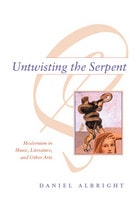
cover of Untwisting the Serpent: Modernism in Music, Literature, and Other Arts

Untwisting the Serpent

Modernism in Music, Literature, and Other Arts

Daniel Albright

University of Chicago Press, 2000

From its dissonant musics to its surrealist spectacles (the urinal is a violin!), Modernist art often seems to give more frustration than pleasure to its audience. In Untwisting the Serpent, Daniel Albright shows that this perception arises partly because we usually consider each art form in isolation, even though many of the most important artistic experiments of the Modernists were collaborations involving several media—Igor Stravinsky's The Rite of Spring is a ballet, Gertrude Stein's Four Saints in Three Acts is an opera, and Pablo Picasso turned his cubist paintings into costumes for Parade.

Focusing on collaborations with a musical component, Albright views these works as either figures of dissonance that try to retain the distinctness of their various media (e.g. Guillaume Apollinaire's Les Mamelles de Tirésias) or figures of consonance that try to lose themselves in some total effect (e.g. Arnold Schoenberg's Erwartung). In so doing he offers a fresh picture of Modernism, and provides a compelling model for the analysis of all artistic collaborations.

Untwisting the Serpent is the recipient of the 2001 Susanne M. Glasscock Humanities Book Prize for Interdisciplinary Scholarship of the Center for Humanities Research at Texas A&M University.
[more]
cover of Untying Things Together: Philosophy, Literature, and a Life in Theory

Untying Things Together

Philosophy, Literature, and a Life in Theory

Eric L. Santner

University of Chicago Press, 2022

Untying Things Together helps to clarify the stakes of the last fifty years of literary and cultural theory by proposing the idea of a sexuality of theory.

In 1905, Freud published his Three Essays on the Theory of Sexuality, the book that established the core psychoanalytic thesis that sexuality is central to formations of the unconscious. With this book, Eric L. Santner inverts Freud’s title to take up the sexuality of theory—or, more exactly, the modes of enjoyment to be found in the kinds of critical thinking that, since the 1960s, have laid claim to that ancient word, “theory.” Santner unfolds his argument by tracking his own relationship with this tradition and the ways his intellectual and spiritual development has been informed by it.

Untying Things Together is both an intellectual history of major theoretical paradigms and a call for their reexamination and renewal. Revisiting many of the topics he has addressed in previous work, Santner proposes a new way of conceptualizing the eros of thinking, attuned to how our minds and bodies individually and collectively incorporate or “encyst” on a void at the heart of things. Rather than proposing a “return to theory,” Santner’s book simply employs theory as a way of further “(un)tying together” the resources of philosophy, art and literature, theology, psychoanalysis, political thought, and more.
[more]
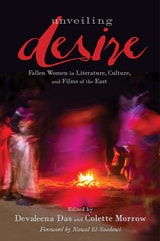
cover of Unveiling Desire: Fallen Women in Literature, Culture, and Films of the East

Unveiling Desire

Fallen Women in Literature, Culture, and Films of the East

Das, Devaleena

Rutgers University Press, 2018

In Unveiling Desire, Devaleena Das and Colette Morrow show that the duality of the fallen/saved woman is as prevalent in Eastern culture as it is in the West, specifically in literature and films. Using examples from the Middle to Far East, including Iran, India, Pakistan, Bangladesh, Thailand, Japan, and China, this anthology challenges the fascination with Eastern women as passive, abject, or sexually exotic, but also resists the temptation to then focus on the veil, geisha, sati, or Muslim women’s oppression without exploring Eastern women’s sexuality beyond these contexts. The chapters cover instead mind/body sexual politics, patriarchal cultural constructs, the anatomy of sex and power in relation to myth and culture, denigration of female anatomy, and gender performativity. From Persepolis to Bollywood, and from fairy tales to crime fiction, the contributors to Unveiling Desire show how the struggle for women’s liberation is truly global.  
[more]