Results by title
914 books match the query 'Medieval' and 4 start with u
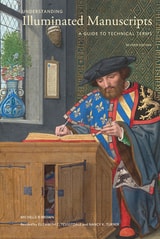
Understanding Illuminated Manuscripts
A Guide to Technical Terms, Revised EditionMichelle Brown
J. Paul Getty Trust, The, 2018
What is a historiated initial? What are canon tables? What is a drollery? This revised edition of Understanding Illuminated Manuscripts: A Guide to Technical Terms offers definitions of the key elements of illuminated manuscripts, demystifying the techniques, processes, materials, nomenclature, and styles used in the making of these precious books.
Updated to reflect current research and technologies, this beautifully illustrated guide includes images of important manuscript illuminations from the collection of the J. Paul Getty Museum and beyond. Concise, readable explanations of the technical terms most frequently encountered in manuscript studies make this portable volume an essential resource for students, scholars, and readers who wish a deeper understanding and enjoyment of illuminated manuscripts and medieval book production.
Updated to reflect current research and technologies, this beautifully illustrated guide includes images of important manuscript illuminations from the collection of the J. Paul Getty Museum and beyond. Concise, readable explanations of the technical terms most frequently encountered in manuscript studies make this portable volume an essential resource for students, scholars, and readers who wish a deeper understanding and enjoyment of illuminated manuscripts and medieval book production.
[more]
Understanding the Medieval Meditative Ascent
Augustine, Anselm, Boethius and DanteRobert McMahon
Catholic University of America Press, 2006
Understanding the Medieval Meditative Ascent uses literary analysis to discover new philosophical meanings in these works. Clearly written in nontechnical language, its account of their literary structures and of the hidden meanings they generate will inform nonspecialist and specialist alike.
[more]
University of Chicago Readings in Western Civilization, Volume 4
Medieval EuropeEdited by Julius Kirshner and Karl F. Morrison
University of Chicago Press, 1986
The University of Chicago Readings in Western Civilization (nine volumes) makes available to students and teachers a unique selection of primary documents, many in new translations. These readings, prepared for the highly praised Western civilization sequence at the University of Chicago, were chosen by an outstanding group of scholars whose experience teaching that course spans almost four decades. Each volume includes rarely anthologized selections as well as standard, more familiar texts; a bibliography of recommended parallel readings; and introductions providing background for the selections. Beginning with Periclean Athens and concluding with twentieth-century Europe, these source materials enable teachers and students to explore a variety of critical approaches to important events and themes in Western history.
Individual volumes provide essential background reading for courses covering specific eras and periods. The complete nine-volume series is ideal for general courses in history and Western civilization sequences.
Individual volumes provide essential background reading for courses covering specific eras and periods. The complete nine-volume series is ideal for general courses in history and Western civilization sequences.
[more]

Utter Antiquity
Perceptions of Prehistory in Renaissance EnglandArthur B. Ferguson
Duke University Press, 1993
Historians know a great deal about how English thinkers of the sixteenth and seventeenth centuries saw the "documentable" past, but relatively little about how they perceived times stretching back beyond history. Arthur B. Ferguson shows in this elegant essay that prehistory had great meaning in Renaissance England. Commentators of various sorts—from poets to antiquaries—looked to the most distant past for the vanishing point that would perfect their historical perspective and orient them in an age of increasing change. In this pursuit they had often to let imagination serve the purposes of interpretation. Though largely speculative, their efforts reveal much about the intellectual life of Renaissance England.
Since the Bible left little room for speculation on prehistory—in fact no room at all for the concept itself—Utter Antiquity concentrates on myth and legend outside of the biblical context and on those who conjured prehistory out of these sources. A subtle conflict between belief and skepticism emerges from these pages, as Ferguson reveals how some Renaissance writers struggled with ancient explanations that flouted reason and experience, while others sidestepped such doubts by relating prehistory to man's social evolution. By isolating and analyzing topics such as skepticism, rationalism, and poetic history, Ferguson illuminates the development of historical consciousness in early modern England. His accessible and eloquent study contributes significantly to an understanding of the Renaissance mind and intellectual history in general.
Since the Bible left little room for speculation on prehistory—in fact no room at all for the concept itself—Utter Antiquity concentrates on myth and legend outside of the biblical context and on those who conjured prehistory out of these sources. A subtle conflict between belief and skepticism emerges from these pages, as Ferguson reveals how some Renaissance writers struggled with ancient explanations that flouted reason and experience, while others sidestepped such doubts by relating prehistory to man's social evolution. By isolating and analyzing topics such as skepticism, rationalism, and poetic history, Ferguson illuminates the development of historical consciousness in early modern England. His accessible and eloquent study contributes significantly to an understanding of the Renaissance mind and intellectual history in general.
[more]