Results by title
128 books match the query 'Men' and 2 start with u

Under the Rug
The (Not So) Hidden History of Men and Their HairpiecesWendy A. Woloson
University of Chicago Press, 0
False hair can reveal honest truths—about the past, gender, identity, and the stories men tell about themselves.
History has seen its share of famous toupees. John Wayne’s. Frank Sinatra’s. Humphrey Bogart’s. Hairpieces can reveal a wearer’s inner motivations, reinforce gender norms, cause embarrassment, and even provoke disgust. Although false, they can create real meaning.
In Wendy A. Woloson’s hands, the toupee helps us see how men have understood themselves and fashioned their identities over time. Starting in the late eighteenth century, when men stopped wearing white powdered wigs, and moving to the 1920s, when toupees could be easily mass-produced, Woloson tells the story of the “Toupee Age.” She investigates why balding was considered such a problem in the first place, how hair became entangled with anxieties about aging, and the ways that looking old posed a threat to manhood. She details the bear’s grease pomades, brush-on dyes, elixirs, false whiskers, and hairpieces that were created to meet shifting notions of masculinity and style. Under the Rug also introduces readers to the people who styled and traded hair, made wigs, and hawked baldness cures. Drawing on business records, advertisements, graphic images, and a host of other primary sources, Woloson incisively explains how such trades seeded fears about thinning hair and sold men solutions. This vanity project continues today, as hair transplants, medications to stimulate hair growth, and Toupee TikTok encourage people to reinvent the way they’re seen—by others and themselves.
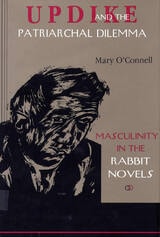
Updike and the Patriarchal Dilemma
Masculinity in the Rabbit NovelsMary O'Connell
Southern Illinois University Press, 1996
Mary O’Connell examines the role of socially constructed masculinity in John Updike’s Rabbit tetralogy—Rabbit Run, Rabbit Redux, Rabbit Is Rich, and Rabbit at Rest—which comprises the longest and most comprehensive representation of masculinity in American literature and places Updike firmly with the precursors of the contemporary movement among men to reevaluate their cultural inheritance.
A disturbing element exists, O’Connell determines, in both the texts of the Rabbit novels and in the critical community that examines them. In the novels, O’Connell finds substantial evidence to demonstrate patterns of psychological and physical abuse toward women, citing as the culminating example the mounting toll of literally or metaphorically dead women in the texts. Critics who characterize Updike as a nonviolent writer who strangely overlooks Rabbit’s repressive and violent behaviors avoid a discomforting but crucial aspect of Updike’s portrait.
Because the critical verdict of nonviolence in Updike’s novels contrasts sharply with the string of female corpses, O’Connell deems that something within the text or culture—or both—is seriously amiss.
Although she examines negative aspects of Rabbit’s behavior, O’Connell avoids the oversimplification of labeling Updike a misogynist. Instead, she looks closely at the forces shaping Rabbit’s gender identity as well as at the ways he experiences masculinity and the ways his gender identity affects his personal and spiritual development, his relationships, and, ultimately, his society. She shows how Updike challenges stereotypical masculinity, revealing its limitations and proscriptions as the source of much unhappiness for both men and women. Further, she substantiates the relation between gender, form, structure, perspective, and language use in the novels, alerting the reader to the ambivalence arising from the male author’s examination of masculinity.
O’Connell maintains that Updike does more than write Rabbit as a stereotypical male; he instead explores in depth his character’s habitually flawed ways of seeing and responding to the world. As she discusses these issues, O’Connell uses the term patriarchy in its broadest sense to refer to the practice of centralizing the male and marginalizing the female in all areas of human life. Patriarchal ideology—the assumptions, values, ideas, and patterns of thought that perpetuate the arrangement—is written as hidden text, permeating every aspect of culture, particularly language, from which it spreads to other signifying systems.
Contrary to conventional critical wisdom, Updike is not a straightforward writer; the Rabbit novels create meaning by challenging, undermining, and qualifying their own explicit content. Updike claims that his novels are "moral debates with the reader," and according to O’Connell, the resisting reader, active and skeptical, is the one most likely to discover what Rabbit conceals and to register the nuances of layered discourse.