479 books match the query 'Methodology' and 6 start with u
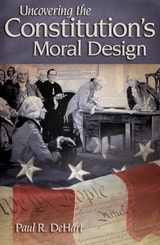
cover of Uncovering the Constitution's Moral Design

Uncovering the Constitution's Moral Design

Paul R. DeHart

University of Missouri Press, 2007

The U.S. Constitution provides a framework for our laws, but what does it have to say about morality? Paul DeHart ferrets out that document’s implicit moral assumptions, demonstrating that the Constitution presupposes a natural law to which human law must conform. His argument works toward resolving current debates over the Constitution’s normative framework while remaining detached from the social issues that divide today’s political arena.

In critiquing previous attempts at describing and evaluating the Constitution’s normative framework, DeHart demonstrates that the Constitution’s moral framework corresponds largely to classical moral theory. Using the method of Inference to the Best Explanation to ascertain our Constitution’s moral meaning, he challenges the logical coherency of modern moral philosophy, normative positivism, and other theories that the Constitution has been argued to embody, offering instead an innovative methodology that can be applied to uncovering the normative framework of other constitutions as well.
[more]
cover of Unifying Political Methodology: The Likelihood Theory of Statistical Inference

Unifying Political Methodology

The Likelihood Theory of Statistical Inference

Gary King

University of Michigan Press, 1998

One of the hallmarks of the development of political science as a discipline has been the creation of new methodologies by scholars within the discipline--methodologies that are well-suited to the analysis of political data. Gary King has been a leader in the development of these new approaches to the analysis of political data. In his book, Unifying Political Methodology, King shows how the likelihood theory of inference offers a unified approach to statistical modeling for political research and thus enables us to better analyze the enormous amount of data political scientists have collected over the years. Newly reissued, this book is a landmark in the development of political methodology and continues to challenge scholars and spark controversy.
"Gary King's Unifying Political Methodology is at once an introduction to the likelihood theory of statistical inference and an evangelist's call for us to change our ways of doing political methodology. One need not accept the altar call to benefit enormously from the book, but the intellectual debate over the call for reformation is likely to be the enduring contribution of the work."
--Charles Franklin, American Political Science Review
"King's book is one of the only existing books which deal with political methodology in a clear and consistent framework. The material in it is now and will continue to be essential reading for all serious students and researchers in political methodology." --R. Michael Alvarez, California Institute of Tech-nology
Gary King is Professor of Government, Harvard University. One of the leading thinkers in political methodology, he is the author of A Solution to the Ecological Inference Problem: Reconstructing Individual Behavior from Aggregate Data and other books and articles.
[more]
cover of Universities and Indian Country: Case Studies in Tribal-Driven Research

Universities and Indian Country

Case Studies in Tribal-Driven Research

Edited by Dennis K. Norman and Joseph P. Kalt

University of Arizona Press, 2015

The book describes the “nation-building” strategy by which an increasing number of Native communities have set about reclaiming powers of self-determination, strengthening their cultures, and developing their economies. A piece of this movement has been the establishment of new models for tribally-driven and requested relations between universities and American Indian/Alaskan Native communities and organizations.

Building on the Harvard Project on American Indian Economic Development’s experience with more than 120 nation-building projects over two decades, Universities and Indian Country posits that the tenets of nation building can provide a strategy for expanding and diversifying universities’ perspectives of knowledge in a multicultural world, while also producing results that are requested by and useful to Native communities.

This groundbreaking volume extends the dialogue begun by the Harvard project, providing another venue for the sharing of knowledge and information. The projects presented address a wide range of topics, including the regulation of genetic research, human resource development, tribal fund-raising, development of tribal museums, and freedom of the press in Indian Country.

Universities and Indian Country’s focus on the concerns and questions of Native communities themselves, provides insight not only into how projects came together, but also into what significance they have to the tribal partners. This compilation is a valuable resource for any student, professional, or community member concerned with issues of nation building and self-determination.
[more]
cover of Untaming the Frontier in Anthropology, Archaeology, and History

Untaming the Frontier in Anthropology, Archaeology, and History

Edited by Bradley J. Parker and Lars Rodseth

University of Arizona Press, 2005
Despite a half century of attempts by social scientists to compare frontiers around the world, the study of these regions is still closely associated with the nineteenth-century American West and the work of Frederick Jackson Turner. As a result, the very concept of the frontier is bound up in Victorian notions of manifest destiny and rugged individualism. The frontier, it would seem, has been tamed. This book seeks to open a new debate about the processes of frontier history in a variety of cultural contexts, untaming the frontier as an analytic concept, and releasing it in a range of unfamiliar settings. Drawing on examples from over four millennia, it shows that, throughout history, societies have been formed and transformed in relation to their frontiers, and that no one historical case represents the normal or typical frontier pattern. The contributors—historians, anthropologists, and archaeologists—present numerous examples of the frontier as a shifting zone of innovation and recombination through which cultural materials from many sources have been unpredictably channeled and transformed. At the same time, they reveal recurring processes of frontier history that enable world-historical comparison: the emergence of the frontier in relation to a core area; the mutually structuring interactions between frontier and core; and the development of social exchange, merger, or conflict between previously separate populations brought together on the frontier. Any frontier situation has many dimensions, and each of the chapters highlights one or more of these, from the physical and ideological aspects of Egypt’s Nubian frontier to the military and cultural components of Inka outposts in Bolivia to the shifting agrarian, religious, and political boundaries in Bengal. They explore cases in which the centripetal forces at work in frontier zones have resulted in cultural hybridization or “creolization,” and in some instances show how satellite settlements on the frontiers of core polities themselves develop into new core polities. Each of the chapters suggests that frontiers are shaped in critical ways by topography, climate, vegetation, and the availability of water and other strategic resources, and most also consider cases of population shifts within or through a frontier zone. As these studies reveal, transnationalism in today’s world can best be understood as an extension of frontier processes that have developed over thousands of years. This book’s interdisciplinary perspective challenges readers to look beyond their own fields of interest to reconsider the true nature and meaning of frontiers.
[more]
cover of Using Context in Information Literacy Instruction: Beyond Basic Skills

Using Context in Information Literacy Instruction

Beyond Basic Skills

Allison Hosier

American Library Association, 2022

Hosier shows academic librarians how to use context when teaching information literacy, an approach that offers a substantive and enduring impact on students' lifelong learning.

Librarians know that information literacy is much more complex and nuanced than the basic library research skill that it's often portrayed as; in fact, as outlined by the ACRL Framework, research is a contextual activity. But the settings in which we teach often constrain our ability to take a more layered approach. This book not only shows you how to teach information literacy as something other than a basic skill, but also how to do it in whatever mode of teaching you’re most often engaged in, whether that's a credit-bearing course, a one-shot session, a tutorial, a reference desk interaction, or a library program. Taking you through each step of the research process, this book shares ideas for adding context while exploring topics such as

  • how conversations about context can be integrated into lessons on common information literacy topics;
  • examples of the six genres of research and suggested course outlines for each;
  • ensuring that context strategies fit within the ACRL Framework;
  • questions for reflection in teaching each step of the research process;
  • four different roles that sources can play when researching a topic;
  • helping students refine a topic that is drawing too many or too few sources;
  • cultivating students to become good decision-makers for the best type of research sources to use depending on their need; and
  • how to address the shortcomings of checklist tools like the CRAAP test.
[more]
cover of Using Qualitative Methods In Action Research

Using Qualitative Methods In Action Research

Douglas Cook

Assoc of College & Research Libraries, 2011

[more]