Results by title
157 books match the query 'Mexican-American Border Region' and 5 start with u

Undocumented Motherhood
Conversations on Love, Trauma, and Border CrossingElizabeth Farfán-Santos
University of Texas Press, 2022
2023 SANA Book Award, Society for the Anthropology of North America
2023 Honorable Mention, Outstanding Book Award NACCS Tejas Foco Award for Non-Fiction, National Association for Chicana and Chicano Studies
2022 Nonfiction Discovery Prize, Writers' League of Texas
An intimate portrayal of the hardships faced by an undocumented family navigating the medical and educational systems in the United States.
Claudia Garcia crossed the border because her toddler, Natalia, could not hear. Leaving behind everything she knew in Mexico, Claudia recounts the terror of migrating alone with her toddler and the incredible challenges she faced advocating for her daughter’s health in the United States. When she arrived in Texas, Claudia discovered that being undocumented would mean more than just an immigration status—it would be a way of living, of mothering, and of being discarded by even those institutions we count on to care.
Elizabeth Farfán-Santos spent five years with Claudia. As she listened to Claudia’s experiences, she recalled her own mother’s story, another life molded by migration, the US-Mexico border, and the quest for a healthy future on either side. Witnessing Claudia’s struggles with doctors and teachers, we see how the education and medical systems enforce undocumented status and perpetuate disability. At one point, in the midst of advocating for her daughter, Claudia suddenly finds herself struck by debilitating pain. Claudia is lifted up by her comadres, sent to the doctor, and reminded why she must care for herself.
A braided narrative that speaks to the power of stories for creating connection, this book reveals what remains undocumented in the motherhood of Mexican women who find themselves making impossible decisions and multiple sacrifices as they build a future for their families.
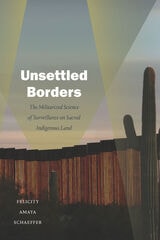
Unsettled Borders
The Militarized Science of Surveillance on Sacred Indigenous LandFelicity Amaya Schaeffer
Duke University Press, 2022
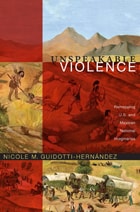
Unspeakable Violence
Remapping U.S. and Mexican National ImaginariesNicole M. Guidotti-Hernández
Duke University Press, 2011
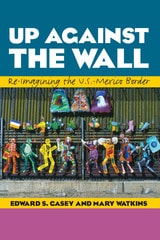
Up Against the Wall
Re-Imagining the U.S.-Mexico BorderBy Edward S. Casey and Mary Watkins
University of Texas Press, 2014
Using the U.S. wall at the border with Mexico as a focal point, two experts examine the global surge of economic and environmental refugees, presenting a new vision of the relationships between citizen and migrant in an era of “Juan Crow,” which systematically creates a perpetual undercaste.
Winner, National Association for Ethnic Studies (NAES) Outstanding Book Award, 2017
As increasing global economic disparities, violence, and climate change provoke a rising tide of forced migration, many countries and local communities are responding by building walls—literal and metaphorical—between citizens and newcomers. Up Against the Wall: Re-imagining the U.S.-Mexico Border examines the temptation to construct such walls through a penetrating analysis of the U.S. wall at the U.S.-Mexico border, as well as investigating the walling out of Mexicans in local communities. Calling into question the building of a wall against a friendly neighboring nation, Up Against the Wall offers an analysis of the differences between borders and boundaries. This analysis opens the way to envisioning alternatives to the stark and policed divisions that are imposed by walls of all kinds. Tracing the consequences of imperialism and colonization as citizens grapple with new migrant neighbors, the book paints compelling examples from key locales affected by the wall—Nogales, Arizona vs. Nogales, Sonora; Tijuana/San Diego; and the lower Rio Grande Valley of Texas. An extended case study of Santa Barbara describes the creation of an internal colony in the aftermath of the U.S. conquest of Mexican land, a history that is relevant to many U.S. cities and towns.
Ranging from human rights issues in the wake of massive global migration to the role of national restorative shame in the United States for the treatment of Mexicans since 1848, the authors delve into the broad repercussions of the unjust and often tragic consequences of excluding others through walled structures along with the withholding of citizenship and full societal inclusion. Through the lens of a detailed examination of forced migration from Mexico to the United States, this transdisciplinary text, drawing on philosophy, psychology, and political theory, opens up multiple insights into how nations and communities can coexist with more justice and more compassion.
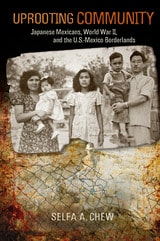
Uprooting Community
Japanese Mexicans, World War II, and the U.S.-Mexico BorderlandsSelfa A. Chew
University of Arizona Press, 2015
In Uprooting Community, Selfa A. Chew examines the lived experience of Japanese Mexicans in the U.S.-Mexico borderlands during World War II. Studying the collaboration of Latin American nation-states with the U.S. government, Chew illuminates the efforts to detain, deport, and confine Japanese residents and Japanese-descent citizens of Latin American countries during World War II. These narratives challenge the notion that Japanese Mexicans enjoyed the protection of the Mexican government during the war and refute the mistaken idea that Japanese immigrants and their descendants were not subjected to internment in Mexico during this period. Through her research, Chew provides evidence that, despite the principles of racial democracy espoused by the Mexican elite, Japanese Mexicans were in fact victims of racial prejudice bolstered by the political alliances between the United States and Mexico.
The treatment of the ethnic Japanese in Mexico was even harsher than what Japanese immigrants and their children in the United States endured during the war, according to Chew. She argues that the number of persons affected during World War II extended beyond the first-generation Japanese immigrants “handled” by the Mexican government during this period, noting instead that the entire multiethnic social fabric of the borderlands was reconfigured by the absence of Japanese Mexicans.