Results by title
1210 books match the query 'Mexico' and 13 start with u
Uncharted Terrains
New Directions in Border Research Methodology, Ethics, and PracticeEdited by Anna Ochoa O’Leary, Colin M. Deeds, and Scott Whiteford
University of Arizona Press, 2013
Each chapter raises methodological and ethical questions relevant to conducting research in transnational contexts, which can frequently be unpredictable or even volatile. The volume addresses the central question of how can scholars work with vulnerable migrant populations along the perilous US–Mexico border and maintain ethical and methodological standards, while also providing useful knowledge to stakeholders? Not only may immigrants be afraid to provide information that could be incriminating, but researchers may also be reluctant to allow their findings to become the basis of harsher law enforcement, unjustly penalize the subjects of their research, and inhibit the formulation of humane and effective immigration policy based on scholarly research.
All of these concerns, which are perfectly legitimate from the social scientists’ point of view, can put researchers into conflict with legal authorities. Contributors acknowledge their quandaries and explain how they have dealt with them. They use specific topics—reproductive health issues and sexually transmitted diseases among immigrant women, a study of undocumented business owners, and the administration of the Mexican Household Survey in Phoenix, among others—to outline research methodology that will be useful for generations of border researchers.
Uncivil Wars
Elena Garro, Octavio Paz, and the Battle for Cultural MemoryBy Sandra Messinger Cypess
University of Texas Press, 2012
The first English-language book to place the works of Elena Garro (1916–1998) and Octavio Paz (1914–1998) in dialogue with each other, Uncivil Wars evokes the lives of two celebrated literary figures who wrote about many of the same experiences and contributed to the formation of Mexican national identity but were judged quite differently, primarily because of gender.
While Paz’s privileged, prize-winning legacy has endured worldwide, Garro’s literary gifts garnered no international prizes and received less attention in Latin American literary circles. Restoring a dual perspective on these two dynamic writers and their world, Uncivil Wars chronicles a collective memory of wars that shaped Mexico, and in turn shaped Garro and Paz, from the Conquest period to the Mexican Revolution; the Spanish Civil War, which the couple witnessed while traveling abroad; and the student massacre at Tlatelolco Plaza in 1968, which brought about social and political changes and further tensions in the battle of the sexes. The cultural contexts of machismo and ethnicity provide an equally rich ground for Sandra Cypess’s exploration of the tandem between the writers’ personal lives and their literary production. Uncivil Wars illuminates the complexities of Mexican society as seen through a tense marriage of two talented, often oppositional writers. The result is an alternative interpretation of the myths and realities that have shaped Mexican identity, and its literary soul, well into the twenty-first century.
Understanding NAFTA
Mexico, Free Trade, and the New North AmericaBy William A. Orme, Jr.
University of Texas Press, 1996
Understanding NAFTA was first published in 1993 as Continental Shift: Free Trade & the New North America. This edition includes a new introduction that brings the NAFTA story up through 1995.
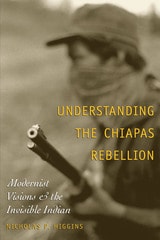
Understanding the Chiapas Rebellion
Modernist Visions and the Invisible IndianBy Nicholas P. Higgins
University of Texas Press, 2004
To many observers in the late 1980s and early 1990s, Mexico appeared to be a modern nation-state at last assuming an international role through its participation in NAFTA and the OECD (Organization of Economic Cooperation and Development). Then came the Zapatista revolt on New Year's Day 1994. Wearing ski masks and demanding not power but a new understanding of the indigenous peoples of Mexico, Subcomandante Marcos and his followers launched what may be the first "post" or "counter" modern revolution, one that challenges the very concept of the modern nation-state and its vision of a fully assimilated citizenry.
This book offers a new way of understanding the Zapatista conflict as a counteraction to the forces of modernity and globalization that have rendered indigenous peoples virtually invisible throughout the world. Placing the conflict within a broad sociopolitical and historical context, Nicholas Higgins traces the relations between Maya Indians and the Mexican state from the conquest to the present—which reveals a centuries-long contest over the Maya people's identity and place within Mexico. His incisive analysis of this contest clearly explains how the notions of "modernity" and even of "the state" require the assimilation of indigenous peoples. With this understanding, Higgins argues, the Zapatista uprising becomes neither surprising nor unpredictable, but rather the inevitable outcome of a modernizing program that suppressed the identity and aspirations of the Maya peoples.
Undoing the Revolution
Comparing Elite Subversion of Peasant RebellionsVasabjit Banerjee
Temple University Press, 2019
Undoing the Revolution looks at the way rural underclasses ally with out-of-power elites to overthrow their governments—only to be shut out of power when the new regime assumes control. Vasabjit Banerjee first examines why peasants need to ally with dissenting elites in order to rebel. He then shows how conflict resolution and subsequent bargains to form new state institutions re-empower allied elites and re-marginalize peasants.
Banerjee evaluates three different agrarian societies during distinct time periods spanning the twentieth century: revolutionary Mexico from 1910 to 1930; late-colonial India from 1920 until 1947; and White-dominated Zimbabwe (Rhodesia) from the mid-1960s to 1980. This comparative approach also allows examination of both the underclass need for elite participation and the variety of causes that elites use to incentivize peasant classes to participate, extending from religious-ethnic identity and common political targets to the peasants’ and elites’ own economic grievances.
Undoing the Revolution demonstrates that both international and domestic investors in cash crops, natural resources, and finance can ally with peasant rebels; and, after threatened or actual state collapse, they can bargain with each other to select new state institutions.
Unintended Lessons of Revolution
Student Teachers and Political Radicalism in Twentieth-Century MexicoTanalís Padilla
Duke University Press, 2021
Unlawful Violence
Mexican Law and Cultural ProductionRebecca Janzen
Vanderbilt University Press, 2022
The abundance of laws and constitutional amendments that have cropped up in response are mirrored in Mexico's fragmented cultural production of the same period. Contemporary Mexican literature grapples with this splintered reality through non-linear stories from multiple perspectives, often told through shifts in time. The novels, such as Jorge Volpi's Una novela criminal [A Novel Crime] (2018) and Julián Herbert's La casa del dolor ajeno [The House of the Pain of Others] (2015) take multiple perspectives and follow non-linear plotlines; other examples, such as the very short stories in ¡Basta! 100 mujeres contra la violencia de género [Enough! 100 Women against Gender-Based Violence] (2013), present perspectives from multiple authors.
Few scholars compare cultural production and legal texts in situations like Mexico, where extreme violence coexists with a high number of human rights laws. Unlawful Violence measures fictional accounts of human rights against new laws that include constitutional amendments to reform legal proceedings, laws that protect children, laws that condemn violence against women, and laws that protect migrants and Indigenous peoples. It also explores debates about these laws in the Mexican house of representatives and senate, as well as interactions between the law and the Mexican public.
Unmaking Waste
New Histories of Old ThingsSarah Newman
University of Chicago Press, 2023
Garbage is often assumed to be an inevitable part and problem of human existence. But when did people actually come to think of things as “trash”—as becoming worthless over time or through use, as having an end?
Unmaking Waste tackles these questions through a long-term, cross-cultural approach. Drawing on archaeological finds, historical documents, and ethnographic observations to examine Europe, the United States, and Central America from prehistory to the present, Sarah Newman traces how different ideas about waste took shape in different times and places. Newman examines what people consider to be “waste” and how they interact with it, as well as what happens when different perceptions of trash come into conflict. Conceptions of waste have shaped forms of reuse and renewal in ancient Mesoamerica, early modern ideas of civility and forced religious conversion in New Spain, and even the modern discipline of archaeology. Newman argues that centuries of assumptions imposed on other places, times, and peoples need to be rethought. This book is not only a broad reconsideration of waste; it is also a call for new forms of archaeology that do not take garbage for granted. Unmaking Waste reveals that waste is not—and never has been—an obvious or universal concept.
Unseen Art
Making, Vision, and Power in Ancient MesoamericaClaudia Brittenham
University of Texas Press, 2023
In Unseen Art, Claudia Brittenham unravels one of the most puzzling phenomena in Mesoamerican art history: why many of the objects that we view in museums today were once so difficult to see. She examines the importance that ancient Mesoamerican people assigned to the process of making and enlivening the things we now call art, as well as Mesoamerican understandings of sight as an especially godlike and elite power, in order to trace a gradual evolution in the uses of secrecy and concealment, from a communal practice that fostered social memory to a tool of imperial power.
Addressing some of the most charismatic of all Mesoamerican sculptures, such as Olmec buried offerings, Maya lintels, and carvings on the undersides of Aztec sculptures, Brittenham shows that the creation of unseen art has important implications both for understanding status in ancient Mesoamerica and for analyzing art in the present. Spanning nearly three thousand years of the Indigenous art of Mexico, Guatemala, Honduras, and Belize, Unseen Art connects the dots between vision, power, and inequality, providing a critical perspective on our own way of looking.
Unspeakable Violence
Remapping U.S. and Mexican National ImaginariesNicole M. Guidotti-Hernández
Duke University Press, 2011
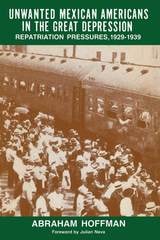
Unwanted Mexican Americans in the Great Depression
Repatriation Pressures, 1929–1939Abraham Hoffman; Foreword by Julian Nava
University of Arizona Press, 1973
Prior to 1931, many Mexican Americans left the United States voluntarily, prompted by homesickness, unemployment, and the Mexican government’s offer of free small land parcels. As the Great Depression deepened, repatriation pressures increased. Anglo groups lobbied for laws that excluded aliens from jobs and welfare benefits. Many businessmen, government officials, and social workers believed that removing Mexican Americans would open up jobs for U.S. citizens and alleviate some of the burden placed on relief agencies.
The Department of Labor’s federal deportation drive, launched in 1931, created an atmosphere of fear and tension in Mexican American communities. Immigration agents conducted surprise searches for people who had entered the country illegally, and Mexicans who had crossed the border before restrictive legislation was passed became prime targets of the deportation campaign.
Welfare agencies throughout the United States organized repatriation programs. The Los Angeles County Welfare Bureau, with the most extensive program, was responsible for the removal of more than thirteen thousand Mexican Americans. A few well-publicized deportations had frightened Mexicans who were unsure of their immigration status. Many chose repatriation over possible deportation.
Using much archival material and many previously unpublished government documents, Hoffman focuses on the repatriation experience in Los Angeles. The city’s large Mexican American population provides an excellent case study of the entire movement. He also surveys the process of Mexican repatriation throughout the entire United States.
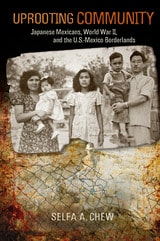
Uprooting Community
Japanese Mexicans, World War II, and the U.S.-Mexico BorderlandsSelfa A. Chew
University of Arizona Press, 2015
In Uprooting Community, Selfa A. Chew examines the lived experience of Japanese Mexicans in the U.S.-Mexico borderlands during World War II. Studying the collaboration of Latin American nation-states with the U.S. government, Chew illuminates the efforts to detain, deport, and confine Japanese residents and Japanese-descent citizens of Latin American countries during World War II. These narratives challenge the notion that Japanese Mexicans enjoyed the protection of the Mexican government during the war and refute the mistaken idea that Japanese immigrants and their descendants were not subjected to internment in Mexico during this period. Through her research, Chew provides evidence that, despite the principles of racial democracy espoused by the Mexican elite, Japanese Mexicans were in fact victims of racial prejudice bolstered by the political alliances between the United States and Mexico.
The treatment of the ethnic Japanese in Mexico was even harsher than what Japanese immigrants and their children in the United States endured during the war, according to Chew. She argues that the number of persons affected during World War II extended beyond the first-generation Japanese immigrants “handled” by the Mexican government during this period, noting instead that the entire multiethnic social fabric of the borderlands was reconfigured by the absence of Japanese Mexicans.

Urban Leviathan
Mexico City in the Twentieth CenturyDiane E. Davis
Temple University Press, 1994
Why, Diane Davis asks, has Mexico City, once known as the city of palaces, turned into a sea of people, poverty, and pollution? Through historical analysis of Mexico City, Davis identifies political actors responsible for the uncontrolled industrialization of Mexico's economic and social center, its capital city. This narrative biography takes a perspective rarely found in studies of third-world urban development: Davis demonstrates how and why local politics can run counter to rational politics, yet become enmeshed, spawning ineffective policies that are detrimental to the city and the nation.
The competing social and economic demand of the working poor and middle classes and the desires of Mexico's ruling Partido Revolucionario Institutional (PRI) have led to gravely diminished services, exorbitant infrastructural expenditures, and counter-productive use of geographic space. Though Mexico City's urban transport system has evolved over the past seven decades from trolley to bus to METRO (subway), it fails to meet the needs of the population, despite its costliness, and is indicative of the city's disastrous and ill-directed overdevelopment. Examining the political forces behind the thwarted attempts to provide transportation in the downtown and sprawling outer residential areas, Davis analyzes the maneuverings of local and national politicians, foreign investors, middle classes, agency bureaucrats, and various factions of the PRI.
Looking to Mexico's future, Davis concludes that growing popular dissatisfaction and frequent urban protests demanding both democratic reform and administrative autonomy in the capital city suggest an unstable future for corporatist politics and the PRI's centralized one-party government.