Results by title
2335 books match the query 'Modern' and 30 start with u

UNITED STATES EUROPEAN RIGHT
1945-1955DEBORAH KISATSKY
The Ohio State University Press, 2005
UNNATURAL VOICES
EXTREME NARRATION IN MODERN AND CONTEMPOBrian Richardson
The Ohio State University Press, 2006
Ukrainian Witchcraft Trials
Volhynia, Podolia, and Ruthenia, 17th–18th CenturiesKateryna Dysa
Central European University Press, 2020
Drawing on quantitative data drawn from a range of trials Kateryna Dysa first describes the ideological background of the tribunals based on works written by priests and theologians that reflect attitudes toward the devil and witches. The main focus of her work, however, is the process leading to witchcraft accusations. From the stories of participants of the trials she shows what led people to enunciate first suspicions then accusations of witchcraft. Finally, she presents a microhistory from one Volhynian village, comparing attitudes toward two “female crimes” in the Ukrainian courts.
The study is based on archival research including witch trials transcripts. Dysa approaches the trials as indications of belief and practice, attempting to understand the actors involved rather than dismiss or condemn them. She takes care to situate early modern Ukrainian witchcraft and its accompanying trials in a broader European context, with comparisons to some African cases as well.
Unacknowledged Kinships
Postcolonial Studies and the Historiography of ZionismEdited by Stefan Vogt, Derek Penslar, and Arieh Saposnik
Brandeis University Press, 2023
There is an “unacknowledged kinship” between studies of Zionism and post-colonial studies, a kinship that deserves to be both discovered and acknowledged. Unacknowledged Kinships strives to facilitate a conversation between the historiography of Zionism and postcolonial studies by identifying and exploring possible linkages and affiliations between their subjects as well as the limits of such connections. The contributors to this volume discuss central theoretical concepts developed within the field of postcolonial studies, and they use these concepts to analyze crucial aspects of the history of Zionism while contextualizing Zionist thought, politics, and culture within colonial and postcolonial histories. This book also argues that postcolonial studies could gain from looking at the history of Zionism as an example of not only colonial domination but also the seemingly contradictory processes of national liberation and self-empowerment.
Unacknowledged Kinships is the first work to systematically investigate the potential for a dialogue between postcolonial studies and Zionist historiography. It is also unique in suggesting that postcolonial concepts can be applied to the history of European Zionism just as comprehensively as to the history of Zionism in Palestine and Israel or Arab countries. Most importantly, the book is an overture for a dialogue between postcolonial studies and the historiography of Zionism.
Uncanny Subjects
Aging in Contemporary NarrativeAmelia DeFalco
The Ohio State University Press, 2009
In the United States anti-aging is a multibillion-dollar industry, and efforts to combat signs of aging have never been stronger, or more lucrative. Although there are many sociological studies of aging and culture, there are few studies that examine the ways cultural texts construct multiple narratives of aging that intersect and sometimes conflict with existing social theories of aging. In Uncanny Subjects, Amelia DeFalco incorporates methodologies and theories derived from the humanities in her investigation into contemporary representations of aging.
Both aging and narrative are a function of time, of change, of one event happening after another. Subjects understand their lives through narrative trajectories—not necessarily as they are living moment to moment, but in the sort of reflection that many argue becomes more prevalent with age. As a result, narrative fiction provides compelling representations of the strange—indeed uncanny—familiarity of the aging self.
DeFalco examines a range of contemporary fiction and film by authors and directors such as John Banville, John Cassavetes, and Alice Munro. As these texts suggest, old age involves a growing awareness of the otherness within, an awareness that reveals identity as multiple, shifting, and contradictory—in short, uncanny. Drawing together theories of the uncanny with research on aging and temporality, DeFalco argues that aging is a category of difference integral to a contemporary understanding of identity and alterity.

Uncertain Dimensions
Western Overseas Empires in the Twentieth CenturyRaymond F. Betts
University of Minnesota Press, 1985
Uncertain Dimensions was first published in 1985. Minnesota Archive Editions uses digital technology to make long-unavailable books once again accessible, and are published unaltered from the original University of Minnesota Press editions.
World War I battered the Western imperial systems and destroyed one, that of Germany, but it did not sound the death knell of an empire. The "scramble" for overseas territory ha reached a virtual conclusion shortly before the war; afterwards, the main business of empire was to ensure a pax colonia: the often contradictory goals of a stable government and economic development. It is with the years between world wars—the brief age of administrative empire — that Raymond Betts is chiefly concerned in this book. An unsettled time, when individuals coped with empire of uncertain dimensions, the interwar years nonetheless left a material legacy—railroads, motor roads, public buildings — and an ideological one—the voices of protest that led to independence after World War II.
Preeminently a cultural history of the era rather than a political narrative, Uncertain Dimensions centers upon the regions we now call the Third World—Subsaharan Africa and Southeast Asia—and the major colonial powers, Great Britain and France. Betts has structured this book as a group of closely linked interpretive essays, each devoted to a specific aspect of the late colonial experience: World War I and the postwar mandates, colonial administration, the European economic imperative and "technology transfer," urbanization, anti-imperial protest, and decolonization. Throughout, he draws upon the work of novelists, poets, and theoreticians—Aime Cesaire, Claude McKay, Leopold Sedar Senghor, Frantz Fanon, and many others—and recognizes the deep irony at the heart of modern imperialism: that contact between Western and Third worlds was mostly confined to two minorities, the alien European and the socially uprooted African or Asian.
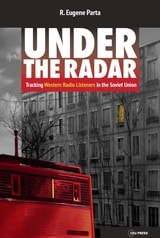
Under the Radar
Tracking Western Radio Listeners in the Soviet UnionR. Eugene Parta
Central European University Press, 2022
Western democracy is currently under attack by a resurgent Russia, weaponizing new technologies and social media. How to respond? During the Cold War, the West fought off similar Soviet propaganda assaults with shortwave radio broadcasts. Founded in 1949, the US-funded Radio Free Europe/Radio Liberty broadcast uncensored information to the Soviet republics in their own languages. About one-third of Soviet urban adults listened to Western radio. The broadcasts played a key role in ending the Cold War and eroding the communist empire.
R. Eugene Parta was for many years the director of Soviet Area Audience Research at RFE/RL, charged among others with gathering listener feedback. In this book he relates a remarkable Cold War operation to assess the impact of Western radio broadcasts on Soviet listeners by using a novel survey research approach. Given the impossibility of interviewing Soviet citizens in their own country, it pioneered audacious interview methods in order to fly under the radar and talk to Soviets traveling abroad, ultimately creating a database of 51,000 interviews which offered unparalleled insights into the media habits and mindset of the Soviet public. By recounting how the “impossible” mission was carried out, Under the Radar also shows how the lessons of the past can help counter the threat from a once and current adversary.

Under the Rug
The (Not So) Hidden History of Men and Their HairpiecesWendy A. Woloson
University of Chicago Press, 0
False hair can reveal honest truths—about the past, gender, identity, and the stories men tell about themselves.
History has seen its share of famous toupees. John Wayne’s. Frank Sinatra’s. Humphrey Bogart’s. Hairpieces can reveal a wearer’s inner motivations, reinforce gender norms, cause embarrassment, and even provoke disgust. Although false, they can create real meaning.
In Wendy A. Woloson’s hands, the toupee helps us see how men have understood themselves and fashioned their identities over time. Starting in the late eighteenth century, when men stopped wearing white powdered wigs, and moving to the 1920s, when toupees could be easily mass-produced, Woloson tells the story of the “Toupee Age.” She investigates why balding was considered such a problem in the first place, how hair became entangled with anxieties about aging, and the ways that looking old posed a threat to manhood. She details the bear’s grease pomades, brush-on dyes, elixirs, false whiskers, and hairpieces that were created to meet shifting notions of masculinity and style. Under the Rug also introduces readers to the people who styled and traded hair, made wigs, and hawked baldness cures. Drawing on business records, advertisements, graphic images, and a host of other primary sources, Woloson incisively explains how such trades seeded fears about thinning hair and sold men solutions. This vanity project continues today, as hair transplants, medications to stimulate hair growth, and Toupee TikTok encourage people to reinvent the way they’re seen—by others and themselves.
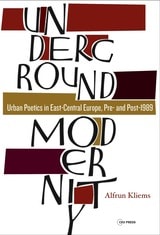
Underground Modernity
Urban Poetics in East-Central Europe, Pre- and Post-1989Alfrun Kliems
Central European University Press, 2021
The literary scholar Alfrun Kliems explores the aesthetic strategies of Eastern European underground literature, art, film and music in the decades before and after the fall of communism, ranging from the ‘father’ of Prague Underground, Egon Bondy, to the neo-Dada Club of Polish Losers in Berlin.
The works she considers are "underground" in the sense that they were produced illegally, or were received as subversive after the regimes had fallen. Her study challenges common notions of ‘Underground’ as an umbrella term for nonconformism. Rather, it depicts it as a sociopoetic reflection of modernity, intimately linked to urban settings, with tropes and aesthetic procedures related to Surrealism, Dadaism, Expressionism, and, above all, pop and counterculture.
The author discusses these commonalities and distinctions in Czech, Polish, Slovak, Ukrainian, Russian, and German authors, musicians, and filmmakers. She identifies intertextual relations across languages and generations, and situates her findings in a transatlantic context (including the Beat Generation, Susan Sontag, Neil Young) and the historical framework of Romanticism and modernity (including Baudelaire and Brecht).
Despite this wide brief, the book never loses sight of its core message: Underground is no arbitrary expression of discontent, but rather the result of a fundamental conflict at the socio-philosophical roots of modernity.
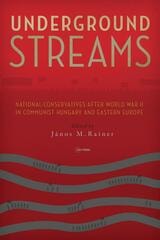
Underground Streams
National-Conservatives after World War II in Communist Hungary and Eastern EuropeJános M. Rainer
Central European University Press, 2023
The authors of this edited volume address the hidden attraction that existed between the extremes of left and right, and of internationalism and nationalism under the decades of communist dictatorship in Eastern Europe. One might suppose that under the suppressive regimes based on leftist ideology and internationalism their right-wing opponents would have been defeated and ultimately removed. These essays, on the other hand, recount the itinerary of survival and revival of "right-wing" thought and activities under communist dictatorship. Resistance and accommodation are explored in the various phases from the Stalinist era to the demise of the Soviet Bloc, with the continuity provided by tacit or concealed right-wing discourses receiving particular consideration. The Eastern European right, both in its conservative and fascist version, centered on nationalism, a legitimizing factor that increased with the downfall of the regimes, and the authors thus accord nationalism special attention.
Two documentary sources for these essays that stand out are files of the security services and the exceptionally rich Oral History Archive compiled by the 1956 Institute in Budapest, Hungary.

Underground Symphony
The Plastic PeopleFrantišek Stárek and Martin Valenta
Karolinum Press, 2026
First-hand insight into the Czechoslovak underground music scene and the numerous obstacles placed in its way by communist-era security services.
Underground Symphony: The Plastic People traces the history of the rock band The Plastic People of the Universe against the backdrop of political developments in communist Czechoslovakia. It begins with the band’s formation in the 1960s, when psychedelic rock was first introduced to Czechoslovakia, through the emergence of the first concepts of cultural opposition and politically oriented dissent, particularly Charter 77, ending with a detailed account of the band’s breakup in the second half of the 1980s.
The authors rely on primary sources, many of which have not been published; for example, the Plastic People’s chronicles, extensive interviews with band members and friends, and contemporary writings by individual participants (in samizdat publications, private correspondence, diaries, etc.). They also “mine” archival sources from the State Security (Archive of Security Services, National Archives, etc.). The result is an insightful study of the legendary underground band and its era.
Understanding Europe (The Works of Christopher Dawson)
Christopher Dawson
Catholic University of America Press, 2009
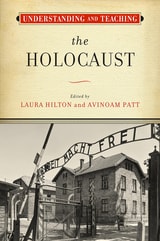
Understanding and Teaching the Holocaust
Edited by Laura Hilton and Avinoam Patt
University of Wisconsin Press, 2022
Each chapter provides pedagogical case studies for teaching content such as antisemitism, resistance and rescue, and the postwar lives of displaced persons. It will transform how students learn about the Holocaust and the circumstances surrounding it.
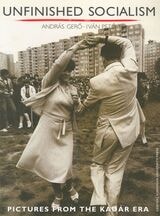
Unfinished Socialism
Pictures from the Kádár EraAndrás Gero
Central European University Press, 1999
This extraordinary book provides a snapshot of socialism throughout the Kádár regime in Hungary (1956-1989) and captures the essence of the world behind the ‘iron curtain’ in a stunning, and often stark, collection of photographs.
Unfinished Socialism is a visually stunning anthropological study containing 450 photographs, many previously unpublished, which portray life in Hungary from every angle: from the May Day March to pop music and from the homeless to sport.
With an introduction that will help the reader understand and appreciate the true meaning of the photographs, this political, social and cultural study of the Kádár years transports the reader back to a time of great significance in Hungary’s long and turbulent history.
Unguessed Kinships
Naturalism and the Geography of Hope in Cormac McCarthySteven Frye
University of Alabama Press, 2023
Literary naturalism at play in one of America’s most visionary novelists: Cormac McCarthy
It took six novels and nearly thirty years for Cormac McCarthy to find commercial success with the National Book Award–winning All the Pretty Horses, followed by major prizes, more best sellers, and Hollywood adaptations of his work. Those successes, though, have obscured McCarthy’s commitment to an older form of literary expression: naturalism.
It is hardly a secret that McCarthy’s work tends to darker themes: violence, brutality, the cruel indifference of nature, themes which would not be out of place in the writing of Jack London or Stephen Crane. But literary naturalism is more than the oversimplified Darwinism that many think of. Nature may be red in tooth and claw, and humans are part of nature, but the humanity depicted in naturalist literature is capable of love, selflessness, and spirituality, as well.
In Unguessed Kinships, Steven Frye illuminates all these dimensions of McCarthy’s work. In his novels and plays, McCarthy engages both explicitly and obliquely with the project of manifest destiny, in the western drama Blood Meridian, the Tennessee Valley Authority-era Tennessee novels, and the atomic frontier of Alamogordo in Cities of the Plain. McCarthy’s concerns are deeply religious and philosophical, drawing on ancient Greek philosophy, Gnosticism, and Nietzsche, among other sources. Frye argues for McCarthy not merely as a naturalist writer but as a naturalist in the most expansive sense. Unguessed Kinships includes biographical and historical context in each chapter, widening the appeal of the text to not just naturalists or McCarthy scholars but anyone studying the literature of the South or the West.
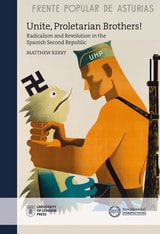
Unite, Proletarian Brothers!
Radicalism and Revolution in the Spanish Second RepublicMatthew Kerry
University of London Press, 2020
Unmanning
How Humans, Machines and Media Perform Drone WarfareKatherine Fehr Chandler
Rutgers University Press, 2020
Unmodern Philosophy and Modern Philosophy
John Dewey, Edited by Phillip Deen, Foreword by Larry A. Hickman
Southern Illinois University Press, 2012
800x600Normal0falsefalsefalseEN-USX-NONEX-NONEMicrosoftInternetExplorer4
In 1947 America’s premier philosopher, educator, and public intellectual John Dewey purportedly lost his last manuscript on modern philosophy in the back of a taxicab. Now, sixty-five years later, Dewey’s fresh and unpretentious take on the history and theory of knowledge is finally available. Editor Phillip Deen has taken on the task of editing Dewey’s unfinished work, carefully compiling the fragments and multiple drafts of each chapter that he discovered in the folders of the Dewey Papers at the Special Collections Research Center at Southern Illinois University Carbondale. He has used Dewey’s last known outline for the manuscript, aiming to create a finished product that faithfully represents Dewey’s original intent. An introduction and editor’s notes by Deen and a foreword by Larry A. Hickman, director of the Center for Dewey Studies, frame this previously lost work.
In Unmodern Philosophy and Modern Philosophy, Dewey argues that modern philosophy is anything but; instead, it retains the baggage of outdated and misguided philosophical traditions and dualisms carried forward from Greek and medieval traditions. Drawing on cultural anthropology, Dewey moves past the philosophical themes of the past, instead proposing a functional model of humanity as emotional, inquiring, purposive organisms embedded in a natural and cultural environment.
Dewey begins by tracing the problematic history of philosophy, demonstrating how, from the time of the Greeks to the Empiricists and Rationalists, the subject has been mired in the search for immutable absolutes outside human experience and has relied on dualisms between mind and body, theory and practice, and the material and the ideal, ultimately dividing humanity from nature. The result, he posits, is the epistemological problem of how it is possible to have knowledge at all. In the second half of the volume, Dewey roots philosophy in the conflicting beliefs and cultural tensions of the human condition, maintaining that these issues are much more pertinent to philosophy and knowledge than the sharp dichotomies of the past and abstract questions of the body and mind. Ultimately, Dewey argues that the mind is not separate from the world, criticizes the denigration of practice in the name of theory, addresses the dualism between matter and ideals, and questions why the human and the natural were ever separated in philosophy. The result is a deeper understanding of the relationship among the scientific, the moral, and the aesthetic.
More than just historically significant in its rediscovery, Unmodern Philosophy and Modern Philosophy provides an intriguing critique of the history of modern thought and a positive account of John Dewey’s naturalized theory of knowing. This volume marks a significant contribution to the history of American thought and finally resolves one of the mysteries of pragmatic philosophy.
Unsettled
The Culture of Mobility and the Working Poor in Early Modern EnglandPatricia Fumerton
University of Chicago Press, 2006
Migrants made up a growing class of workers in late sixteenth- and seventeenth- century England. In fact, by 1650, half of England’s rural population consisted of homeless and itinerant laborers. Unsettled is an ambitious attempt to reconstruct the everyday lives of these dispossessed people. Patricia Fumerton offers an expansive portrait of unsettledness in early modern England that includes the homeless and housed alike.
Fumerton begins by building on recent studies of vagrancy, poverty, and servants, placing all in the light of a new domestic economy of mobility. She then looks at representations of the vagrant in a variety of pamphlets and literature of the period. Since seamen were a particularly large and prominent class of mobile wage-laborers in the seventeenth century, Fumerton turns to seamen generally and to an individual poor seaman as a case study of the unsettled subject: Edward Barlow (b. 1642) provides a rare opportunity to see how the laboring poor fashioned themselves, for he authored a journal of over 225,000 words and 147 pages of drawings. Barlow’s journal, studied extensively here for the first time, vividly charts what he himself termed his “unsettled mind” and the perpetual anxieties of England’s working and wayfaring poor. Ultimately, Fumerton explores representations of seamen as unsettled in the broadside ballads of Barlow’s time.
Unsettling Sexuality
Queer Horizons in the Long Eighteenth CenturyJeremy Chow
University of Delaware Press, 2025
This book is also freely available online as an open access digital edition on Manifold, here: https://openpub.udel.edu/projects/unsettling-sexuality.
Unsettling Sexuality: Queer Horizons in the Long Eighteenth Century challenges the traditional ways that scholarship has approached sexuality, gender nonconformity, and sex (as well as its absence) in the long eighteenth century. Drawing from recent and emerging criticisms in Middle Eastern and Asian studies, Black studies, and Native American and Indigenous studies, the collected authors perform intersectional queer readings, reimagine queer historiographic methods, and spearhead new citational models that can invigorate the field. Contributors read with and against diverse European, transatlantic, and global archives to explore mutually informative frameworks of gender, sexuality, race, indigeneity, ability, and class. In charting multidirectional queer horizons, this collection locates new prospective desires and intimacies in the literature, culture, and media of the period to imagine new directions and simultaneously unsettle eighteenth-century studies.
Untying Things Together
Philosophy, Literature, and a Life in TheoryEric L. Santner
University of Chicago Press, 2022
In 1905, Freud published his Three Essays on the Theory of Sexuality, the book that established the core psychoanalytic thesis that sexuality is central to formations of the unconscious. With this book, Eric L. Santner inverts Freud’s title to take up the sexuality of theory—or, more exactly, the modes of enjoyment to be found in the kinds of critical thinking that, since the 1960s, have laid claim to that ancient word, “theory.” Santner unfolds his argument by tracking his own relationship with this tradition and the ways his intellectual and spiritual development has been informed by it.
Untying Things Together is both an intellectual history of major theoretical paradigms and a call for their reexamination and renewal. Revisiting many of the topics he has addressed in previous work, Santner proposes a new way of conceptualizing the eros of thinking, attuned to how our minds and bodies individually and collectively incorporate or “encyst” on a void at the heart of things. Rather than proposing a “return to theory,” Santner’s book simply employs theory as a way of further “(un)tying together” the resources of philosophy, art and literature, theology, psychoanalysis, political thought, and more.
Unwilling Germans
The Goldhagen DebateRobert R. Shandley
University of Minnesota Press, 1998
A comprehensive overview of the controversy surrounding Hitler’s Willing Executioners.
Few if any books of the past fifty years have moved a broad section of the German public to think about their country’s Nazi past as has Daniel Jonah Goldhagen’s Hitler’s Willing Executioners. The main argument of his book is that Germans committed the unthinkable acts of the Holocaust not because they were forced to but out of a deeply held conviction that killing Jews was morally just. Unwilling Germans? traces the intense and varied reception of a book that has created more heated debate than any other treatment of Germany’s genocidal past.
When Goldhagen’s book first appeared, it was almost universally dismissed by journalists and historians alike. However, following a book tour in Germany, Goldhagen started winning over many of his ardent detractors and finding a young, receptive audience. Although German scholars reacted to Goldhagen and his argument with outrage and dismissal, ironically the German public was mesmerized by both the book and Goldhagen himself.Unwilling Germans? reprints articles that originally appeared in German newspapers, the popular press, and journals, as well as offering original essays. Among the writers whose work is represented are historians, journalists, political scientists, and literary critics, including Jürgen Habermas and Klaus Theweleit. The book traces the initial reactions in Germany to the debate surrounding the U.S. publication of the book, the subsequent reviews and reactions upon the publication of the German translation, and recent commentary by Goldhagen and the American historian Christopher Browning. A unique and fascinating collection, Unwilling Germans? will help to sort out the confusing nature of the response to the “Goldhagen Debate,” and shed light on both Germany’s continuing process of coming to terms with its Nazi past and the resonances of that debate in the United States.ISBN 0-8166-3100-X Cloth $44.95xxISBN 0-8166-3101-8 Paper $17.95224 pages 5 7/8 x 9 JuneTranslation inquiries: University of Minnesota Press
Up from Nothing
The Michigan State University Cyclotron LaboratorySam M. Austin
Michigan State University Press, 2016
The cyclotron laboratory at MSU has been known for years as the best university nuclear physics laboratory in the United States, and perhaps in the world. But very few, even in its hometown of East Lansing, know how it achieved that status or why it prospered when laboratories at many other famous universities faded.
In this book Austin, a nuclear physicist who has been at the laboratory since the beginning of its ascent, gives us a remarkable story. It begins with an exceptional individual, Henry Blosser, who founded the laboratory, built a cyclotron accelerator of uniquely high precision, and recruited a team of nuclear physicists that used it to establish the laboratory’s reputation. Its credibility led to a sequence of accelerators, each operating in a different sub?eld while continuing a tradition of forefront science, and to a laboratory culture that fostered the courage and foresight to compete for the FRIB in the face of daunting odds.
Updike
America's Man of LettersWilliam H. Pritchard
University of Massachusetts Press, 2005
Uprising in East Germany, 1953
The Cold War, the German Question, and the First Major Upheaval behind the Iron CurtainThe National Security Archive Ostermann
Central European University Press, 2001
This volume is the second in the series Cold War Documentary Readers, a project of the US National Security Archive and the Cold War International History Project.
The volume is the first documented account of this early Cold War crisis from both sides of the Iron Curtain. Based on the recent unprecedented access to the once-closed archives of several member states of the Warsaw Pact, this collection of primary-source documents presents one of the most notorious events of post-war European history in a highly readable format.
Previously unreleased Kremlin records, once highly classified American documents, materials from the Soviet Foreign Ministry, and transcripts of internal East German Communist Party Politburo meetings in the days leading to the uprising in the German Democratic Republic (GDR) are among the highlights of this sensational documentary.
In this volume, as in the previous one in the series, each part is preceded by a detailed introductory essay to provide the necessary historical and political context. The individual documents are introduced by short headnotes summarizing the contents and orienting the reader. A chronology, glossary and bibliography offer further background information.
Upstaging the Cold War
American Dissent and Cultural Diplomacy, 1940-1960Andrew J. Falk
University of Massachusetts Press, 2010
Traditional interpretations of the 1950s have emphasized how American anti-communists deployed censorship and the blacklist to silence dissent, particularly in the realm of foreign policy. Yet those efforts at repression did not always succeed. Throughout the early years of the Cold War, a significant number of writers and performers continued to express controversial views about international relations in Hollywood films, through the new medium of television, on the Broadway stage, and from behind the scenes.
By promoting superpower cooperation, decolonization, nuclear disarmament, and other taboo causes, dissident artists such as Lillian Hellman, Arthur Miller, Rod Serling, Dalton Trumbo, Reginald Rose, and Paddy Chayefsky managed both to stretch the boundaries of Cold War ideology and to undermine some of its basic assumptions. Working at times under assumed names and in some cases outside the United States, they took on the role of informal diplomats who competed with Washington in representing America to the world.
Ironically, the dissidents' international appeal eventually persuaded the U.S. foreign policy establishment that their unconventional views could be an asset in the Cold War contest for “hearts and minds,” and their artistic work an effective means to sell American values and culture abroad. By the end of the 1950s, the Eisenhower administration not only appropriated the work of these talented artists but enlisted some of them to serve as official voices of Cold War cultural diplomacy.
Uranium Matters
Central European Uranium in International Politics, 19001960Rainer Karlsch
Central European University Press, 2008
Urban Histories of Rajasthan
Religion, Politics and Society (1550–1800)Elizabeth M. Thelen
Gingko, 2022
Diverse peoples intermingled in the streets and markets of premodern Indian cities. This book considers how these diverse residents lived together and negotiated their differences. Which differences mattered, when and to whom? How did state actions and policies affect urban society and the lives of various communities? How and why did conflict occur in urban spaces? Through these questions, this book explores the histories of urban communities in the three cities of Ajmer, Nagaur, and Pushkar in Rajasthan, between the sixteenth and eighteenth centuries. The focus of this study is on everyday life, contextualizing religious practices and conflicts by considering patterns of patronage and broader conflict patterns within society. The book examines various archival documents, from family and institutional records to state registers, and uses these documents to demonstrate the complex and sometimes contradictory ways religion intersected with politics, economics, and society. The author shows how many patronage patterns and processes persisted in altered forms, and how the robustness of these structures contributed to the resilience of urban spaces and society in precolonial Rajasthan.
Urban Saniscapes
Slums, Housing and Everyday Sanitation in Accra and Nairobi, 1908–1963Waseem-Ahmed Bin-Kasim
Michigan State University Press, 2025
Utopian Horizons
Ideology, Politics, LiteratureZsolt Cziganyik
Central European University Press, 2017