Results by title
227 books match the query 'New England (CT, MA, ME, NH, RI, VT)' and 2 start with u
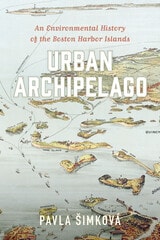
Urban Archipelago
An Environmental History of the Boston Harbor IslandsPavla Šimková
University of Massachusetts Press, 2021
The Boston Harbor Islands have been called Boston's "hidden shores." While some are ragged rocks teeming with coastal wildlife, such as oystercatchers and harbor seals, others resemble manicured parks or have the appearance of wooded hills rising gently out of the water. Largely ignored by historians and previously home to prisons, asylums, and sewage treatment plants, this surprisingly diverse ensemble of islands has existed quietly on the urban fringe over the last four centuries. Even their latest incarnation as a national park and recreational hub has emphasized their separation from, rather than their connection to, the city.
In this book, Pavla Šimková reinterprets the Boston Harbor Islands as an urban archipelago, arguing that they have been an integral part of Boston since colonial days, transformed by the city's changing values and catering to its current needs. Drawing on archival sources, historic maps and photographs, and diaries from island residents, this absorbing study attests that the harbor islands' story is central to understanding the ways in which Boston has both shaped and been shaped by its environment over time.
In this book, Pavla Šimková reinterprets the Boston Harbor Islands as an urban archipelago, arguing that they have been an integral part of Boston since colonial days, transformed by the city's changing values and catering to its current needs. Drawing on archival sources, historic maps and photographs, and diaries from island residents, this absorbing study attests that the harbor islands' story is central to understanding the ways in which Boston has both shaped and been shaped by its environment over time.
[more]
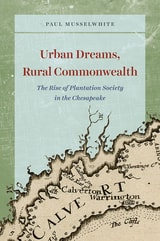
Urban Dreams, Rural Commonwealth
The Rise of Plantation Society in the ChesapeakePaul Musselwhite
University of Chicago Press, 2018
The English settlers who staked their claims in the Chesapeake Bay were drawn to it for a variety of reasons. Some sought wealth from the land, while others saw it as a place of trade, a political experiment, or a potential spiritual sanctuary. But like other European colonizers in the Americas, they all aspired to found, organize, and maintain functioning towns—an aspiration that met with varying degrees of success, but mostly failure. Yet this failure became critical to the economy and society that did arise there. As Urban Dreams, Rural Commonwealth reveals, the agrarian plantation society that eventually sprang up around the Chesapeake Bay was not preordained—rather, it was the necessary product of failed attempts to build cities.
Paul Musselwhite details the unsuccessful urban development that defined the region from the seventeenth century through the Civil War, showing how places like Jamestown and Annapolis—despite their small size—were the products of ambitious and cutting-edge experiments in urbanization comparable to those in the largest port cities of the Atlantic world. These experiments, though, stoked ongoing debate about commerce, taxation, and self-government. Chesapeake planters responded to this debate by reinforcing the political, economic, and cultural authority of their private plantation estates, with profound consequences for the region’s laborers and the political ideology of the southern United States. As Musselwhite makes clear, the antebellum economy around this well-known waterway was built not in the absence of cities, but upon their aspirational wreckage.
Paul Musselwhite details the unsuccessful urban development that defined the region from the seventeenth century through the Civil War, showing how places like Jamestown and Annapolis—despite their small size—were the products of ambitious and cutting-edge experiments in urbanization comparable to those in the largest port cities of the Atlantic world. These experiments, though, stoked ongoing debate about commerce, taxation, and self-government. Chesapeake planters responded to this debate by reinforcing the political, economic, and cultural authority of their private plantation estates, with profound consequences for the region’s laborers and the political ideology of the southern United States. As Musselwhite makes clear, the antebellum economy around this well-known waterway was built not in the absence of cities, but upon their aspirational wreckage.
[more]