Results by title
91 books match the query 'Nordic Countries' and 2 start with u
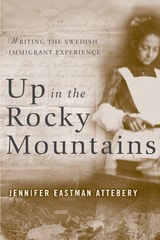
Up in the Rocky Mountains
Writing the Swedish Immigrant ExperienceJennifer Eastman Attebery
University of Minnesota Press, 2007
Before the turn of the twentieth century, many Swedish men emigrated to the American Rockies as itinerant laborers, drawn by the region’s developing industries. Single Swedish women ventured west, too, and whole families migrated, settling into farm communities. By 1920, one-fifth of all Swedish immigrants were living in the West.
In Up in the Rocky Mountains, Jennifer Eastman Attebery offers a new perspective on Swedish immigrants’ experiences in Idaho, Montana, Utah, Wyoming, Colorado, and New Mexico from 1880 to 1917 by interpreting their letters home. Considering more than three hundred letters, Attebery analyzes their storytelling, repetitive language, traditional phrasing, and metaphoric images. Recognizing the letters’ power as a folk form, Attebery sees in them the writers’ relationships back in Sweden as well as their encounters with religious and labor movements, regionalism, and nationalism in their new country.
By defining personal letters as a vernacular genre, Attebery provides a model for discerning immigrants’ shared culture in correspondence collections. By studying their words, she brings to life small Swedish communities throughout the Rocky Mountain region.
Jennifer Eastman Attebery is professor of English and director of American studies at Idaho State University.
Urban Planning in the Nordic World
Ellen Braae
University of Wisconsin Press, 2022
Urban planning is a keystone in the materialization of the Nordic welfare states. That is not to say that there is one particular city form or planning practice that is synonymous with the emerging welfare city, as welfare per se is far from normative. On the contrary, welfare is a highly ambiguous and contested notion that has changed over the postwar decades, which is also reflected in the development of the welfare city.
However, welfare in urban planning has mainly been associated with ideas of “the good life” and egalitarianism. In a Nordic context, the state has taken the lead in providing the social engineering “hardware” for advancing this universal aim. Social demographic welfare is economically based on full employment, and in this regard housing and caregiving support are key components. Yet education, infrastructure, and leisure facilities are also basic features in the distribution of universal welfare services for citizens’ entire lives. The results, ideally, are green and spacious welfare cities.
This book outlines the origins, development, challenges, and lived realities of the changing welfare city, focusing primarily on Denmark. Strategies have changed over the decades as models of development have shifted and as the needs of society and a warming planet have come into focus. The current welfare city can be described as an urban landscape characterized by, on the one hand, a division of functions and, on the other, mutual competition. The role of the state has been minimized, turning municipalities into the new major agents in attracting taxpayers and providing goods—both by means of urban planning.