Results by title
56 books match the query 'Philadelphia (Pa.)' and 2 start with u
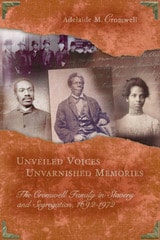
Unveiled Voices, Unvarnished Memories
The Cromwell Family in Slavery and Segregation, 1692-1972Adelaide M. Cromwell
University of Missouri Press, 2006
When an industrious slave named Willis Hodges Cromwell earned the money to obtain liberty for his wife—who then bought freedom for him and for their children—he set in motion a family saga that resounds today. His youngest son, John Wesley Cromwell, became an educator, lawyer, and newspaper publisher—and one of the most influential men of letters in the generation that bridged Frederick Douglass and W. E. B. Du Bois. Now, in Unveiled Voices, Unvarnished Memories, his granddaughter, Adelaide M. Cromwell, documents the journey of her family from the slave marts of Annapolis to achievements in a variety of learned professions.
John W. Cromwell began the family archives from which this book is drawn—letters and documents that provide an unprecedented view of how one black family thought, strived, and survived in American society from the seventeenth century to the twentieth. These papers reflect intimate thoughts about such topics as national and local leaders, moral behavior, color consciousness, and the challenges of everyday life in a racist society. They also convey a wealth of rich insights on the burdens that black parents’ demands for achievement placed on their children, the frequently bitter rivalries within the intellectual class of the African American community, and the negative impact on African American women of sexism in a world dominated by black men whose own hold on respect was tentative at best.
The voices gathered here give readers an inside look at the formation and networks of the African American elite, as John Cromwell forged friendships with such figures as journalist John E. Bruce and the Reverend Theophilus Gould Steward. Letters with those two faithfully depict the forces that shaped the worldview of the small but steadily expanding community of African American intellectuals who helped transform the nation’s attitudes and policies on race, and whose unguarded comments on a wide range of matters will be of particular interest to social historians. Additional correspondence between John and his son, John Jr., brings the family story into modern times.
Unveiled Voices, Unvarnished Memories is a rare look at the public and private world of individuals who refused to be circumscribed by racism and the ghetto while pursuing their own well-being. Its narrative depth breaks new ground in African American history and offers a unique primary source for that community.
[more]
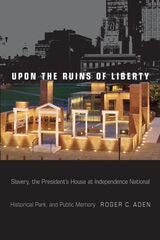
Upon the Ruins of Liberty
Slavery, the President's House at Independence National Historical Park, and Public MemoryRoger C. Aden
Temple University Press, 2014
The 2002 revelation that George Washington kept slaves in his executive mansion at Philadelphia's Independence National Historical Park in the 1790s prompted an eight-year controversy about the role of slavery in America's commemorative landscape. When the President's House installation opened in 2010, it became the first federal property to feature a slave memorial.
In Upon the Ruins of Liberty, Roger Aden offers a compelling account that explores the development of this important historic site and how history, space, and public memory intersected with contemporary racial politics. Aden constructs this engrossing tale by drawing on archival material and interviews with principal figures in the controversy-including historian Ed Lawler, site activist Michael Coard, and site designer Emanuel Kelly.
Upon the Ruins of Liberty chronicles the politically-charged efforts to create a fitting tribute to the place where George Washington (and later, John Adams) shaped the presidency while denying freedom to the nine enslaved Africans in his household. From design to execution, the plans prompted advocates to embrace stories informed by race, and address difficulties that included how to handle the results of the site excavation. As such, this landmark project raised concerns and provided lessons about the role of public memory and how places are made to shape the nation's identity.
[more]