Results by title
230 books match the query 'Physics' and 4 start with u
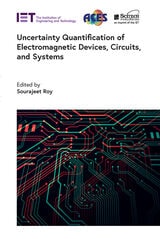
Uncertainty Quantification of Electromagnetic Devices, Circuits, and Systems
Sourajeet Roy
The Institution of Engineering and Technology, 2022
Uncertainty Quantification of Electromagnetic Devices, Circuits, and Systems describes the advances made over the last decade in the topic of uncertainty quantification (UQ) and stochastic analysis. The primary goal of the book is to educate and inform electronics engineers about the most recent numerical techniques, mathematical theories, and computational methods to perform UQ for electromagnetic devices, circuits, and systems.
[more]
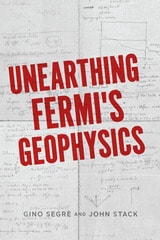
Unearthing Fermi's Geophysics
Gino C. Segrè and John D. Stack
University of Chicago Press, 2022
Follow Nobel laureate and legendary teacher Enrico Fermi’s lost course on geophysics.
Nobel Prize–winning physicist Enrico Fermi (1901–54) is known for his work on experimental particle and nuclear physics, quantum theory, and statistical mechanics, and for his particular ability to condense complicated problems into approximations for understanding and testing theory in a variety of scientific disciplines. Six of his graduate students went on to win their own Nobel Prizes.
Unearthing Fermi’s Geophysics opens a window onto two underrepresented facets of this extraordinary thinker: Fermi’s teaching and his contribution to the field of geophysics. Drawing on Fermi’s handwritten calculations and notes, many of which are reproduced here in photographic facsimile, physicists Gino Segrè and John Stack have reconstructed a coursebook of Fermi’s insights into the physics of a range of geological and atmospheric phenomena. From gravity on Earth to thermodynamics in the atmosphere, the physics of raindrops, the Coriolis effect in hurricanes, tidal physics, earthquakes and seismic waves, Earth’s magnetism, atmospheric electricity, and much more, Unearthing Fermi’s Geophysics reveals the hidden workings of the world above, around, and below us—and of the mind of a great scientist who was able to bring those physical workings to light.
[more]
University of Chicago Graduate Problems in Physics with Solutions
Jeremiah A. Cronin, David F. Greenberg, and Valentine L. Telegdi
University of Chicago Press, 1979
University of Chicago Graduate Problems in Physics covers a broad range of topics, from simple mechanics to nuclear physics. The problems presented are intriguing ones, unlike many examination questions, and physical concepts are emphasized in the solutions.
Many distinguished members of the Department of Physics and the Enrico Fermi Institute at the University of Chicago have served on the candidacy examination committees and have, therefore, contributed to the preparation of problems which have been selected for inclusion in this volume. Among these are Morrell H. Cohen, Enrico Fermi, Murray Gell-Mann, Roger Hildebrand, Robert S. Mulliken, John Simpson, and Edward Teller.
Many distinguished members of the Department of Physics and the Enrico Fermi Institute at the University of Chicago have served on the candidacy examination committees and have, therefore, contributed to the preparation of problems which have been selected for inclusion in this volume. Among these are Morrell H. Cohen, Enrico Fermi, Murray Gell-Mann, Roger Hildebrand, Robert S. Mulliken, John Simpson, and Edward Teller.
[more]

Useful Optics
Walter T. Welford
University of Chicago Press, 1991
Students and professionals alike have long felt the need of a modern source of practical advice on the use of optical tools in scientific research. Walter T. Welford's Useful Optics meets this need.
Welford offers a succinct review of principles basic to the construction and use of optics in physics. His lucid explanations and clear illustrations will particularly help those whose interests lie in other areas but who nevertheless must understand enough about optics to create the experimental apparatus necessary to their research. Consistently emphasizing applications and practical points of design, Welford covers a host of topics: mirrors and prisms, optical materials, aberration, the limits of image formation and resolution, illumination for image-forming systems, laser beams, interference and interferometry, detectors and light sources, holography, and more. The final chapter deals with putting together an experimental optics system.
Many areas of the physical sciences and engineering increasingly demand an appreciation of optics. Welford's Useful Optics will prove indispensable to any researcher trying to develop and use effective optical apparatus.
Walter T. Welford (1916-1990) was professor of physics at Imperial College of Science, Technology and Medicine from 1951 until his death. He was a Fellow of the Royal Society and of the Optical Society of America.
[more]