Results by title
101 books match the query 'Planning' and 4 start with u
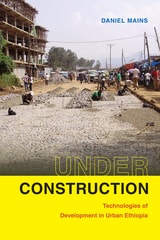
Under Construction
Technologies of Development in Urban EthiopiaDaniel Mains
Duke University Press, 2019
Over the past decade, Ethiopia has had one of the world's fastest growing economies, largely due to its investments in infrastructure, and it is through building dams, roads, and other infrastructure that the Ethiopian state seeks to become a middle-income country by 2025. Yet most urban Ethiopians struggle to meet their daily needs and actively oppose a ruling party that they associate with corruption and mismanagement. In Under Construction Daniel Mains explores the intersection of development and governance by examining the conflicts surrounding the construction of specific infrastructural technologies: asphalt and cobblestone roads, motorcycle taxis, and hydroelectric dams. These projects serve as sites for nation building and the means for the state to assert its legitimacy. The construction process—as well as Ethiopians' experience of living with the disruption of construction zones—reveals the tension and conflict between the promise of progress and the possibility of failure. Mains demonstrates how infrastructures as both ethnographic sites and as a means of theorizing such concepts as progress, development, and the state offer a valuable contrast to accounts of African abjection and decline.
[more]
Urban Lowlands
A History of Neighborhoods, Poverty, and PlanningSteven T. Moga
University of Chicago Press, 2020
Interrogates the connections between a city’s physical landscape and the poverty and social problems that are often concentrated at its literal lowest points.
In Urban Lowlands, Steven T. Moga looks closely at the Harlem Flats in New York City, Black Bottom in Nashville, Swede Hollow in Saint Paul, and the Flats in Los Angeles, to interrogate the connections between a city’s actual landscape and the poverty and social problems that are often concentrated at its literal lowest points. Taking an interdisciplinary perspective on the history of US urban development from the nineteenth to the mid-twentieth century, Moga reveals patterns of inequitable land use, economic dispossession, and social discrimination against immigrants and minorities. In attending to the landscapes of neighborhoods typically considered slums, Moga shows how physical and policy-driven containment has shaped the lives of the urban poor, while wealth and access to resources have been historically concentrated in elevated areas—truly “the heights.” Moga’s innovative framework expands our understanding of how planning and economic segregation alike have molded the American city.
In Urban Lowlands, Steven T. Moga looks closely at the Harlem Flats in New York City, Black Bottom in Nashville, Swede Hollow in Saint Paul, and the Flats in Los Angeles, to interrogate the connections between a city’s actual landscape and the poverty and social problems that are often concentrated at its literal lowest points. Taking an interdisciplinary perspective on the history of US urban development from the nineteenth to the mid-twentieth century, Moga reveals patterns of inequitable land use, economic dispossession, and social discrimination against immigrants and minorities. In attending to the landscapes of neighborhoods typically considered slums, Moga shows how physical and policy-driven containment has shaped the lives of the urban poor, while wealth and access to resources have been historically concentrated in elevated areas—truly “the heights.” Moga’s innovative framework expands our understanding of how planning and economic segregation alike have molded the American city.
[more]
Urban Lowlands
A History of Neighborhoods, Poverty, and PlanningSteven T. Moga
University of Chicago Press, 2020
This is an auto-narrated audiobook version of this book.
Interrogates the connections between a city’s physical landscape and the poverty and social problems that are often concentrated at its literal lowest points.
In Urban Lowlands, Steven T. Moga looks closely at the Harlem Flats in New York City, Black Bottom in Nashville, Swede Hollow in Saint Paul, and the Flats in Los Angeles, to interrogate the connections between a city’s actual landscape and the poverty and social problems that are often concentrated at its literal lowest points. Taking an interdisciplinary perspective on the history of US urban development from the nineteenth to the mid-twentieth century, Moga reveals patterns of inequitable land use, economic dispossession, and social discrimination against immigrants and minorities. In attending to the landscapes of neighborhoods typically considered slums, Moga shows how physical and policy-driven containment has shaped the lives of the urban poor, while wealth and access to resources have been historically concentrated in elevated areas—truly “the heights.” Moga’s innovative framework expands our understanding of how planning and economic segregation alike have molded the American city.
[more]

Using Servant Leadership
How to Reframe the Core Functions of Higher EducationLetizia, Angelo J.
Rutgers University Press, 2018
Using Servant Leadership provides an instructive guide for how faculty members can engage in servant leadership with administrators, students, and community members. By utilizing a wide range of research and through a series of case studies, Angelo J. Letizia demonstrates how, with a bit of creative thinking, the ideals of servant leadership can work even in the fractious, cash-strapped world of contemporary higher education. Furthermore, he considers how these concepts can be implemented in pedagogy, research, strategic planning, accountability, and assessment. This book points the way to a more humane university, one that truly serves the public good.
[more]