704 books match the query 'Political Process' and 6 start with u
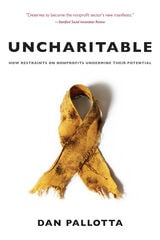
cover of Uncharitable: How Restraints on Nonprofits Undermine Their Potential

Uncharitable

How Restraints on Nonprofits Undermine Their Potential

Dan Pallotta

University Press of New England, 2010
Uncharitable goes where no other book on the nonprofit sector has dared to tread. Where other texts suggest ways to optimize performance inside the existing paradigm, Uncharitable suggests that the paradigm itself is the problem and calls into question our fundamental canons about charity. Author Dan Pallotta argues that society’s nonprofit ethic acts as a strict regulatory mechanism on the natural economic law. It creates an economic apartheid that denies the nonprofit sector critical tools and permissions that the for-profit sector is allowed to use without restraint (e.g., no risk-reward incentives, no profit, counterproductive limits on compensation, and moral objections to the use of donated dollars for anything other than program expenditures). These double-standards place the nonprofit sector at extreme disadvantage to the for profit sector on every level. While the for profit sector is permitted to use all the tools of capitalism to advance the sale of consumer goods, the nonprofit sector is prohibited from using any of them to fight hunger or disease. Capitalism is blamed for creating the inequities in our society, but charity is prohibited from using the tools of capitalism to rectify them. Ironically, this is all done in the name of charity, but it is a charity whose principal benefit flows to the for-profit sector and one that denies the nonprofit sector the tools and incentives that have built virtually everything of value in society. The very ethic we have cherished as the hallmark of our compassion is in fact what undermines it. This irrational system, Pallotta explains, has its roots in 400-year-old Puritan ethics that banished self-interest from the realm of charity. The ideology is policed today by watchdog agencies and the use of “efficiency” measures, which Pallotta argues are flawed, unjust, and should be abandoned. By declaring our independence from these obsolete ideas, Pallotta theorizes, we can dramatically accelerate progress on the most urgent social issues of our time. Pallotta has written an important, provocative, timely, and accessible book—a manifesto about equal economic rights for charity. Its greatest contribution may be to awaken society to the fact that they were so unequal in the first place.
[more]
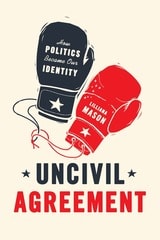
cover of Uncivil Agreement: How Politics Became Our Identity

Uncivil Agreement

How Politics Became Our Identity

Lilliana Mason

University of Chicago Press, 2018

A powerful analysis of the causes of America's dangerously polarized politics 

Political polarization in America is at an all-time high, and the conflict has moved beyond disagreements about matters of policy. For the first time in more than twenty years, research has shown that members of both parties hold strongly unfavorable views of their opponents. This is polarization rooted in social identity, and it is growing. The campaign and election of Donald Trump laid bare this fact of the American electorate, its successful rhetoric of “us versus them” tapping into a powerful current of anger and resentment.
           
With Uncivil Agreement, Lilliana Mason looks at the growing social gulf across racial, religious, and cultural lines, which have recently come to divide neatly between the two major political parties. She argues that group identifications have changed the way we think and feel about ourselves and our opponents. Even when Democrats and Republicans can agree on policy outcomes, they tend to view one other with distrust and to work for party victory over all else. Although the polarizing effects of social divisions have simplified our electoral choices and increased political engagement, they have not been a force that is, on balance, helpful for American democracy. Bringing together theory from political science and social psychology, Uncivil Agreement clearly describes this increasingly “social” type of polarization in American politics and will add much to our understanding of contemporary politics.

[more]
cover of Under Fire: The Nra and the Battle for Gun Control

Under Fire

The Nra and the Battle for Gun Control

Osha Gray Davidson

University of Iowa Press, 1998
Originally published in 1993, Under Fire was widely hailed as the first objective examination of the NRA and its efforts to defeat gun control legislation. Now in this expanded edition, Osha Gray Davidson shows how the NRA's extremism has cost the organization both political power and popular support. He offers a well-reasoned and workable approach to gun control, one that will find many supporters even among the NRA membership.
[more]
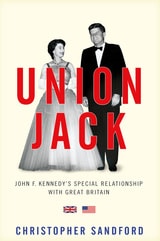
cover of Union Jack: JFK's Special Relationship with Great Britain

Union Jack

JFK's Special Relationship with Great Britain

Christopher Sandford

University Press of New England, 2017
John F. Kennedy carried on a lifelong love affair with England and the English. From his speaking style to his tastes in art, architecture, theater, music, and clothes, his personality reflected his deep affinity for a certain kind of idealized Englishness. In Union Jack, noted biographer Christopher Sandford tracks Kennedy’s exploits in Great Britain between 1935 and 1963, and looks in-depth at the unique way Britain shaped JFK throughout his adult life and how JFK charmed British society. This mutual affinity took place against a backdrop of some of the twentieth century’s most profound events: The Great Depression, Britain’s appeasement of Hitler, the Second World War, the reconstruction of Western Europe, the development and rapid proliferation of weapons of mass destruction, and the ideological schism between East and West. Based on extensive archival work as well as firsthand accounts from former British acquaintances, including old girlfriends, Union Jack charts two paths in the life of JFK. The first is his deliberate, long-term struggle to escape the shadow of his father, Joseph Kennedy, former U.S. Ambassador to Great Britain. The second is the emergence of a peculiarly American personality whose consistently pro-British, rallying rhetoric was rivaled only by Winston Churchill. By explaining JFK’s special relationship with Great Britain, Union Jack offers a unique and enduring portrait of another side of this historic figure in the centennial year of his birth.
[more]
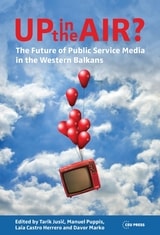
cover of Up in the Air?: The Future of Public Service Media in the Western Balkans

Up in the Air?

The Future of Public Service Media in the Western Balkans

Tarik Jusic

Central European University Press, 2021

The agenda for transition after the demise of communism in the Western Balkans made the conversion of state radio and television into public service broadcasters a priority, converting mouthpieces of the regime into public forums in which various interests and standpoints could be shared and deliberated. There is general agreement that this endeavor has not been a success. Formally, the countries adopted the legal and institutional requirements of public service media according to European standards. The ruling political elites, however, retained their control over the public media by various means.

Can this trend be reversed? Instead of being marginalized or totally manipulated, can public service media become vehicles of genuine democratization? 

A comparison of public service media in seven countries (Albania, Bosnia & Herzegovina, Croatia, Kosovo, Montenegro, North Macedonia, and Serbia) addresses these important questions.

[more]
cover of Urban Reform and Its Consequences: A Study in Representation

Urban Reform and Its Consequences

A Study in Representation

Susan Welch and Timothy Bledsoe

University of Chicago Press, 1988

Throughout this century, reformers have fought to eliminate party control of city politics. As a result, the majority of American cities today elect council members in at-large and nonpartisan elections. This result of the turn-of-the-century Progressive movement, which worked for election rules that eliminated the power of the urban machine and the working class on which it was based, is today still a subject of lively debate. For example, in the mid-1980s, regular Democrats in Chicago sought to institute a nonpartisan mayoral election. Supporters thought that reform would make the electoral process more democratic, while opponents charged that it was meant to dilute the voting powers of blacks. Clearly, the effect of urban reform remains an important issue for scholars and politicians alike.

Susan Welch and Timothy Bledsoe clarify a portion of the debate by investigating how election structures affect candidates and the nature of representation. They examine the different effects of district versus at-large elections and of partisan versus nonpartisan elections. Who gets elected? Are representatives' socioeconomic status and party affiliation related to election form? Are election structures related to how those who are elected approach their jobs? Do they see themselves as representatives concerned with the good of the city as a whole?

Urban Reform and Its Consequences reports an unprecedented wealth of data drawn from a sample of nearly 1,000 council members and communities with populations between 50,000 and 1 million across 42 states. The sample includes communities that use a variety of election procedures. This study is therefore the most comprehensive and accurate to date.

Welch and Bledsoe conclude that nonpartisan and at-large elections do give city councils a more middle- and upper-middle-class character and have changed the way representatives view their jobs. Reform measures have not, however, produced councils that are significantly more conservative or more prone to conflict. Overall, the authors conclude that partisan and district elections are more likely to represent the whole community and to make the council more accountable to the electorate.
[more]