Results by title
1668 books match the query 'Popular culture' and 17 start with u
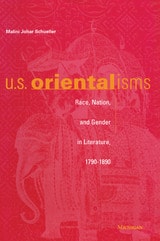
U.S. Orientalisms
Race, Nation, and Gender in Literature, 1790-1890Malini Johar Schueller
University of Michigan Press, 2001
This book begins with an examination of the literature of the "Barbary" Orient generated by the U.S. Algerian conflict in the late eighteenth century in the works of such writers as Royall Tyler, Susanna Rowson, and Washington Irving. It then moves on to the Near East Orientalist literature of the nineteenth century in light of Egyptology, theories of race, and the growth of missionary fervor in writers such as John DeForest, Maria Susanna Cummins, Herman Melville, Edgar Allan Poe, and Harriet Prescott Spofford. Finally, Schueller considers the Indic Orientalism of the period in the context of Indology, British colonialism, and the push for Asian trade in the United States, focusing particularly on Emerson and Whitman. U.S. Orientalisms demonstrates how these writers strove to create an Orientalism premised on the idea of civilization and empire moving West, from Asia, through Europe, and culminating in the New World.
Schueller draws on the work of Michel Foucault, Edward Said, Homi Bhabha, Rey Chow, and Judith Butler and compellingly demonstrates how a raced, compensatory "Orientalist" discourse of empire was both contested and evoked in the literary works of a wide variety of writers. The book will be of interest to readers in American history, postcolonial studies, gender studies, and literary theory.
Malini Johar Schueller is Associate Professor, Department of English, University of Florida. She is the author of The Politics of Voice: Liberalism and Social Criticism from Franklin to Kingston.

Uncommon Goods
Global Dimensions of the ReadymadeJaimey Hamilton Faris
Intellect Books, 2013
Since Marcel Duchamp created his “readymades” a century ago—most famously christening a urinal as a fountain— the practice of incorporating commodity objects into art has become ever more pervasive. Uncommon Goods traces one particularly important aspect of that progression: the shift in artistic concern toward the hidden ethical dimensions of global commerce. Jaimey Hamilton Faris discusses the work of, among many others, Ai Weiwei, Cory Arcangel, Thomas Hirschhorn, and Santiago Sierra, reading their artistic explorations as overlapping with debates about how common goods hold us and our world in common. The use of readymade now registers concerns about international migrant labor, outsourced manufacturing, access to natural resources, intellectual copyright, and the commoditization of virtual space.
In each chapter, Hamilton Faris introduces artists who exemplify the focus of readymade aesthetics on aspects of global commodity culture, including consumption, marketing, bureaucracy, labor, and community. She explores how materially intensive, “uncommon” aesthetic situations can offer moments to meditate on the kinds of objects, experiences, and values we ostensibly share in the age of globalization. The resulting volume will be an important contribution to scholarship on readymade art as well as to the study of materiality, embodiment, and globalization.

Under Pressure
A Song by David Bowie and QueenMax Brzezinski
Duke University Press, 2025
Under a Bad Sign
Criminal Self-Representation in African American Popular CultureJonathan Munby
University of Chicago Press, 2011
What accounts for the persistence of the figure of the black criminal in popular culture created by African Americans? Unearthing the overlooked history of art that has often seemed at odds with the politics of civil rights and racial advancement, Under a Bad Sign explores the rationale behind this tradition of criminal self-representation from the Harlem Renaissance to contemporary gangsta culture.
In this lively exploration, Jonathan Munby takes a uniquely broad view, laying bare the way the criminal appears within and moves among literary, musical, and visual arts. Munby traces the legacy of badness in Rudolph Fisher and Chester Himes’s detective fiction and in Claude McKay, Julian Mayfield, and Donald Goines’s urban experience writing. Ranging from Peetie Wheatstraw’s gangster blues to gangsta rap, he also examines criminals in popular songs. Turning to the screen, the underworld films of Oscar Micheaux and Ralph Cooper, the 1970s blaxploitation cycle, and the 1990s hood movie come under his microscope as well. Ultimately, Munby concludes that this tradition has been a misunderstood aspect of African American civic life and that, rather than undermining black culture, it forms a rich and enduring response to being outcast in America.
Undercover Asian
Multiracial Asian Americans in Visual CultureLeiLani Nishime
University of Illinois Press, 2014
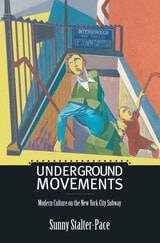
Underground Movements
Modern Culture on the New York City SubwaySunny Stalter-Pace
University of Massachusetts Press, 2013
Writers and artists took up questions that originated in the sphere of urban planning to explore how underground movement changed the ways people understand the city. Modern poets envisioned the subway as a space of literary innovation; playwrights and fiction writers used it to gauge the consequences of migration and immigration; and essayists found that it underscored the fragile relationship between urban development and memory. Even today, the symbolic associations forged by these early texts continue to influence understanding of the cultural significance of the subway and the city it connects.
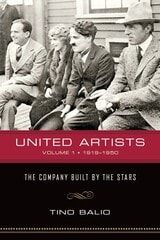
United Artists, Volume 1, 1919–1950
The Company Built by the StarsTino Balio
University of Wisconsin Press, 2009
This edition is updated with a new introduction by Balio that places in relief UA’s operations for those readers who may be unfamiliar with film industry practices and adds new perspective to the company’s place within Hollywood.
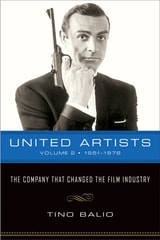
United Artists, Volume 2, 1951–1978
The Company That Changed the Film IndustryTino Balio
University of Wisconsin Press, 2009
This edition includes an expanded introduction that examines the history of United Artists from 1978 to 2008, as well as an account of Arthur Krim’s attempt to mirror UA’s success at Orion Pictures from 1978 to 1991.
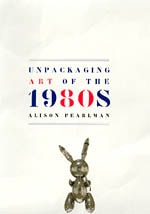
Unpackaging Art of the 1980s
Alison Pearlman
University of Chicago Press, 2003
Pearlman reassesses the works and careers of six artists who became critics' biggest targets. In each of three chapters, she pairs two artists the critics viewed as emblematic of a given trend: Julian Schnabel and David Salle in association with Neo-Expressionism; Jean-Michel Basquiat and Keith Haring vis-à-vis Graffiti Art; and Peter Halley and Jeff Koons in relation to Simulationism. Pearlman shows how all these artists shared important but unrecognized influences and approaches: a crucial and overwhelming inheritance of 1960s and 1970s Conceptualism, a Warholian understanding of public identity, and a deliberate and nuanced use of past styles and media. Through in-depth discussions of works, from Haring's body-paintings of Grace Jones to Schnabel's movie Basquiat, Pearlman demonstrates how these artists' interests exemplified a broader, generational shift unrecognized by critics. She sees this shift as starting not in the 1980s but in the mid-1970s, when key developments in artistic style, art-world structures, and consumer culture converged to radically alter the course of American art.
Unpackaging Art of the 1980s offers an innovative approach to one of the most significant yet least understood episodes in twentieth-century art.
Unruly Souls
The Digital Activism of Muslim and Christian FeministsKristin M. Peterson
Rutgers University Press, 2022
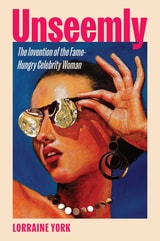
Unseemly
The Invention of the Fame-Hungry Celebrity WomanLorraine York
University of Delaware Press, 2027
Fame-shaming suggests that those who identify as women and openly pursue public recognition transgress the bounds of propriety and good taste. In Unseemly, Lorraine York analyzes fame-hunger accusations that have been directed at “fame whores” and “drama queens” from the seventeenth to the twenty-first centuries, showing how these women have creatively handled such accusations. From Margaret Cavendish, Aphra Behn, Barbara Strozzi, Eliza Haywood, and Sarah Bernhardt to Helen Frankenthaler, Yoko Ono, Madonna, Kim Kardashian, Hillary Rodham Clinton, and Alexandria Ocasio-Cortez, York shows how fame-shaming has been informed by expectations of gender, sexuality, race, and class.
The unease that gives rise to public shaming of women who desire fame, says York, is a reaction to their skillful use of emergent media, whether print, film, secular song, science fiction, reality television, political speech, or social media. Fame hunger is not, as some assume, the last refuge of the untalented. To the contrary, women who have been accused of an unseemly thirst for celebrity turn out to be especially adept at emergent and boundary-breaking forms of cultural expression.

Unsettling
Jews, Whiteness, and Incest in American Popular CultureEli Bromberg
Rutgers University Press, 2021
Untimely Interventions
AIDS Writing, Testimonial, and the Rhetoric of HauntingRoss Chambers
University of Michigan Press, 2004
Ross Chambers argues that culture produces itself as civilized by denying the forms of collective violence and other traumatic experience that it cannot control. In the context of such denial, personal accounts of collective disaster can function as a form of counter-denial. By investigating a range of writing on AIDS, the First World War, and the Holocaust, Chambers shows how such writing produces a rhetorical effect of haunting, as it seeks to describe the reality of those experiences culture renders unspeakable.
Ross Chambers is Professor of Romance Languages at the University of Michigan. His other books includeFacing It: AIDS Diaries and the Death of the Author.

Unwatchable
Baer, Nicholas
Rutgers University Press, 2019
With over 50 original essays by leading scholars, artists, critics, and curators, this is the first book to trace the “unwatchable” across our contemporary media environment, in which viewers encounter difficult content on various screens and platforms. Appealing to a broad academic and general readership, the volume offers multidisciplinary approaches to the vast array of troubling images that circulate in global visual culture.
Uproarious
How Feminists and Other Subversive Comics Speak TruthCynthia Willett
University of Minnesota Press, 2019
Humor is often dismissed as cruel ridicule or harmless fun. But what if laughter is a vital force to channel rage against patriarchy, Islamophobia, or mass incarceration? To create moments of empathy and dialogue between Black Lives Matter and the police? These and other such questions are at the heart of this powerful reassessment of humor. Placing theorists in conversation with comedians, Uproarious offers a full-frontal approach to the very foundation of comedy and its profound political impact.
Here Cynthia Willett and Julie Willett address the four major theories of humor—superiority, relief, incongruity, and social play—through the lens of feminist and game-changing comics such as Wanda Sykes, Margaret Cho, Hannah Gadsby, Hari Kondabolu, and Tig Notaro. They take a radical and holistic approach to the understanding of humor, particularly of humor deployed by those from groups long relegated to the margins, and propose a powerful new understanding of humor as a force that can engender politically progressive social movements. Drawing on a range of cross-disciplinary sources, from philosophies and histories of humor to the psychology and physiology of laughter to animal studies, Uproarious offers a richer understanding of the political and cathartic potential of humor.
A major new contribution to a wider dialogue on comedy, Uproarious grounds for us explorations of outsider humor and our golden age of feminist comics—showing that when women, prisoners, even animals, laugh back, comedy along with belly laughs forge new identities and alter the political climate.
Urban Music Governance
What Busking Can Teach Us about Data, Policy and Our CitiesJess Reia
Intellect Books, 2025
What happens when precarious urban cultural laborers take data collection, laws, and policymaking into their own hands? Buskers have been part of our cities for hundreds of years, but they remain invisible to governments and in datasets. From nuisance to public art, this cultural practice can help us understand the politics of data collection, archives, regulatory frameworks, and urban planning. Busking also responds to underlying questions on the boundaries of the rights to the city, and who has a voice in shaping how our cities are planned and governed.
A transnational exploration of street performance, Urban Music Governance examines the intricate limits of legality, data visibility, and resistance from the perspective of those working at the social and regulatory margins of society. Based on a decade of fieldwork in Rio de Janeiro and Montreal, this book offers a lively account of why such an often-overlooked practice matters today.
By investigating the role of busking in contemporary society, Urban Music Governance presents an original interdisciplinary study that exposes how power dynamics in policymaking decide issues of access—and exclusion—around us, above and below ground.
Utopia Limited
The Sixties and the Emergence of the PostmodernMarianne DeKoven
Duke University Press, 2004
DeKoven rigorously analyzes a broad array of cultural and political texts important in the sixties—from popular favorites such as William S. Burroughs’s Naked Lunch to political manifestoes including The Port Huron Statement, the founding document of SDS (Students for a Democratic Society). She examines texts that overtly discuss the conflict in Vietnam, Black Power, and second-wave feminism—including Frances FitzGerald’s Fire in the Lake, James Baldwin’s The Fire Next Time, and Shulamith Firestone’s The Dialectic of Sex; experimental pieces such as The Living Theatre’s Paradise Now; influential philosophical works including Roland Barthes’s Mythologies and Herbert Marcuse’s One-Dimensional Man; and explorations of Las Vegas, the prime location of postmodernity. Providing extensive annotated bibliographies on both the sixties and postmodernism, Utopia Limited is an invaluable resource for understanding the impact of that tumultuous decade on the present.