Results by title
117 books match the query 'Production and direction' and 3 start with u
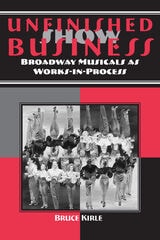
Unfinished Show Business
Broadway Musicals as Works-in-ProcessBruce Kirle
Southern Illinois University Press, 2005
In this fresh approach to musical theatre history, Bruce Kirle challenges the commonly understood trajectory of the genre. Drawing on the notion that the world of the author stays fixed while the world of the audience is ever-changing, Kirle suggests that musicals are open, fluid products of the particular cultural moment in which they are performed. Incomplete as printed texts and scores, musicals take on unpredictable lives of their own in the complex transformation from page to stage.
Using lenses borrowed from performance studies, cultural studies, queer studies, and ethnoracial studies, Unfinished Show Business: Broadway Musicals as Works-in-Process argues that musicals are as interesting for the provocative issues they raise about shifting attitudes toward American identity as for their show-stopping song-and-dance numbers and conveniently happy endings. Kirle illustrates how performers such as Ed Wynn, Fanny Brice, and the Marx Brothers used their charismatic personalities and quirkiness to provide insights into the struggle of marginalized ethnoracial groups to assimilate. Using examples from favorites including Oklahoma!, Fiddler on the Roof, A Chorus Line, and Les Misérables, Kirle demonstrates Broadway’s ability to bridge seemingly insoluble tensions in society, from economic and political anxiety surrounding World War II to generational conflict and youth counterculture to corporate America and the “me” generation. Enlivened by a gallery of some of Broadway’s most memorable moments—and some amusing, obscure ones as well—this study will appeal to students, scholars, and lifelong musical theatre enthusiasts.
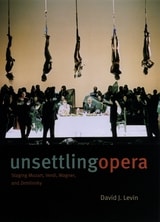
Unsettling Opera
Staging Mozart, Verdi, Wagner, and ZemlinskyDavid J. Levin
University of Chicago Press, 2007
What happens when operas that are comfortably ensconced in the canon are thoroughly rethought and radically recast on stage? What does a staging do to our understanding of an opera, and of opera generally? While a stage production can disrupt a work that was thought to be established, David J. Levin here argues that the genre of opera is itself unsettled, and that the performance of operas, at its best, clarifies this condition by bringing opera’s restlessness and volatility to life.
Unsettling Opera explores a variety of fields, considering questions of operatic textuality, dramaturgical practice, and performance theory. Levin opens with a brief history of opera production, opera studies, and dramatic composition, and goes on to consider in detail various productions of the works of Wagner, Mozart, Verdi, and Alexander Zemlinsky. Ultimately, the book seeks to initiate a dialogue between scholars of music, literature, and performance by addressing questions raised in each field in a manner that influences them all.
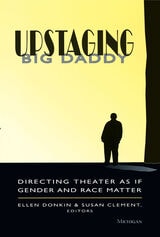
Upstaging Big Daddy
Directing Theater as if Gender and Race MatterEllen Donkin and Susan Clement, Editors
University of Michigan Press, 1993
What happens, then, when a feminist who directs for the theater decides that there is something called a feminist director, someone who sees her job as protesting and intervening in the existing system of representation? The contributors to this volume provide a wide range of answers, in original essays that disrupt traditional approaches of directing by showing how feminist theory might be applied in practice.
Essays and interviews by a wide variety of directors, scholars, and other theater specialists offer fresh new models for thinking about directing. The collection includes essays on African-American theater, feminist “classics,” and male directors working on feminist plays, as well as concrete suggestions for directing a variety of plays, from works by Shakespeare and Euripides to those by Caryl Churchill, Aishah Rahman, and Helene Cixous. The theoretical material, drawing from a wide range of contemporary critics and theorists, has been written with the director in mind, partly for the purpose of analyzing texts but also for inspiring creative directorial and design solutions.