Results by title
597 books match the query 'Psychological aspects' and 9 start with u

Unbecoming Cinema
Unsettling Encounters with Ethical Event FilmsDavid H. Fleming
Intellect Books, 2017
A PDF version of this book is available for free in open access via the OAPEN Library platform, www.oapen.org It has been made available under a Creative Commons Attribution 4.0 International Public License and is part of Knowledge Unlatched.

Undertale
Can a Game Give Hope?Anastasia Salter
University of Chicago Press, 2025
A powerful exploration of the importance and social complexity of the indie gaming sensation
On the surface, the 2015 game Undertale didn’t seem like much, supported by fan funding and with minimalist retro graphics. But despite its pixelated monsters and dated role-playing mechanics, Undertale invited fans and players to rethink their very relationship with gaming and game characters. Players encountered an extraordinary range of possible play experiences, with paths through the game’s unassuming world leading to both empathy and extreme violence, offering room for reflection and growth. Players could befriend (sometimes queer) monsters or kill them, for instance, appealing to each monster’s unique personality to negotiate survival and find community.
Contextualizing this game’s success in the wake of the Gamergate online harassment campaign and meditating on questions of violence and authenticity, writer and game scholar Anastasia Salter offers a profound exploration of this game sensation and a personal story of hope at a time when Salter was otherwise “done” with games. Undertale’s unique structure helped make it synonymous with “indie” games, built outside of the studio as a passion project and inspiring similar passion among its many fans even a decade later. But Undertale’s story also speaks to an auteur dream: What game developer Toby Fox and his collaborators accomplished on a small budget, with relatively simple tools, has left people replaying, arguing, and creating in its wake.
As we enter a cultural moment where intense interest is shifting towards flashy creativity, powered by generative artificial intelligence, Undertale reminds fans and newcomers of the power of thoughtful and intentional human design.
Unforgiving Places
The Unexpected Origins of American Gun ViolenceJens Ludwig
University of Chicago Press, 2025
In 2007, economist Jens Ludwig moved to the South Side of Chicago to research two big questions: Why does gun violence happen, and is there anything we can do about it? Almost two decades later, the answers aren’t what he expected. Unforgiving Places is Ludwig’s revelatory portrait of gun violence in America’s most famously maligned city.
Disproving the popular narrative that shootings are the calculated acts of malicious or desperate people, Ludwig shows how most shootings actually grow out of a more fleeting source: interpersonal conflict, especially arguments. By examining why some arguments turn tragic while others don't, Ludwig shows gun violence to be more circumstantial—and more solvable—than our traditional approaches lead us to believe.
Drawing on decades of research and Ludwig’s immersive fieldwork in Chicago, including “countless hours spent in schools, parks, playgrounds, housing developments, courtrooms, jails, police stations, police cars, and lots and lots of McDonald'ses,” Unforgiving Places is a breakthrough work at the cutting edge of behavioral economics. As Ludwig shows, progress on gun violence doesn’t require America to solve every other social problem first; it only requires that we find ways to intervene in the places and the ten-minute windows where human behaviors predictably go haywire.
Universalism without Uniformity
Explorations in Mind and CultureEdited by Julia L. Cassaniti and Usha Menon
University of Chicago Press, 2017
The contributors to Universalism without Uniformity offer tools for bridging silos that have historically separated anthropology’s attention to culture and psychology’s interest in universal mental processes. Throughout, they seek to answer intricate yet fundamental questions about why we are motivated to find meaning in everything around us and, in turn, how we constitute the cultural worlds we inhabit through our intentional involvement in them. Laying bare entrenched disciplinary blind spots, this book offers a trove of insights on issues such as morality, emotional functioning, and conceptions of the self across cultures. Filled with impeccable empirical research coupled with broadly applicable theoretical reflections on taking psychological diversity seriously, Universalism without Uniformity breaks new ground in the study of mind and culture.
Unlimited Intimacy
Reflections on the Subculture of BarebackingTim Dean
University of Chicago Press, 2009
Barebacking—when gay men deliberately abandon condoms and embrace unprotected sex—has incited a great deal of shock, outrage, anger, and even disgust, but very little contemplation. Purposely flying in the face of decades of safe-sex campaigning and HIV/AIDS awareness initiatives, barebacking is unquestionably radical behavior, behavior that most people would rather condemn than understand. Thus the time is ripe for Unlimited Intimacy, Tim Dean’s riveting investigation into barebacking and the distinctive subculture that has grown around it.
Audacious and undeniably provocative, Dean’s profoundly reflective account is neither a manifesto nor an apology; instead, it is a searching analysis that tests the very limits of the study of sex in the twenty-first century. Dean’s extensive research into the subculture provides a tour of the scene’s bars, sex clubs, and Web sites; offers an explicit but sophisticated analysis of its pornography; and documents his own personal experiences in the culture. But ultimately, it is HIV that animates the controversy around barebacking, and Unlimited Intimacy explores how barebackers think about transmitting the virus—especially the idea that deliberately sharing it establishes a new network of kinship among the infected. According to Dean, intimacy makes us vulnerable, exposes us to emotional risk, and forces us to drop our psychological barriers. As a committed experiment in intimacy without limits—one that makes those metaphors of intimacy quite literal—barebacking thus says a great deal about how intimacy works.
Written with a fierce intelligence and uncompromising nerve, Unlimited Intimacy will prove to be a milestone in our understanding of sexual behavior.

Unnatural Selection
A Memoir of Adoption and WildernessAndrea Ross
CavanKerry Press, 2021
Unseen Flesh
Gynecology and Black Queer Worth-Making in BrazilNessette Falu
Duke University Press, 2023

Unwatchable
Baer, Nicholas
Rutgers University Press, 2019
With over 50 original essays by leading scholars, artists, critics, and curators, this is the first book to trace the “unwatchable” across our contemporary media environment, in which viewers encounter difficult content on various screens and platforms. Appealing to a broad academic and general readership, the volume offers multidisciplinary approaches to the vast array of troubling images that circulate in global visual culture.
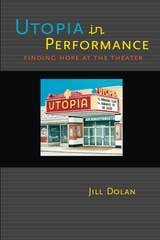
Utopia in Performance
Finding Hope at the TheaterJill Dolan
University of Michigan Press, 2005
---David Román, University of Southern California
What is it about performance that draws people to sit and listen attentively in a theater, hoping to be moved and provoked, challenged and comforted? In Utopia in Performance, Jill Dolan traces the sense of visceral, emotional, and social connection that we experience at such times, connections that allow us to feel for a moment not what a better world might look like, but what it might feel like, and how that hopeful utopic sentiment might become motivation for social change.
She traces these "utopian performatives" in a range of performances, including the solo performances of feminist artists Holly Hughes, Deb Margolin, and Peggy Shaw; multicharacter solo performances by Lily Tomlin, Danny Hoch, and Anna Deavere Smith; the slam poetry event Def Poetry Jam; The Laramie Project; Blanket, a performance by postmodern choreographer Ann Carlson; Metamorphoses by Mary Zimmerman; and Deborah Warner's production of Medea starring Fiona Shaw. While the book richly captures moments of "feeling utopia" found within specific performances, it also celebrates the broad potential that performance has to provide a forum for being human together; for feeling love, hope, and commonality in particular and historical (rather than universal and transcendent) ways.