156 books match the query 'Psychotherapy' and 3 start with u

cover of Unclenching Our Fists: Abusive Men on the Journey to Nonviolence

Unclenching Our Fists

Abusive Men on the Journey to Nonviolence

Sara Elinoff Acker

Vanderbilt University Press, 2013

This book features eleven first-person stories of men from diverse class and racial backgrounds who have made a long-term commitment to end their physical and emotional abuse and controlling behaviors. These men speak frankly about the abuse they inflicted on their families, what it took to get them to face themselves, and how they feel about the damage they have caused. All participated in violence intervention programs, some for as long as ten years. To put a face on violence and to encourage activism for reform, most of the eleven have allowed their photos and real names to be used in the book.


Surrounding this material are chapters that provide context about the disputes among researchers about whether batterer intervention programs work (only a small number of batterers renounce their abuse) and chapters that address the reactions of partners to these stories. "When the Man You Love is Abusive" is designed to caution women not to be manipulated by accounts of change and to outline the stages men need to pass through in the long process of becoming accountable. "The Last Word: Voices of Survivors" ends the book with a focus group discussion in which former abuse victims and advocates respond candidly to the men's stories.
[more]
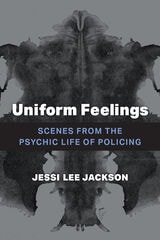
cover of Uniform Feelings: Scenes from the Psychic Life of Policing

Uniform Feelings

Scenes from the Psychic Life of Policing

Jessi Lee Jackson

University of Michigan Press, 2022

In Uniform Feelings, American studies scholar and abolitionist psychotherapist Jessi Lee Jackson reads policing as a set of emotional and relational practices in order to shed light on the persistence of police violence.  Jackson argues that psychological investments in U.S. police power emerge at various sites: her counseling room, manuals for addressing bias, museum displays, mortality statistics, and memorial walls honoring fallen officers.  Drawing on queer, feminist, anticolonial, and Black engagements with psychoanalysis to think through U.S. policing—and bringing together a mix of clinical case studies, autotheory, and ethnographic research—the book moves from the individual to the institutional. Jackson begins with her work as a psychotherapist working across the spectrum of relationships to policing, and then turns to interrogate carceral psychology—the involvement of her profession in ongoing state violence.  Jackson orbits around two key questions: how are our relationships shaped by proximity to state violence, and how can our social worlds be transformed to challenge state-sanctioned violence?
[more]
cover of Unruly Spirits: The Science of Psychic Phenomena in Modern France

Unruly Spirits

The Science of Psychic Phenomena in Modern France

M. Brady Brower

University of Illinois Press, 2010

Unruly Spirits connects the study of séances, telepathy, telekinesis, materializations, and other parapsychic phenomena in France during the age of Sigmund Freud to an epistemological crisis that would eventually yield the French adoption of psychoanalysis. Skillfully navigating experiments conducted by nineteenth-century French psychical researchers and the wide-ranging debates that surrounded their work, M. Brady Brower situates the institutional development of psychical research at the intersection of popular faith and the emergent discipline of psychology.
 
Brower shows how spiritualist mediums were ignored by French academic scientists for nearly three decades. Only after the ideologues of the Third Republic turned to science to address what they took to be the excess of popular democracy would the marvels of mediumism begin to emerge as legitimate objects of scientific inquiry. Taken up by the most prominent physicists, physiologists, and psychologists of the last decades of the nineteenth century, psychical research would eventually stall in the 1920s as researchers struggled to come to terms with interpersonal phenomena (such as trust and good faith) that could not be measured within the framework of their experimental methods.
 
In characterizing psychical research as something other than a mere echo of popular spirituality or an anomaly among the sciences, Brower argues that the questions surrounding mediums served to sustain the scientific project by forestalling the establishment of a closed and complete system of knowledge. By acknowledging persistent doubt about the intentions of its participants, psychical research would result in the realization of a subjectivity that was essentially indeterminate and would thus clear the way for the French reception of psychoanalysis and the Freudian unconscious and its more comprehensive account of subjective uncertainty.
[more]