262 books match the query 'Public health' and 2 start with u
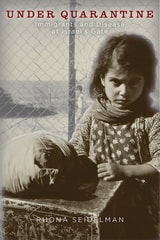
cover of Under Quarantine: Immigrants and Disease at Israel’s Gate

Under Quarantine

Immigrants and Disease at Israel’s Gate

Rhona Seidelman

Rutgers University Press, 2020
Under Quarantine is the riveting story of Shaar Ha’aliya, a central immigrant processing camp opened shortly after Israel became an independent state. This historic gateway for Jewish migration was surrounded by a controversial barbed wire fence. The camp administrators defended this imposing barrier as a necessary quarantine measure - even as detained immigrants regularly defied it by crawling out of the camp and returning at will. Focusing on the conflicts and complications surrounding the medical quarantine, this book brings the history of this place and the remarkable experiences of the immigrants who went through it to life.  Evocative and bold, Under Quarantine shows that we cannot fully understand Israel until we understand Shaar Ha’aliya.  The gate of arrival for nearly half a million immigrants - a space of homecoming, conflict, exclusion and welcoming - here was the country’s crucible.
[more]
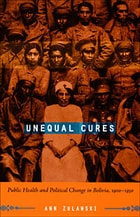
cover of Unequal Cures: Public Health and Political Change in Bolivia, 1900–1950

Unequal Cures

Public Health and Political Change in Bolivia, 1900–1950

Ann Zulawski

Duke University Press, 2007

Unequal Cures illuminates the connections between public health and political change in Bolivia from the beginning of the twentieth century, when the country was a political oligarchy, until the eve of the 1952 national revolution that ushered in universal suffrage, agrarian reform, and the nationalization of Bolivia’s tin mines. Ann Zulawski examines both how the period’s major ideological and social transformations changed medical thinking and how ideas of public health figured in debates about what kind of country Bolivia should become. Zulawski argues that the emerging populist politics of the 1930s and 1940s helped consolidate Bolivia’s medical profession and that improved public health was essential to the creation of a modern state. Yet she finds that at mid-century, women, indigenous Bolivians, and the poor were still considered inferior and consequently received often inadequate medical treatment and lower levels of medical care.

Drawing on hospital and cemetery records, censuses, diagnoses, newspaper accounts, and interviews, Zulawski describes the major medical problems that Bolivia faced during the first half of the twentieth century, their social and economic causes, and efforts at their amelioration. Her analysis encompasses the Rockefeller Foundation’s campaign against yellow fever, the almost total collapse of Bolivia’s health care system during the disastrous Chaco War with Paraguay (1932–35), an assessment of women’s health in light of their socioeconomic realities, and a look at Manicomio Pacheco, the national mental hospital.

[more]