Results by title
391 books match the query 'Public opinion' and 6 start with u
Understanding NAFTA
Mexico, Free Trade, and the New North AmericaBy William A. Orme, Jr.
University of Texas Press, 1996
Understanding NAFTA was first published in 1993 as Continental Shift: Free Trade & the New North America. This edition includes a new introduction that brings the NAFTA story up through 1995.
Undoing Suicidism
A Trans, Queer, Crip Approach to Rethinking (Assisted) SuicideAlexandre Baril
Temple University Press, 2023
Undoing Suicidism questions the belief that the best way to help suicidal people is through the logic of prevention. Alexandre Baril presents the thought-provoking argument that supporting assisted suicide for suicidal people could better prevent unnecessary deaths. Offering a new queercrip model of (assisted) suicide, he invites us to imagine what could happen if we started thinking about (assisted) suicide from an anti-suicidist and intersectional framework.
Baril provides a radical reconceptualization of (assisted) suicide and invaluable reflections for academics, activists, practitioners, and policymakers.
Unlearning the Language of Conquest
Scholars Expose Anti-Indianism in AmericaEdited by Four Arrows (Don Trent Jacobs)
University of Texas Press, 2006
Responding to anti-Indianism in America, the wide-ranging perspectives culled in Unlearning the Language of Conquest present a provocative account of the contemporary hegemony still at work today, whether conscious or unconscious. Four Arrows has gathered a rich collection of voices and topics, including:
- Waziyatawin Angela Cavender Wilson's "Burning Down the House: Laura Ingalls Wilder and American Colonialism," which probes the mentality of hatred woven within the pages of this iconographic children's literature.
- Vine Deloria's "Conquest Masquerading as Law," examining the effect of anti-Indian prejudice on decisions in U.S. federal law.
- David N. Gibb's "The Question of Whitewashing in American History and Social Science," featuring a candid discussion of the spurious relationship between sources of academic funding and the types of research allowed or discouraged.
- Barbara Alice Mann's "Where Are Your Women? Missing in Action," displaying the exclusion of Native American women in curricula that purport to illuminate the history of Indigenous Peoples.
Bringing to light crucial information and perspectives on an aspect of humanity that pervades not only U.S. history but also current sustainability, sociology, and the ability to craft accurate understandings of the population as a whole, Unlearning the Language of Conquest yields a liberating new lexis for realistic dialogues.
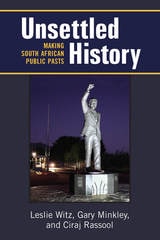
Unsettled History
Making South African Public PastsLeslie Witz, Gary Minkley, and Ciraj Rassool
University of Michigan Press, 2017
Leslie Witz, Gary Minkley, and Ciraj Rassool take the reader to sites of historical production in which complex ideas about pasts are invoked, and navigate a path toward understanding the agencies of image-making and memory production. This volume is the outcome of the authors’ intensive collaborative research and engagement over twenty-five years on questions including the production and performance of apartheid history; the cultural politics of social history; South Africa’s Truth and Reconciliation Commission and practices of orality; tourism as an arena of image-making and historical construction; museums as sites of heritage production for a new South Africa; photographs, archival meanings, and the construction of the social documentary; and the centenary commemorations of the South African War and the making of race. The authors not only witnessed many of these instances of history-making but were also participants in their constitution.

Urban Nightmares
The Media, The Right, And The Moral Panic Over The CitySteve Macek
University of Minnesota Press, 2006

Us Against Them
Ethnocentric Foundations of American OpinionDonald R. Kinder and Cindy D. Kam
University of Chicago Press, 2009
Ethnocentrism—our tendency to partition the human world into in-groups and out-groups—pervades societies around the world. Surprisingly, though, few scholars have explored its role in political life. Donald Kinder and Cindy Kam fill this gap with Us Against Them, their definitive explanation of how ethnocentrism shapes American public opinion.
Arguing that humans are broadly predisposed to ethnocentrism, Kinder and Kam explore its impact on our attitudes toward an array of issues, including the war on terror, humanitarian assistance, immigration, the sanctity of marriage, and the reform of social programs. The authors ground their study in previous theories from a wide range of disciplines, establishing a new framework for understanding what ethnocentrism is and how it becomes politically consequential. They also marshal a vast trove of survey evidence to identify the conditions under which ethnocentrism shapes public opinion. While ethnocentrism is widespread in the United States, the authors demonstrate that its political relevance depends on circumstance. Exploring the implications of these findings for political knowledge, cosmopolitanism, and societies outside the United States, Kinder and Kam add a new dimension to our understanding of how democracy functions.