Results by title
325 books match the query 'Race identity' and 7 start with u
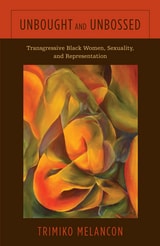
Unbought and Unbossed
Transgressive Black Women, Sexuality, and RepresentationTrimiko Melancon
Temple University Press, 2014
Drawing from black feminist and critical race theories, historical discourses on gender and sexuality, and literary criticism, Melancon explores the variety and complexity of black female identity. She illuminates how authors including Ann Allen Shockley, Alice Walker, and Gayl Jones engage issues of desire, intimacy, and independence to shed light on a more complex black identity, one ungoverned by rigid politics over-determined by race, gender and sexuality.
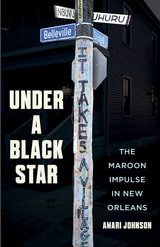
Under a Black Star
The Maroon Impulse in New OrleansAmari Johnson
University of Minnesota Press, 2025
Uncovering the spirit of freedom and self-determination in New Orleans
In Under a Black Star, Amari Johnson explores what he defines as the “maroon impulse” among the BlackStar Community in the Algiers neighborhood of New Orleans. This community sought autonomy for Black people facing systemic marginalization through denied employment, insufficient education, and a housing crisis following Hurricane Katrina, establishing initiatives such as Kamali Academy, a homeschool collective, and BlackStar Books and Caffé, a bookstore and gathering place. Instead of appealing to the city, they built the community they desired by employing legacies of marronage: disengagement, flight, and reengagement.
An active participant in the physical and ideological development of these autonomous spaces, Johnson provides nuanced insights into the community’s work toward liberation and self-determination. Demonstrating that marronage is a cultural tradition throughout the African Diaspora, he focuses on the transtemporal maroon process to show how it is central to the pursuit of autonomy, community, and freedom.
From the swamps of southeastern Louisiana, across urban obstacles, and into BlackStar’s creative spaces, Johnson’s path leads him to ask: How did the New Orleans community mobilize the tradition of marronage to create autonomous spaces amid gentrification? What forms might the maroon impulse take in the twenty-first century? This dynamic ethnographic memoir ultimately illuminates marronage as a potent form of liberatory potential, offering strategies for similar communities across the country and around the world.

Under the Sky of My Africa
Alexander Pushkin and BlacknessCatherine Nepomnyashchy
Northwestern University Press, 2006
Roughly in the year 1705, a young African boy, acquired from the seraglio of the Turkish sultan, was transported to Russia as a gift to Peter the Great. This child, later known as Abram Petrovich Gannibal, was to become Peter's godson and to live to a ripe old age, having attained the rank of general and the status of Russian nobility. More important, he was to become the great-grandfather of Russia's greatest national poet, Alexander Pushkin. It is the contention of the editors of this book, borne out by the essays in the collection, that Pushkin's African ancestry has played the role of a "wild card" of sorts as a formative element in Russian cultural mythology; and that the ways in which Gannibal's legacy has been included in or excluded from Pushkin's biography over the last two hundred years can serve as a shifting marker of Russia's self-definition.
The first single volume in English on this rich topic, Under the Sky of My Africa addresses the wide variety of interests implicated in the question of Pushkin's blackness-race studies, politics, American studies, music, mythopoetic criticism, mainstream Pushkin studies. In essays that are by turns biographical, iconographical, cultural, and sociological in focus, the authors-representing a broad range of disciplines and perspectives-take us from the complex attitudes toward race in Russia during Pushkin's era to the surge of racism in late Soviet and post-Soviet contemporary Russia. In sum, Under the Sky of My Africa provides a wealth of basic material on the subject as well as a series of provocative readings and interpretations that will influence future considerations of Pushkin and race in Russian culture.
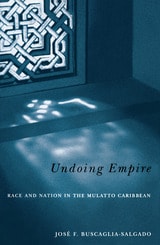
Undoing Empire
Race And Nation In The Mulatto CaribbeanJose F. Buscaglia-Salgado
University of Minnesota Press, 2003
A revelatory account that places mulatto experience at the center of Caribbean history
This ambitious book brings to light the story of what José F. Buscaglia-Salgado terms mulataje—the ways Caribbean aesthetics offer the possibility of the ultimate erasure of racial difference. Undoing Empire gives a broad panorama stretching from the complex politics of medieval Iberian societies to the beginning of direct U.S. hegemony in the Caribbean at the end of the nineteenth century.
Buscaglia-Salgado begins with an examination of Washington Irving’s “American Columbiad” as an act of historical and territorial plundering. He then traces the roots of mulatto society to the pre-1492 Iberian world, not only finding a connection between the Moors of “Old Spain” and the morenos—the blacks and mulattoes of the New World—but also offering a profound critique of creole and imperial discourses. Buscaglia-Salgado reads the pursuit and contestation of what he terms the European Ideal in colonial texts, architecture, and paintings, then identifies the mulatto movement of “undoing” the Ideal in the wars that shook the nineteenth-century Caribbean from Haiti to Cuba, arguing that certain projects of national liberation have moved contrary to the historical claims to freedom in the mulatto world.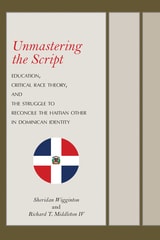
Unmastering the Script
Education, Critical Race Theory, and the Struggle to Reconcile the Haitian Other in Dominican IdentitySheridan Wigginton and Richard T. Middleton IV
University of Alabama Press, 2019
Unmastering the Script: Education, Critical Race Theory, and the Struggle to Reconcile the Haitian Other in Dominican Identity examines how school curriculum–based representations of Dominican identity navigate black racial identity, its relatedness to Haiti, and the culturally entrenched pejorative image of the Haitian Other in Dominican society. Wigginton and Middleton analyze how social science textbooks and historical biographies intended for young Dominicans reflect an increasing shift toward a clear and public inclusion of blackness in Dominican identity that serves to renegotiate the country’s long-standing antiblack racial master script.
The authors argue that although many of the attempts at this inclusion reflect a lessening of “black denial,” when considered as a whole, the materials often struggle to find a consistent and coherent narrative for the place of blackness within Dominican identity, particularly regarding the ways in which blackness continues to be meaningfully related to the otherness of Haitian racial identity. Unmastering the Script approaches the text materials as an example of “reconstructing” and “unburying” an African past, supporting the uneven, slow, and highly context-specific nature of the process.
This work engages with multiple disciplines including history, anthropology, education, and race studies, building on a new wave of Dominican scholarship that considers how contemporary perspectives of Dominican identity both accept the existence of an African past and seek to properly weigh its importance. The use of critical race theory as the framework facilitates unfolding the past political and legal agendas of governing elites in the Dominican Republic and also helps to unlock the nuance of an increasingly black-inclusive Dominican identity. In addition, this framework allows the unveiling of some of the socially damaging effects the Haitian Other master script can have on children, particularly those of Haitian ancestry, in the Dominican Republic.
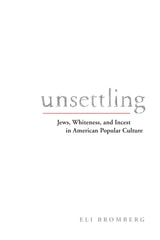
Unsettling
Jews, Whiteness, and Incest in American Popular CultureEli Bromberg
Rutgers University Press, 2021
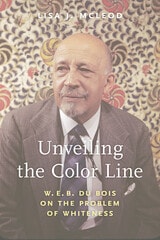
Unveiling the Color Line
W. E. B. Du Bois on the Problem of WhitenessLisa J. McLeod
University of Massachusetts Press, 2024
In The Souls of Black Folk, W. E. B. Du Bois brilliantly details the African American experience. Yet the renowned sociologist was also an astute chronicler of white people, particularly their racism. As Unveiling the Color Line demonstrates, Du Bois’s trenchant analysis of whiteness and white supremacy began in his earliest work—his 1890 speech on Jefferson Davis—and continued in every major book he published in his more than sixty-year career, up to The Black Flame Trilogy.
Lisa J. McLeod traces the development of Du Bois’s conception of whiteness, and the racism inherent to it, as an all-encompassing problem, whether predicated on ignorance, moral failure, or the inability to recognize the humanity in other people. In clear, elegant prose, McLeod investigates Du Bois’s complex and nuanced thinking, putting his insights into dialogue with contemporary racial theorists to demonstrate his continuing value to present-day critical thought and activism.