376 books match the query 'Racism' and 6 start with u
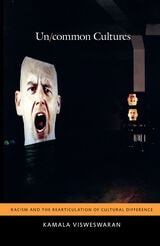
cover of Un/common Cultures: Racism and the Rearticulation of Cultural Difference

Un/common Cultures

Racism and the Rearticulation of Cultural Difference

Kamala Visweswaran

Duke University Press, 2010
In Un/common Cultures, Kamala Visweswaran develops an incisive critique of the idea of culture at the heart of anthropology, describing how it lends itself to culturalist assumptions. She holds that the new culturalism—the idea that cultural differences are definitive, and thus divisive—produces a view of “uncommon cultures” defined by relations of conflict rather than forms of collaboration. The essays in Un/common Cultures straddle the line between an analysis of how racism works to form the idea of “uncommon cultures” and a reaffirmation of the possibilities of “common cultures,” those that enact new forms of solidarity in seeking common cause. Such “cultures in common” or “cultures of the common” also produce new intellectual formations that demand different analytic frames for understanding their emergence. By tracking the emergence and circulation of the culture concept in American anthropology and Indian and French sociology, Visweswaran offers an alternative to strictly disciplinary histories. She uses critical race theory to locate the intersection between ethnic/diaspora studies and area studies as a generative site for addressing the formation of culturalist discourses. In so doing, she interprets the work of social scientists and intellectuals such as Elsie Clews Parsons, Alice Fletcher, Franz Boas, Louis Dumont, Claude Lévi-Strauss, Clifford Geertz, W. E. B. Du Bois, and B. R. Ambedkar.
[more]
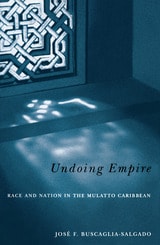
cover of Undoing Empire: Race And Nation In The Mulatto Caribbean

Undoing Empire

Race And Nation In The Mulatto Caribbean

Jose F. Buscaglia-Salgado

University of Minnesota Press, 2003

A revelatory account that places mulatto experience at the center of Caribbean history

This ambitious book brings to light the story of what José F. Buscaglia-Salgado terms mulataje—the ways Caribbean aesthetics offer the possibility of the ultimate erasure of racial difference. Undoing Empire gives a broad panorama stretching from the complex politics of medieval Iberian societies to the beginning of direct U.S. hegemony in the Caribbean at the end of the nineteenth century.

Buscaglia-Salgado begins with an examination of Washington Irving’s “American Columbiad” as an act of historical and territorial plundering. He then traces the roots of mulatto society to the pre-1492 Iberian world, not only finding a connection between the Moors of “Old Spain” and the morenos—the blacks and mulattoes of the New World—but also offering a profound critique of creole and imperial discourses. Buscaglia-Salgado reads the pursuit and contestation of what he terms the European Ideal in colonial texts, architecture, and paintings, then identifies the mulatto movement of “undoing” the Ideal in the wars that shook the nineteenth-century Caribbean from Haiti to Cuba, arguing that certain projects of national liberation have moved contrary to the historical claims to freedom in the mulatto world.
[more]
cover of Unequal City: Race, Schools, and Perceptions of Injustice

Unequal City

Race, Schools, and Perceptions of Injustice

Carla Shedd is assistant professor of sociology and African American studies at Columbia University.

Russell Sage Foundation, 2015

Chicago has long struggled with racial residential segregation, high rates of poverty, and deepening class stratification, and it can be a challenging place for adolescents to grow up. Unequal City examines the ways in which Chicago’s most vulnerable residents navigate their neighborhoods, life opportunities, and encounters with the law. In this pioneering analysis of the intersection of race, place, and opportunity, sociologist and criminal justice expert Carla Shedd illuminates how schools either reinforce or ameliorate the social inequalities that shape the worlds of these adolescents.

Shedd draws from an array of data and in-depth interviews with Chicago youth to offer new insight into this understudied group. Focusing on four public high schools with differing student bodies, Shedd reveals how the predominantly low-income African American students at one school encounter obstacles their more affluent, white counterparts on the other side of the city do not face. Teens often travel long distances to attend school which, due to Chicago’s segregated and highly unequal neighborhoods, can involve crossing class, race, and gang lines. As Shedd explains, the disadvantaged teens who traverse these boundaries daily develop a keen “perception of injustice,” or the recognition that their economic and educational opportunities are restricted by their place in the social hierarchy.

Adolescents’ worldviews are also influenced by encounters with law enforcement while traveling to school and during school hours. Shedd tracks the rise of metal detectors, surveillance cameras, and pat-downs at certain Chicago schools. Along with police procedures like stop-and-frisk, these prison-like practices lead to distrust of authority and feelings of powerlessness among the adolescents who experience mistreatment either firsthand or vicariously. Shedd finds that the racial composition of the student body profoundly shapes students’ perceptions of injustice. The more diverse a school is, the more likely its students of color will recognize whether they are subject to discriminatory treatment. By contrast, African American and Hispanic youth whose schools and neighborhoods are both highly segregated and highly policed are less likely to understand their individual and group disadvantage due to their lack of exposure to youth of differing backgrounds.
[more]
cover of Uneven Encounters: Making Race and Nation in Brazil and the United States

Uneven Encounters

Making Race and Nation in Brazil and the United States

Micol Seigel

Duke University Press, 2009

In Uneven Encounters, Micol Seigel chronicles the exchange of popular culture between Brazil and the United States in the years between the World Wars, and demonstrates how that exchange affected ideas of race and nation in both countries. From Americans interpreting advertisements for Brazilian coffee or dancing the Brazilian maxixe, to Rio musicians embracing the “foreign” qualities of jazz, Seigel traces a lively, cultural back and forth. Along the way, she shows how race and nation for both elites and non-elites are constructed together, and driven by global cultural and intellectual currents as well as local, regional, and national ones.

Seigel explores the circulation of images of Brazilian coffee and of maxixe in the United States during the period just after the imperial expansions of the early twentieth century. Exoticist interpretations structured North Americans’ paradoxical sense of themselves as productive “consumer citizens.” Some people, however, could not simply assume the privileges of citizenship. In their struggles against racism, Afro-descended citizens living in Rio de Janeiro, São Paulo, New York, and Chicago encountered images and notions of each other, and found them useful. Seigel introduces readers to cosmopolitan Afro-Brazilians and African Americans who rarely traveled far from home but who nonetheless absorbed ideas from abroad. She suggests that studies comparing U.S. and Brazilian racial identities as two distinct constructions are misconceived. Racial formation transcends national borders; attempts to understand it must do the same.
[more]
cover of Unreconciled: From Racial Reconciliation to Racial Justice in Christian Evangelicalism

Unreconciled

From Racial Reconciliation to Racial Justice in Christian Evangelicalism

Andrea Smith

Duke University Press, 2019
In the 1990s, many evangelical Christian organizations and church leaders began to acknowledge their long history of racism and launched efforts at becoming more inclusive of people of color. While much of this racial reconciliation movement has not directly confronted systemic racism's structural causes, there exists a smaller countermovement within evangelicalism, primarily led by women of color who are actively engaged in antiracism and social justice struggles. In Unreconciled Andrea Smith examines these movements through a critical ethnic studies lens, evaluating the varying degrees to which evangelical communities that were founded on white supremacy have addressed racism. Drawing on evangelical publications, sermons, and organization statements, as well as ethnographic fieldwork and participation in evangelical events, Smith shows how evangelicalism is largely unable to effectively challenge white supremacy due to its reliance upon discourses of whiteness. At the same time, the work of progressive evangelical women of color not only demonstrates that evangelical Christianity can be an unexpected place in which to find theoretical critique and social justice organizing but also shows how critical ethnic studies' interventions can be applied broadly across political and religious divides outside the academy.
[more]
cover of Unwelcome Shores: Black Refugees in America

Unwelcome Shores

Black Refugees in America

Bernadette Ludwig

Rutgers University Press, 2026

Unwelcome Shores is an ethnographic study of the Liberian refugee community in Staten Island, New York, home to the largest per capita concentration of Liberians in the U.S., that sheds light on the racialization of Black refugees and the racism they have experienced at every step of their migration journey. In this pioneering study, sociologist Bernadette Ludwig explores how Liberians have responded to such racist exclusions, noting how members of this community reject the informal refugee label once they are resettled in the United States. Liberian migrants often view the label as a liability since the larger general public, the media, and the U.S. government tend to regard Black refugees as an economic and social burden unworthy of assistance. Indeed, Black refugees’ humanity is often ignored, Ludwig contends, in favor of overemphasizing presumed barbaric violence, endemic wars, cultural backwardness, and diseases. By detailing the lack of aid and support for Black refugees and describing how Liberian refugees in particular have had to overcome various struggles and barriers in coming to the U.S. and while living here, Unwelcome Shores highlights the overarching role of race and anti-Black racism in American society.
[more]