Results by title
76 books match the query 'Representation' and 2 start with u
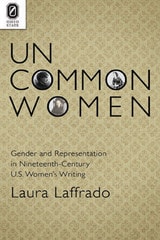
Uncommon Women
Gender and Representation in Nineteenth-Century U.S. Women's WritingLaura Laffrado
The Ohio State University Press, 2009
Uncommon Women discusses provocative, highly readable, nineteenth-century American texts that complicate notions of self-writing and female agency. This feminist study considers the generic forms, language, and illustrations of a group of complex and often daring texts, including Sarah Kemble Knight’s unconventional travel Journal (1825); Fanny Fern’s controversial newspaper essays (1851–72); Civil War nurse Louisa May Alcott’s Hospital Sketches (1863); and cross-dressed soldier’s S. Emma E. Edmonds’s Nurseand Spy in the Union Army (1865), along with later women’s war reminiscences. The study concludes with a fresh reading of neglected aspects of Harriet Jacobs’s Incidents in the Life of a Slave Girl (1861), the primary Black female autobiographical text of the century, which fundamentally displays what whiteness enabled.
Uncommon Women reveals attempts of white middle-class women to both violate and align themselves with gendered assumptions. In doing so, it makes visible the ways in which these texts disputed restrictive female constructions, tested boundaries of race and class, and anticipated reaction to their disruptive discourses. The resulting conflicted self-representations illuminate the vexed contours of women’s autobiography.
This study’s findings make plain the impact of white/male discourses of gender on women’s self-narrativeand illustrate how unconventional women were pressured to embrace domesticity, heterosexuality, marriage, motherhood, and political passivity.
[more]

Urban Reform and Its Consequences
A Study in RepresentationSusan Welch and Timothy Bledsoe
University of Chicago Press, 1988
Throughout this century, reformers have fought to eliminate party control of city politics. As a result, the majority of American cities today elect council members in at-large and nonpartisan elections. This result of the turn-of-the-century Progressive movement, which worked for election rules that eliminated the power of the urban machine and the working class on which it was based, is today still a subject of lively debate. For example, in the mid-1980s, regular Democrats in Chicago sought to institute a nonpartisan mayoral election. Supporters thought that reform would make the electoral process more democratic, while opponents charged that it was meant to dilute the voting powers of blacks. Clearly, the effect of urban reform remains an important issue for scholars and politicians alike.
Susan Welch and Timothy Bledsoe clarify a portion of the debate by investigating how election structures affect candidates and the nature of representation. They examine the different effects of district versus at-large elections and of partisan versus nonpartisan elections. Who gets elected? Are representatives' socioeconomic status and party affiliation related to election form? Are election structures related to how those who are elected approach their jobs? Do they see themselves as representatives concerned with the good of the city as a whole?
Urban Reform and Its Consequences reports an unprecedented wealth of data drawn from a sample of nearly 1,000 council members and communities with populations between 50,000 and 1 million across 42 states. The sample includes communities that use a variety of election procedures. This study is therefore the most comprehensive and accurate to date.
Welch and Bledsoe conclude that nonpartisan and at-large elections do give city councils a more middle- and upper-middle-class character and have changed the way representatives view their jobs. Reform measures have not, however, produced councils that are significantly more conservative or more prone to conflict. Overall, the authors conclude that partisan and district elections are more likely to represent the whole community and to make the council more accountable to the electorate.
[more]