Results by title
165 books match the query 'Resistance' and 4 start with u
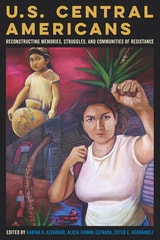
U.S. Central Americans
Reconstructing Memories, Struggles, and Communities of ResistanceEdited by Karina O. Alvarado, Alicia Ivonne Estrada, and Ester E. Hernández
University of Arizona Press, 2017
In summer 2014, a surge of unaccompanied child migrants from Central America to the United States gained mainstream visibility—yet migration from Central America has been happening for decades. U.S. Central Americans explores the shared yet distinctive experiences, histories, and cultures of 1.5-and second-generation Central Americans in the United States.
While much has been written about U.S. and Central American military, economic, and political relations, this is the first book to articulate the rich and dynamic cultures, stories, and historical memories of Central American communities in the United States. Contributors to this anthology—often writing from their own experiences as members of this community—articulate U.S. Central Americans’ unique identities as they also explore the contradictions found within this multivocal group.
Working from within Guatemalan, Salvadoran, and Maya communities, contributors to this critical study engage histories and transnational memories of Central Americans in public and intimate spaces through ethnographic, in-depth, semistructured, qualitative interviews, as well as literary and cultural analysis. The volume’s generational, spatial, urban, indigenous, women’s, migrant, and public and cultural memory foci contribute to the development of U.S. Central American thought, theory, and methods. Woven throughout the analysis, migrants’ own oral histories offer witness to the struggles of displacement, travel, navigation, and settlement of new terrain. This timely work addresses demographic changes both at universities and in cities throughout the United States.
U.S. Central Americans draws connections to fields of study such as history, political science, anthropology, ethnic studies, sociology, cultural studies, and literature, as well as diaspora and border studies. The volume is also accessible in size, scope, and language to educators and community and service workers wanting to know about their U.S. Central American families, neighbors, friends, students, employees, and clients.
Contributors:
Leisy Abrego
Karina O. Alvarado
Maritza E. Cárdenas
Alicia Ivonne Estrada
Ester E. Hernández
Floridalma Boj Lopez
Steven Osuna
Yajaira Padilla
Ana Patricia Rodríguez
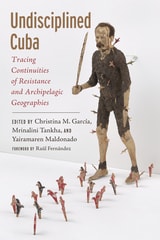
Undisciplined Cuba
Tracing Continuities of Resistance and Archipelagic GeographiesChristina M. García
Rutgers University Press, 2027
Undisciplined Cuba brings scholars of diverse disciplines and moves through multiple temporalities and geographies, allowing Cuba to emerge as a negotiated reality. Rather than rehearse narratives of exceptionalism and Cold War relationships that have detached the nation from its Antillean neighbors, this edited volume understands Cuba as deeply embedded in the Caribbean archipelago. Its chapters encompass feminist activism, public health, cinema for social justice, marine geopoetics, racial geographies, and literary corporealities. Drawing from an archipelagic framework and a decolonial practice of undisciplining, the anthology counters the tendency to treat landscapes, and cultural and political manifestations as artifacts of a national identity or evidence of a discrete geopolitical entity. Instead, Undisciplined Cuba attends to processes, to dynamic relations and continuities of resistance that defy periodization and institutional representation. The book offers a granular view of Cuba and an approach to Caribbean studies that imagines networks in excess of traditional categories of thought.
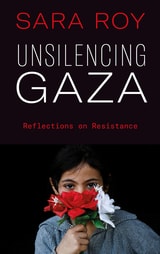
Unsilencing Gaza
Reflections on ResistanceSara Roy
Pluto Press, 2021
Gaza, the centre of Palestinian nationalism and resistance to the occupation, is the linchpin of the Israeli-Palestinian conflict and the key to its resolution. Since 2005, Israel has deepened the isolation of the territory, severing it almost completely from its most vital connections to the West Bank, Israel and beyond, and has deliberately shattered its economy, transforming Palestinians from a people with political rights into a humanitarian problem.
Sara Roy unpacks this process, looking at US foreign policy towards the Palestinians, as well as analysing the trajectory of Israeli policy toward Gaza, which became a series of punitive approaches meant not only to contain the Hamas regime but weaken Gazan society.
Roy also reflects on Gaza's ruination from a Jewish perspective and discusses the connections between Gaza's history and her own as a child of Holocaust survivors. This book, a follow up from the renowned Failing Peace, comes from one of the world's most acclaimed writers on the region.