Results by title
53 books match the query 'Revolutionaries' and 2 start with u
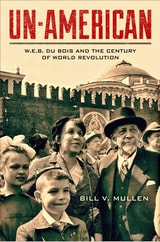
Un-American
W.E.B. Du Bois and the Century of World RevolutionBill V Mullen
Temple University Press, 2015
Un-American is Bill Mullen’s revisionist account of renowned author and activist W.E.B. Du Bois’s political thought toward the end of his life, a period largely dismissed and neglected by scholars. He describes Du Bois’s support for what the Communist International called “world revolution” as the primary objective of this aged radical’s activism. Du Bois was a champion of the world’s laboring millions and critic of the Cold War, a man dedicated to animating global political revolution.
Mullen argues that Du Bois believed that the Cold War stalemate could create the conditions in which the world powers could achieve not only peace but workers’ democracy. Un-American shows Du Bois to be deeply engaged in international networks and personal relationships with revolutionaries in India, China, and Africa. Mullen explores how thinkers like Karl Marx, Jawaharlal Nehru, Mohandas Gandhi, and C.L.R. James helped him develop a theory of world revolution at a stage in his life when most commentators regard him as marginalized. This original political biography also challenges assessments of Du Bois as an American “race man.”

Unruly Women
200 Years of Philosophers, Romantics, and RevolutionariesKristin Gjesdal
University of Chicago Press, 0
A vivid account of the powerful ideas and remarkable lives of eleven women philosophers across two centuries.
When you think of modern philosophers, who comes to mind? Likely, they are popular figures such as Kant, Hegel, Marx, and Nietzsche. But what if the history of philosophy we know is missing some of its most vital voices?
As Kristin Gjesdal shows us in Unruly Women, there is an abundance of important thinkers who were famous in their time, helped shape philosophy as we know it, and yet have been pushed into oblivion. She introduces eleven iconic women philosophers, from Germaine de Staël in Paris during the French Revolution to Angela Davis during the Black freedom movement in the US, whose ideas challenged and revolutionized the intellectual orthodoxies of their time. Moving across centuries, traditions, and political contexts, Unruly Women illustrates how the work of these philosophers engaged with questions that remain urgent now: What does freedom imply? How are power and inequality produced and sustained? What roles do gender, race, and class play in shaping our lives? And who gets to define what counts as knowledge, reason, and philosophy?
More than just an act of historical recovery, this book places these forgotten thinkers in conversation with one another, revealing a new history of philosophy—one shaped not only by abstract systems and canonical texts, but also by struggles over justice, emancipation, and political change. The result is a vibrant and accessible account of philosophy as something lived, contested, and deeply connected to the world around us—with unruly ideas that still matter today.