Results by title
51 books match the query 'Rights' and 3 start with u
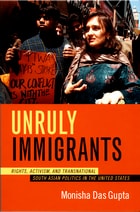
Unruly Immigrants
Rights, Activism, and Transnational South Asian Politics in the United StatesMonisha Das Gupta
Duke University Press, 2006
Das Gupta offers an ethnography of seven South Asian organizations in the northeastern United States, looking at their development and politics as well as the conflicts that have emerged within the groups over questions of sexual, class, and political identities. She examines the ways that women’s organizations have defined and responded to questions of domestic violence as they relate to women’s immigration status; she describes the construction of a transnational South Asian queer identity and culture by people often marginalized by both mainstream South Asian and queer communities in the United States; and she draws attention to the efforts of labor groups who have sought economic justice for taxi drivers and domestic workers by confronting local policies that exploit cheap immigrant labor. Responding to the shortcomings of the state, their communities, and the larger social movements of which they are a part, these groups challenge the assumption that citizenship is the necessary basis of rights claims.
Unsettling Choice
Race, Rights, and the Partitioning of Public EducationUjju Aggarwal
University of Minnesota Press, 2024
How the Great Recession revealed a system of school choice built on crisis, precarity, and exclusion
What do universal rights to public goods like education mean when codified as individual, private choices? Is the “problem” of school choice actually not about better choices for all but, rather, about the competition and exclusion that choice engenders—guaranteeing a system of winners and losers? Unsettling Choice addresses such questions through a compelling ethnography that illuminates how one path of neoliberal restructuring in the United States emerged in tandem with, and in response to, the Civil Rights movement.
Drawing on ethnographic research in one New York City school district, Unsettling Choice traces the contestations that surfaced when, in the wake of the 2007–2009 Great Recession, public schools navigated austerity by expanding choice-based programs. Ujju Aggarwal argues that this strategy, positioned as “saving public schools,” mobilized mechanisms rooted in market logics to recruit families with economic capital on their side, thereby solidifying a public sphere that increasingly resembled the private—where contingency was anticipated and rights for some were marked by intensified precarity for poor and working-class Black and Latinx families.
As Unsettling Choice shows, these struggles over public schools—one of the last remaining universal public goods in the United States—were entrapped within neoliberal regimes that exceeded privatization and ensured exclusion even as they were couched in language of equity, diversity, care, and rights. And yet this richly detailed and engaging book also tracks an architecture of expansive rights, care, and belonging built among poor and working-class parents at a Head Start center, whose critique of choice helps us understand how we might struggle for—and reimagine—justice, and a public that remains to be won.
Retail e-book files for this title are screen-reader friendly with images accompanied by short alt text and/or extended descriptions.

Utility and Rights
R.G. Frey, Editor
University of Minnesota Press, 1984
Utility and Rights was first published in 1984. Minnesota Archive Editions uses digital technology to make long-unavailable books once again accessible, and are published unaltered from the original University of Minnesota Press editions.
At issue in the clash between utilitarianism and the theory of rights is a fundamental question about the theoretical underpinnings of moral and political philosophy. Is this structure to be utility-based—grounded in the general welfare—or is it to be based on individual moral and political rights, as critics of utilitarianism increasingly insist? The argument centers, in part, upon the fact that utilitarianism, with its emphasis upon outcomes and total utility in the world, seems to employ a value theory that offers no protection to persons and their vital interests.
The essays in this volume grapple with the main issues in this controversy. They share a common concern with the nature of rights and the ways in which various moral theories can accommodate them; some measure the degree to which utilitarianism can or cannot be modified to include rights. Eight of the eleven essays were written expressly for this book; all of the authors are deeply engaged in the debate over utility and rights, and their essays build upon and extend current thinking on the subject. R. G. Frey's lucid introduction will make the book appropriate for advanced students as well as for scholars in moral, political, and legal theory.
"One ubiquitous criticism of utilitarianism is that it cannot make sense of moral rights at all. This collection is the first that explicitly addresses these issues, and it marks a major step in the debate."–Dale Jamieson, University of Colorado
R. G. Frey is senior lecturer in philosophy at the University of Liverpool. He is the author of Interests and Rights and Rights, Killing, and Suffering.