Results by title
131 books match the query 'Sex role in literature' and 2 start with u
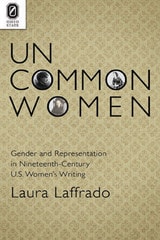
Uncommon Women
Gender and Representation in Nineteenth-Century U.S. Women's WritingLaura Laffrado
The Ohio State University Press, 2009
Uncommon Women discusses provocative, highly readable, nineteenth-century American texts that complicate notions of self-writing and female agency. This feminist study considers the generic forms, language, and illustrations of a group of complex and often daring texts, including Sarah Kemble Knight’s unconventional travel Journal (1825); Fanny Fern’s controversial newspaper essays (1851–72); Civil War nurse Louisa May Alcott’s Hospital Sketches (1863); and cross-dressed soldier’s S. Emma E. Edmonds’s Nurseand Spy in the Union Army (1865), along with later women’s war reminiscences. The study concludes with a fresh reading of neglected aspects of Harriet Jacobs’s Incidents in the Life of a Slave Girl (1861), the primary Black female autobiographical text of the century, which fundamentally displays what whiteness enabled.
Uncommon Women reveals attempts of white middle-class women to both violate and align themselves with gendered assumptions. In doing so, it makes visible the ways in which these texts disputed restrictive female constructions, tested boundaries of race and class, and anticipated reaction to their disruptive discourses. The resulting conflicted self-representations illuminate the vexed contours of women’s autobiography.
This study’s findings make plain the impact of white/male discourses of gender on women’s self-narrativeand illustrate how unconventional women were pressured to embrace domesticity, heterosexuality, marriage, motherhood, and political passivity.
[more]
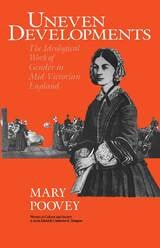
Uneven Developments
The Ideological Work of Gender in Mid-Victorian EnglandMary Poovey
University of Chicago Press, 1988
Mary Poovey's The Proper Lady and the Woman Writer has become a standard text in feminist literary discourse. In Uneven Developments Poovey turns to broader historical concerns in an analysis of how notions of gender shape ideology.
Asserting that the organization of sexual difference is a social, not natural, phenomenon, Poovey shows how representations of gender took the form of a binary opposition in mid-Victorian culture. She then reveals the role of this opposition in various discourses and institutions—medical, legal, moral, and literary. The resulting oppositions, partly because they depended on the subordination of one term to another, were always unstable. Poovey contends that this instability helps explain why various institutional versions of binary logic developed unevenly. This unevenness, in turn, helped to account for the emergence in the 1850s of a genuine oppositional voice: the voice of an organized, politicized feminist movement.
Drawing on a wide range of sources—parliamentary debates, novels, medical lectures, feminist analyses of work, middle-class periodicals on demesticity—Poovey examines various controversies that provide glimpses of the ways in which representations of gender were simultaneously constructed, deployed, and contested. These include debates about the use of chloroform in childbirth, the first divorce law, the professional status of writers, the plight of governesses, and the nature of the nursing corps. Uneven Developments is a contribution to the feminist analysis of culture and ideology that challenges the isolation of literary texts from other kinds of writing and the isolation of women's issues from economic and political histories.
[more]