Results by title
87 books match the query 'Sexual minorities' and 4 start with u
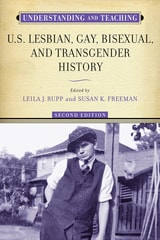
Understanding and Teaching U.S. Lesbian, Gay, Bisexual, and Transgender History
Edited by Leila J. Rupp and Susan K. Freeman
University of Wisconsin Press, 2017
Taking into account recent historic changes, this second edition updates the essays on the Supreme Court, same-sex marriage, the Right, and trans history. Authors of several other essays have taken the opportunity to add new material and references where warranted.
[more]
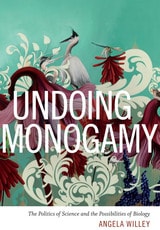
Undoing Monogamy
The Politics of Science and the Possibilities of BiologyAngela Willey
Duke University Press, 2016
In Undoing Monogamy Angela Willey offers a radically interdisciplinary exploration of the concept of monogamy in U.S. science and culture, propelled by queer feminist desires for new modes of conceptualization and new forms of belonging. She approaches the politics and materiality of monogamy as intertwined with one another such that disciplinary ways of knowing themselves become an object of critical inquiry. Refusing to answer the naturalization of monogamy with a naturalization of nonmonogamy, Willey demands a critical reorientation toward the monogamy question in the natural sciences, social sciences, and humanities. The book examines colonial sexual science, monogamous voles, polyamory, and the work of Alison Bechdel and Audre Lorde to show how challenging the lens through which human nature is seen as monogamous or nonmonogamous forces us to reconsider our investments in coupling and in disciplinary notions of biological bodies.
[more]
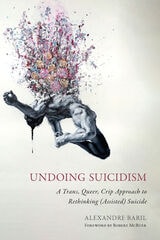
Undoing Suicidism
A Trans, Queer, Crip Approach to Rethinking (Assisted) SuicideAlexandre Baril
Temple University Press, 2023
In Undoing Suicidism, Alexandre Baril argues that suicidal people are oppressed by what he calls structural suicidism, a hidden oppression that, until now, has been unnamed and under-theorized. Each year, suicidism and its preventionist script and strategies reproduce violence and cause additional harm and death among suicidal people through forms of criminalization, incarceration, discrimination, stigmatization, and pathologization. This is particularly true for marginalized groups experiencing multiple oppressions, including queer, trans, disabled, or Mad people.
Undoing Suicidism questions the belief that the best way to help suicidal people is through the logic of prevention. Alexandre Baril presents the thought-provoking argument that supporting assisted suicide for suicidal people could better prevent unnecessary deaths. Offering a new queercrip model of (assisted) suicide, he invites us to imagine what could happen if we started thinking about (assisted) suicide from an anti-suicidist and intersectional framework.
Baril provides a radical reconceptualization of (assisted) suicide and invaluable reflections for academics, activists, practitioners, and policymakers.
[more]
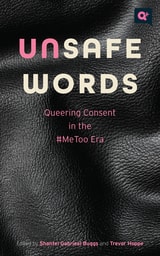
Unsafe Words
Queering Consent in the #MeToo EraShantel Gabrieal Buggs
Rutgers University Press, 2023
Queer people may not have invented sex, but queers have long been pioneers in imagining new ways to have it. Yet their voices have been largely absent from the #MeToo conversation. What can queer people learn from the #MeToo conversation? And what can queer communities teach the rest of the world about ethical sex? This provocative book brings together academics, activists, artists, and sex workers to tackle challenging questions about sex, power, consent, and harm. While responding to the need for sex to be consensual and mutually pleasurable, these chapter authors resist the heteronormative assumptions, class norms, and racial privilege underlying much #MeToo discourse. The essays reveal the tools that queer communities themselves have developed to practice ethical sex—from the sex worker negotiating with her client to the gay man having anonymous sex in the back room. At the same time, they explore how queer communities might better prevent and respond to sexual violence without recourse to a police force that is frequently racist, homophobic, and transphobic.
Telling a queerer side of the #MeToo story, Unsafe Words dares to challenge dogmatic assumptions about sex and consent while developing tools and language to promote more ethical and more pleasurable sex for everyone.
Telling a queerer side of the #MeToo story, Unsafe Words dares to challenge dogmatic assumptions about sex and consent while developing tools and language to promote more ethical and more pleasurable sex for everyone.
[more]