Results by title
238 books match the query 'Social Classes & Economic Disparity' and 3 start with u
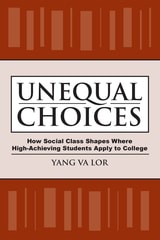
Unequal Choices
How Social Class Shapes Where High-Achieving Students Apply to CollegeYang Va Lor
Rutgers University Press, 2023
High-achieving students from socioeconomically disadvantaged backgrounds are more likely to end up at less selective institutions compared to their socioeconomically advantaged peers with similar academic qualifications. A key reason for this is that few highly able, socioeconomically disadvantaged students apply to selective institutions in the first place. In Unequal Choices, Yang Va Lor examines the college application choices of high-achieving students, looking closely at the ways the larger contexts of family, school, and community influence their decisions. For students today, contexts like high schools and college preparation programs shape the type of colleges that they deem appropriate, while family upbringing and personal experiences influence how far from home students imagine they can apply to college. Additionally, several mechanisms reinforce the reproduction of social inequality, showing how institutions and families of the middle and upper-middle class work to procure advantages by cultivating dispositions among their children for specific types of higher education opportunities.
[more]
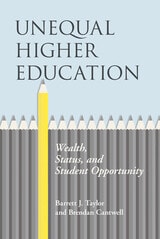
Unequal Higher Education
Wealth, Status, and Student OpportunityBarrett J. Taylor
Rutgers University Press, 2019
American higher education is often understood as a vehicle for social advancement. However, the institutions at which students enroll differ widely from one another. Some enjoy tremendous endowment savings and/or collect resources via research, which then offsets the funds that students contribute. Other institutions rely heavily on student tuition payments. These schools may struggle to remain solvent, and their students often bear the lion’s share of educational costs. Unequal Higher Education identifies and explains the sources of stratification that differentiate colleges and universities in the United States. Barrett J. Taylor and Brendan Cantwell use quantitative analysis to map the contours of this system. They then explain the mechanisms that sustain it and illustrate the ways in which rising institutional inequality has limited individual opportunity, especially for students of color and low-income individuals.
[more]
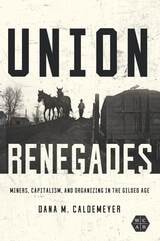
Union Renegades
Miners, Capitalism, and Organizing in the Gilded AgeDana M. Caldemeyer
University of Illinois Press, 2021
In the late nineteenth century, Midwestern miners often had to decide if joining a union was in their interest. Arguing that these workers were neither pro-union nor anti-union, Dana M. Caldemeyer shows that they acted according to what they believed would benefit them and their families. As corporations moved to control coal markets and unions sought to centralize their organizations to check corporate control, workers were often caught between these institutions and sided with whichever one offered the best advantage in the moment. Workers chased profits while paying union dues, rejected national unions while forming local orders, and broke strikes while claiming to be union members. This pragmatic form of unionism differed from what union leaders expected of rank-and-file members, but for many workers the choice to follow or reject union orders was a path to better pay, stability, and independence in an otherwise unstable age.
Nuanced and eye-opening, Union Renegades challenges popular notions of workers attitudes during the Gilded Age.
[more]