Results by title
862 books match the query 'Social History' and 13 start with u
Under Eastern Eyes
A Comparative History of East European Travel Writing on EuropeAlex Drace-Francis
Central European University Press, 2008
Undercut
Cut Glass in Working-Class Life During the Long Gilded AgeJoseph Larnerd
University of Delaware Press, 0
How did workers experience cut glass during its cultural heyday? Rather than privilege the stories of factory owners or wealthy consumers, Undercut: Cut Glass in Working-Class Life During the Long Gilded Age refracts the medium’s history through the labors required to make and maintain these dazzling artifacts as well as popular representations of this work, from demonstrations at world's fairs to images of domestic workers with finished pieces in their charge. Cut glass and the many manifestations of public interest in its labors offered working people, too, occasions for self-reflection and, perhaps, self-realization. Foregrounding their lives, Undercut offers a multifaceted social art history of a once-popular genre of decorative art that cuts across class, gender, and race.
Underground Leviathan
Corporate Sovereignty and Mining in the AmericasIsrael G. Solares
University of Nevada Press, 2024
Author Israel G. Solares examines how the twentieth century multinational firm established and articulated multinational corporate sovereignty in ways that reflect other multinational titans, like the East Asian Trade companies, and presages the digital giants and space corporations of the twenty-first century. Bridging the domineering practices used during the colonization of Southern Asia with the futuristic colonies on the Moon, Underground Leviathan documents the cost of a corporation’s unyielding desire to consume the secrets at the center of the Earth.
Underground Movements
Modern Culture on the New York City SubwaySunny Stalter-Pace
University of Massachusetts Press, 2013
Writers and artists took up questions that originated in the sphere of urban planning to explore how underground movement changed the ways people understand the city. Modern poets envisioned the subway as a space of literary innovation; playwrights and fiction writers used it to gauge the consequences of migration and immigration; and essayists found that it underscored the fragile relationship between urban development and memory. Even today, the symbolic associations forged by these early texts continue to influence understanding of the cultural significance of the subway and the city it connects.
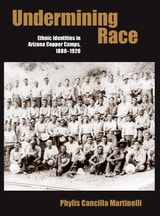
Undermining Race
Ethnic Identities in Arizona Copper Camps, 1880–1920Phylis Cancilla Martinelli
University of Arizona Press, 2009
Phylis Martinelli argues that the case of Italians in Arizona provides insight into “in between” racial and ethnic categories, demonstrating that the categorizing of Italians varied from camp to camp depending on local conditions—such as management practices in structuring labor markets and workers’ housing, and the choices made by immigrants in forging communities of language and mutual support. Italians—even light-skinned northern Italians—were not considered completely “white” in Arizona at this historical moment, yet neither were they consistently racialized as non-white, and tactics used to control them ranged from micro to macro level violence.
To make her argument, Martinelli looks closely at two “white camps” in Globe and Bisbee and at the Mexican camp of Clifton-Morenci. Comparing and contrasting the placement of Italians in these three camps shows how the usual binary system of race relations became complicated, which in turn affected the existing race-based labor hierarchy, especially during strikes. The book provides additional case studies to argue that the biracial stratification system in the United States was in fact triracial at times. According to Martinelli, this system determined the nature of the associations among laborers as well as the way Americans came to construct “whiteness.”
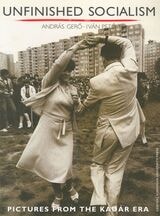
Unfinished Socialism
Pictures from the Kádár EraAndrás Gero
Central European University Press, 1999
This extraordinary book provides a snapshot of socialism throughout the Kádár regime in Hungary (1956-1989) and captures the essence of the world behind the ‘iron curtain’ in a stunning, and often stark, collection of photographs.
Unfinished Socialism is a visually stunning anthropological study containing 450 photographs, many previously unpublished, which portray life in Hungary from every angle: from the May Day March to pop music and from the homeless to sport.
With an introduction that will help the reader understand and appreciate the true meaning of the photographs, this political, social and cultural study of the Kádár years transports the reader back to a time of great significance in Hungary’s long and turbulent history.

Unfit For Marriage
Impotent Spouses On Trial In The Basque Region Of Spain, 1650-1750Edward J. Behrend-Martinez
University of Nevada Press, 2014
The Catholic Church of early modern Europe intended the sacrament of matrimony to represent a lifelong commitment, and it allowed few grounds for the dissolution of an unhappy marriage. One was nonconsummation owing to the sexual impotency of one of the partners. Even then, an annulment was granted only after a church court had conducted a lengthy investigation of the case, soliciting testimony from numerous witnesses as well as from the aggrieved couple, and had subjected the allegedly impotent spouse (and sometimes both spouses) to an intimate physical examination.
Edward J. Behrend-Martinez has studied the transcripts of eighty-three impotency trials conducted by the ecclesiastical court of Calahorra (La Rioja), a Spanish diocese with urban and rural parishes, both Basque and Castilian. From these records, he draws a detailed, fascinating portrait of private life and public sexuality in early modern Europe. These trials were far more than a salacious inquiry into the intimate details of other people’s lives. The church valued marital sex as a cornerstone of stable society, intended not only for procreation but also for maintaining domestic harmony. Every couple’s sex life, however private in practice or intention, was a matter of public and ecclesiastical concern. Unfit for Marriage offers vivid accounts of marital sex and the role that property, gender, and personal preference played in marriage in early modern Europe. It is essential reading for anyone interested in social history, sexuality, gender studies, canon law, legal history, and the history of divorce in western Europe.
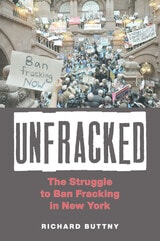
Unfracked
The Struggle to Ban Fracking in New YorkRichard Buttny
University of Massachusetts Press, 2024
Since fracking emerged as a way of extracting natural gas, through intense deep drilling and the use of millions of gallons of water and chemicals to fracture shale, it has been controversial. It is perceived in different ways by different people—by some as an opportunity for increased resources and possibly jobs and other income; by others as a public health and environmental threat; and for many, an unknown. Richard Buttny, a scholar who works on rhetoric and discursive practices, read a story in his local paper in New York about hydrofracking coming to his area and had to research what it was, and what it could mean for his community. Soon he joined neighbors in fighting to have the practice banned state-wide. At the same time, he turned his scholarly eye to the messaging from both sides of the fight, using first-person accounts, interviews, and media coverage.
The activists fighting fracking won. New York is now the only state in the US with sizable deposits of natural gas that has banned hydraulic fracturing, or fracking. Unfracked explains the competing rhetoric and discourses on fracking among New York-based advocates, experts, the grassroots, and political officials. Buttny examines how these positions evolved over time and how eventually the state arrived at a decision to ban this extractive technology. His accessible approach provides both a historical recounting of the key events of this seven-year conflict, along with four in-depth case studies: a grassroots citizen group, a public hearing with medical physicians, a key intergovernmental hearing, and a formal debate among experts. The result is a look at a very recent, important historical moment and a useful examination of environmental activist and fossil fuel advocate rhetoric around an issue that continues to cause debate nationwide.
Unrefined
How Capitalism Reinvented SugarDavid Singerman
University of Chicago Press, 2025
Sugar is everywhere in the western diet, blamed for epidemics of obesity, diabetes, and other modern maladies. Our addiction to sweetness has a long and unsavory history. Over the past five hundred years, sugar has shaped empires, made fortunes for a few, and brought misery for millions of workers both enslaved and free. How did sugar become a defining modern food and an essential global commodity?
In Unrefined, David Singerman recasts our thinking about this crucial substance in the history of capitalism. Before the nineteenth century, sugar’s value depended on natural qualities: its color, its taste, where it was grown, and who had made it. But beginning around 1850, a combination of plantation owners, industrialists, and scientists set out to redefine sugar itself. Deploying the tools and rhetoric of science, they transformed not just how sugar was produced or traded but even how people thought about it. By changing sugar into a pure chemical object, these forces stripped power from workers and enabled—and obscured—new kinds of fraud, corruption, and monopoly.
Taking us to unexplored spaces in the world of sugar, from laboratories and docks to refineries and the halls of Congress, Singerman illuminates dark intersections of the histories of corruption, science, and capitalism.
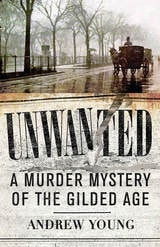
Unwanted
A Murder Mystery of the Gilded AgeAndrew Young
Westholme Publishing, 2016
On the foggy, cold morning of February 1, 1896, a boy came upon what he thought was a pile of clothes. It was soon discovered to be the headless body of a young woman, brutally butchered and discarded. She was found just across the river from one of the largest cities in the country, Cincinnati, Ohio. Soon the authorities, the newspapers, and the public were obsessed with finding the poor girl’s identity and killer. Misinformation and rumor spread wildly around the case and led authorities down countless wrong paths. Initially, it appeared the crime would go unsolved. An autopsy, however, revealed that the victim was four months pregnant, presenting a possible motive. It would take the hard work of a sheriff, two detectives, and the unlikely dedication of a shoe dealer to find out who the girl was; and once she had been identified, the case came together. Within a short time the police believed they had her killers—a handsome and charismatic dental student and his roommate—and enough evidence to convict them of first-degree murder. While the suspects seemed to implicate themselves, the police never got a clear answer as to what exactly happened to the girl and they were never able to find her lost head—despite the recovery of a suspicious empty valise.
Centering his riveting new book, Unwanted: A Murder Mystery of the Gilded Age, around this shocking case and how it was solved, historian Andrew Young re-creates late nineteenth- century America, where Coca-Cola in bottles, newfangled movie houses, the Gibson Girl, and ragtime music played alongside prostitution, temperance, racism, homelessness, the rise of corporations, and the women’s rights movement. While the case inspired the sensationalized pulp novel Headless Horror, songs warning girls against falling in love with dangerous men, ghost stories, and the eerie practice of random pennies left heads up on a worn gravestone, the story of an unwanted young woman captures the contradictions of the Gilded Age as America stepped into a new century, and toward a modern age.
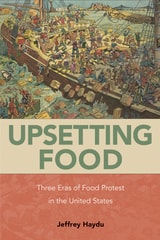
Upsetting Food
Three Eras of Food Protests in the United StatesJeffrey Haydu
Temple University Press, 2021
Battle lines have long been drawn over how food is produced, what food is made available to whom, and how best to protect consumers from risky or unhealthy food. Jeffrey Haydu resurrects the history of food reform and protest in Upsetting Food, showing how activists defined food problems, articulated solutions, and mobilized for change in the United States.
Haydu’s sociological history starts in the 1830s with diet reformer Sylvester Graham, who blamed alcohol and store-bought bread—signs of a commercializing urban society—for poor health and moral decline. His successors at the turn of the twentieth century rallied against impure food and pushed for women to be schooled in scientific food preparation and nutrition. Decades later, in the 1960s and ’70s, a grassroots movement for organic food battled commercial food production in favor of food grown ecologically, by small farmers, and without artificial chemicals.
Each campaign raised doubts about food safety, health, and transparency, reflecting how a capitalist system can undermine trust in food. But Haydu also considers how each movement reflects the politics, inequalities, and gender relations of its time. And he traces how outcomes of each campaign laid the groundwork for the next. The three eras thus come together as parts of a single, recurring food movement.
Upsetting Food offers readers a historical background to better understand contemporary and contentious food politics.
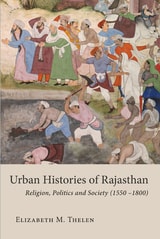
Urban Histories of Rajasthan
Religion, Politics and Society (1550–1800)Elizabeth M. Thelen
Gingko, 2022
Diverse peoples intermingled in the streets and markets of premodern Indian cities. This book considers how these diverse residents lived together and negotiated their differences. Which differences mattered, when and to whom? How did state actions and policies affect urban society and the lives of various communities? How and why did conflict occur in urban spaces? Through these questions, this book explores the histories of urban communities in the three cities of Ajmer, Nagaur, and Pushkar in Rajasthan, between the sixteenth and eighteenth centuries. The focus of this study is on everyday life, contextualizing religious practices and conflicts by considering patterns of patronage and broader conflict patterns within society. The book examines various archival documents, from family and institutional records to state registers, and uses these documents to demonstrate the complex and sometimes contradictory ways religion intersected with politics, economics, and society. The author shows how many patronage patterns and processes persisted in altered forms, and how the robustness of these structures contributed to the resilience of urban spaces and society in precolonial Rajasthan.
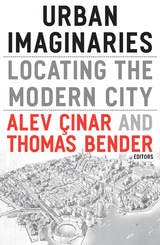
Urban Imaginaries
Locating the Modern CityAlev Cinar
University of Minnesota Press, 2007
For millennia, the city stood out against the landscape, walled and compact. This concept of the city was long accepted as adequate for characterizing the urban experience. However, the nature of the city, both real and imagined, has always been more permeable than this model reveals.
The essays in Urban Imaginaries respond to this condition by focusing on how social and physical space is conceived as both indefinite and singular. They emphasize the ways this space is shared and thus made into urban culture. Urban Imaginaries offers case studies on cities in Brazil, Israel, Turkey, Lebanon, and India, as well as in the United States and France, and in doing so blends social, cultural, and political approaches to better understand the contemporary urban experience.
Contributors: Margaret Cohen, Stanford U; Camilla Fojas, De Paul U; Beatriz Jaguaribe, Federal U of Rio de Janeiro; Anthony D. King, SUNY Binghamton; Mark LeVine, U of California, Irvine; Srirupa Roy, U of Massachusetts, Amherst; Seteney Shami, Social Science Research Council; AbdouMaliq Simone, New School U; Maha Yahya; Deniz Yükseker, Koç U, Istanbul.
Alev Çinar is associate professor of political science and public administration at Bilkent University, Turkey. Thomas Bender is university professor of the humanities and history at New York University.