322 books match the query 'Social change' and 5 start with u

cover of Uncertainties Of Knowledge

Uncertainties Of Knowledge

Immanuel Wallerstein

Temple University Press, 2004
The Uncertainties of Knowledge extends Immanuel Wallerstein's decade-long work of elucidating the crisis of knowledge in current intellectual thought. He argues that the disciplinary divisions of academia have trapped us in a paradigm that assumes knowledge is a certainty and that it can help us explain the social world. This is wrong, he suggests. Instead, Wallerstein offers a new conception of the social sciences, one whose methodology allows for uncertainties.
[more]
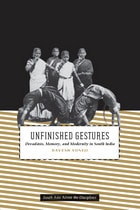
cover of Unfinished Gestures: Devadasis, Memory, and Modernity in South India

Unfinished Gestures

Devadasis, Memory, and Modernity in South India

Davesh Soneji

University of Chicago Press, 2011
 
Unfinished Gestures presents the social and cultural history of courtesans in South India who are generally called devadasis, focusing on their encounters with colonial modernity in the nineteenth and early twentieth centuries. Following a hundred years of vociferous social reform, including a 1947 law that criminalized their lifestyles, the women in devadasis communities contend with severe social stigma and economic and cultural disenfranchisement. Adroitly combining ethnographic fieldwork with historical research, Davesh Soneji provides a comprehensive portrait of these marginalized women and unsettles received ideas about relations among them, the aesthetic roots of their performances, and the political efficacy of social reform in their communities.
 
Poignantly narrating the history of these women, Soneji argues for the recognition of aesthetics and performance as a key form of subaltern self-presentation and self-consciousness. Ranging over courtly and private salon performances of music and dance by devadasis in the nineteenth century, the political mobilization of devadasis identity in the twentieth century, and the post-reform lives of women in these communities today, Unfinished Gestures charts the historical fissures that lie beneath cultural modernity in South India.
[more]
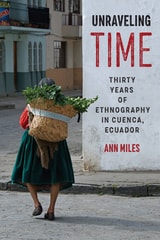
cover of Unraveling Time: Thirty Years of Ethnography in Cuenca, Ecuador

Unraveling Time

Thirty Years of Ethnography in Cuenca, Ecuador

Ann Miles

University of Texas Press, 2022

Ann Miles has been chronicling life in the Ecuadorian city of Cuenca for more than thirty years. In that time, she has witnessed change after change. A large regional capital where modern trains whisk residents past historic plazas, Cuenca has invited in the world and watched as its own citizens risk undocumented migration abroad. Families have arrived from rural towns only to then be displaced from the gentrifying city center. Over time, children have been educated, streetlights have made neighborhoods safer, and remittances from overseas have helped build new homes and sometimes torn people apart. Roads now connect people who once were far away, and talking or texting on cell phones has replaced hanging out at the corner store.

Unraveling Time traces the enduring consequences of political and social movements, transnational migration, and economic development in Cuenca. Miles reckons with details that often escape less committed observers, suggesting that we learn a good deal more when we look back on whole lives. Practicing what she calls an ethnography of accrual, Miles takes a long view, where decades of seemingly disparate experiences coalesce into cultural transformation. Her approach not only reveals what change has meant in a major Latin American city but also serves as a reflection on ethnography itself.
[more]
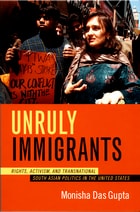
cover of Unruly Immigrants: Rights, Activism, and Transnational South Asian Politics in the United States

Unruly Immigrants

Rights, Activism, and Transnational South Asian Politics in the United States

Monisha Das Gupta

Duke University Press, 2006

In Unruly Immigrants, Monisha Das Gupta explores the innovative strategies that South Asian feminist, queer, and labor organizations in the United States have developed to assert claims to rights for immigrants without the privileges or security of citizenship. Since the 1980s many South Asian immigrants have found the India-centered “model minority” politics of previous generations inadequate to the task of redressing problems such as violence against women, homophobia, racism, and poverty. Thus they have devised new models of immigrant advocacy, seeking rights that are mobile rather than rooted in national membership, and advancing their claims as migrants rather than as citizens-to-be. Creating social justice organizations, they have inventively constructed a transnational complex of rights by drawing on local, national, and international laws to seek entitlements for their constituencies.

Das Gupta offers an ethnography of seven South Asian organizations in the northeastern United States, looking at their development and politics as well as the conflicts that have emerged within the groups over questions of sexual, class, and political identities. She examines the ways that women’s organizations have defined and responded to questions of domestic violence as they relate to women’s immigration status; she describes the construction of a transnational South Asian queer identity and culture by people often marginalized by both mainstream South Asian and queer communities in the United States; and she draws attention to the efforts of labor groups who have sought economic justice for taxi drivers and domestic workers by confronting local policies that exploit cheap immigrant labor. Responding to the shortcomings of the state, their communities, and the larger social movements of which they are a part, these groups challenge the assumption that citizenship is the necessary basis of rights claims.

[more]
cover of Using Media for Social Innovation

Using Media for Social Innovation

Aneta Podkalicka and Ellie Rennie

Intellect Books, 2018

This book offers a critical road map for understanding and researching “social innovation media”—initiatives that look for new solutions to seemingly intractable social problems by combining creativity, media technologies, and engaged collectives in their design and implementation. Presenting a number of case studies, including campaigns dealing with young people, Indigenous peoples, human rights, and environmental issues, the book takes a close look at the guiding principles, assumptions, goals, practices, and outcomes of these experiments, revealing the challenges they face, the components of their innovation, and the cultural economy within which they operate.
[more]