501 books match the query 'South' and 5 start with u
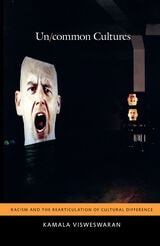
cover of Un/common Cultures: Racism and the Rearticulation of Cultural Difference

Un/common Cultures

Racism and the Rearticulation of Cultural Difference

Kamala Visweswaran

Duke University Press, 2010
In Un/common Cultures, Kamala Visweswaran develops an incisive critique of the idea of culture at the heart of anthropology, describing how it lends itself to culturalist assumptions. She holds that the new culturalism—the idea that cultural differences are definitive, and thus divisive—produces a view of “uncommon cultures” defined by relations of conflict rather than forms of collaboration. The essays in Un/common Cultures straddle the line between an analysis of how racism works to form the idea of “uncommon cultures” and a reaffirmation of the possibilities of “common cultures,” those that enact new forms of solidarity in seeking common cause. Such “cultures in common” or “cultures of the common” also produce new intellectual formations that demand different analytic frames for understanding their emergence. By tracking the emergence and circulation of the culture concept in American anthropology and Indian and French sociology, Visweswaran offers an alternative to strictly disciplinary histories. She uses critical race theory to locate the intersection between ethnic/diaspora studies and area studies as a generative site for addressing the formation of culturalist discourses. In so doing, she interprets the work of social scientists and intellectuals such as Elsie Clews Parsons, Alice Fletcher, Franz Boas, Louis Dumont, Claude Lévi-Strauss, Clifford Geertz, W. E. B. Du Bois, and B. R. Ambedkar.
[more]
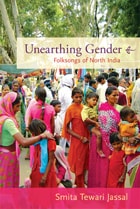
cover of Unearthing Gender: Folksongs of North India

Unearthing Gender

Folksongs of North India

Smita Tewari Jassal

Duke University Press, 2012

Unearthing Gender is a compelling ethnographic analysis of folksongs sung primarily by lower-caste women in north India, in the fields, at weddings, during travels, and in other settings. Smita Tewari Jassal uses these songs to explore how ideas of caste, gender, sexuality, labor, and power may be strengthened, questioned, and fine-tuned through music. At the heart of the book is a library of songs, in their original Bhojpuri and in English translation, framed by Jassal’s insights into the complexities of gender and power.

The significance of these folksongs, Jassal argues, lies in their suggesting and hinting at themes, rather than directly addressing them: women sing what they often cannot talk about. Women’s lives, their feelings, their relationships, and their social and familial bonds are persuasively presented in song. For the ethnographer, the songs offer an entry into the everyday cultures of marginalized groups of women who have rarely been the focus of systematic analytical inquiry.
[more]
cover of Unreasonable Histories: Nativism, Multiracial Lives, and the Genealogical Imagination in British Africa

Unreasonable Histories

Nativism, Multiracial Lives, and the Genealogical Imagination in British Africa

Christopher J. Lee

Duke University Press, 2015
In Unreasonable Histories, Christopher J. Lee unsettles the parameters and content of African studies as currently understood. At the book's core are the experiences of multiracial Africans in British Central Africa—contemporary Malawi, Zimbabwe, and Zambia—from the 1910s to the 1960s. Drawing on a spectrum of evidence—including organizational documents, court records, personal letters, commission reports, popular periodicals, photographs, and oral testimony—Lee traces the emergence of Anglo-African, Euro-African, and Eurafrican subjectivities which constituted a grassroots Afro-Britishness that defied colonial categories of native and non-native. Discriminated against and often impoverished, these subaltern communities crafted a genealogical imagination that reconfigured kinship and racial descent to make political claims and generate affective meaning. But these critical histories equally confront a postcolonial reason that has occluded these experiences, highlighting uneven imperial legacies that still remain. Based on research in five countries, Unreasonable Histories ultimately revisits foundational questions in the field, to argue for the continent's diverse heritage and to redefine the meanings of being African in the past and present—and for the future.
[more]
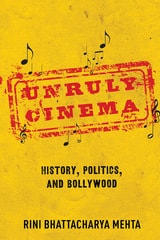
cover of Unruly Cinema: History, Politics, and Bollywood

Unruly Cinema

History, Politics, and Bollywood

Rini Bhattacharya Mehta

University of Illinois Press, 2020

Between 1931 and 2000, India's popular cinema steadily overcame Hollywood domination. Bollywood, the film industry centered in Mumbai, became nothing less than a global cultural juggernaut. But Bollywood is merely one part of the country's prolific, multilingual cinema. Unruly Cinema looks at the complex series of events that allowed the entire Indian film industry to defy attempts to control, reform, and refine it in the twentieth century and beyond.

Rini Bhattacharya Mehta considers four aspects of Indian cinema's complicated history. She begins with the industry's surprising, market-driven triumph over imports from Hollywood and elsewhere in the 1930s. From there she explores how the nationalist social melodrama outwitted the government with its 1950s cinematic lyrical manifestoes. In the 1970s, an action cinema centered on the angry young male co-opted the voice of the oppressed. Finally, Mehta examines Indian film's discovery of the global neoliberal aesthetic that encouraged the emergence of Bollywood.
[more]
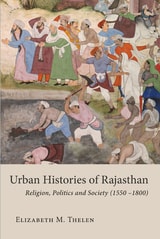
cover of Urban Histories of Rajasthan: Religion, Politics and Society (1550–1800)

Urban Histories of Rajasthan

Religion, Politics and Society (1550–1800)

Elizabeth M. Thelen

Gingko, 2022

An exploration of religious conflicts in premodern urban India.
 
Diverse peoples intermingled in the streets and markets of premodern Indian cities. This book considers how these diverse residents lived together and negotiated their differences. Which differences mattered, when and to whom? How did state actions and policies affect urban society and the lives of various communities? How and why did conflict occur in urban spaces? Through these questions, this book explores the histories of urban communities in the three cities of Ajmer, Nagaur, and Pushkar in Rajasthan, between the sixteenth and eighteenth centuries. The focus of this study is on everyday life, contextualizing religious practices and conflicts by considering patterns of patronage and broader conflict patterns within society. The book examines various archival documents, from family and institutional records to state registers, and uses these documents to demonstrate the complex and sometimes contradictory ways religion intersected with politics, economics, and society. The author shows how many patronage patterns and processes persisted in altered forms, and how the robustness of these structures contributed to the resilience of urban spaces and society in precolonial Rajasthan.
 
[more]