Results by title
100 books match the query 'Sovereignty' and 2 start with u
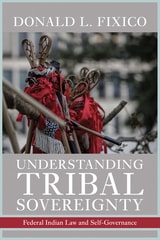
Understanding Tribal Sovereignty
Federal Indian Law and Self-GovernanceDonald L. Fixico
University of Arizona Press, 2026
What does tribal sovereignty really mean—and why does it matter today?
Accessibly written for the nonspecialist, acclaimed historian Donald L. Fixico unpacks the complex history and legal foundations of tribal sovereignty in the United States. From traditional Native governance to landmark treaties, federal laws, and court cases, Fixico guides readers through the evolution of tribal self-rule and its modern expressions—from tribal constitutions to license plates and casinos. Designed for students, educators, tribal members, and professionals alike, this book offers a clear, compelling introduction to one of the most important—and often misunderstood—concepts in American Indian affairs.
This book is a go-to source for understanding the federal Indian laws, treaties, and court cases simplified to explain tribal sovereignty.
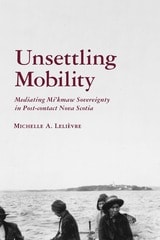
Unsettling Mobility
Mediating Mi’kmaw Sovereignty in Post-contact Nova ScotiaMichelle A. Lelièvre
University of Arizona Press, 2017
Since contact, attempts by institutions such as the British Crown and the Catholic Church to assimilate indigenous peoples have served to mark those people as “Other” than the settler majority. In Unsettling Mobility, Michelle A. Lelièvre examines how mobility has complicated, disrupted, and—at times—served this contradiction at the core of the settler colonial project.
Drawing on archaeological, ethnographic, and archival fieldwork conducted with the Pictou Landing First Nation—one of thirteen Mi’kmaw communities in Nova Scotia—Lelièvre argues that, for the British Crown and the Catholic Church, mobility has been required not only for the settlement of the colony but also for the management and conversion of the Mi’kmaq. For the Mi’kmaq, their continued mobility has served as a demonstration of sovereignty over their ancestral lands and waters despite the encroachment of European settlers.
Unsettling Mobility demonstrates the need for an anthropological theory of mobility that considers not only how people move from one place to another but also the values associated with such movements, and the sensual perceptions experienced by moving subjects. Unsettling Mobility argues that anthropologists, indigenous scholars, and policy makers must imagine settlement beyond sedentism. Rather, both mobile and sedentary practices, the narratives associated with those practices, and the embodied experiences of them contribute to how people make places—in other words, to how they settle.
Unsettling Mobility arrives at a moment when indigenous peoples in North America are increasingly using movement as a form of protest in ways that not only assert their political subjectivity but also remake the nature of that subjectivity.