Results by title
389 books match the query 'State' and 10 start with u
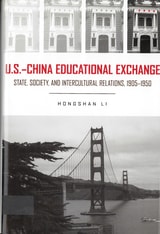
U.S.- China Educational Exchange
State, Society, and Intercultural Relations, 1905-1950Li, Hongshan
Rutgers University Press, 2007
U.S.-China relations became increasingly important and complex in the twentieth century. While economic, political, and military interactions all grew over time, the most dramatic expansion took place in educational exchange, turning it into the strongest tie between the two nations. By the end of the 1940s, tens of thousands of Chinese and American students and scholars had crisscrossed the Pacific, leaving indelible marks on both societies. Although all exchange programs were terminated during the cold war, the two nations reemerged as top partners within a decade after the reestablishment of diplomatic relations.
Approaching U.S.-China relations from a unique and usually overlooked perspective, Hongshan Li reveals that both the drastic expansion and complete termination of educational ties between the two nations in the first half of the twentieth century were largely the results of direct and deep intervention from the American and Chinese governments. Benefiting from government support and collaboration, educational exchange succeeded in diffusing knowledge and improving mutual understanding between the two peoples across the divide of civilizations. However, the visible hand of government also proved to be most destructive to the development of healthy intercultural relations when educational interactions were treated merely as an instrument for crisis management.
UW Struggle
When a State Attacks Its UniversityChuck Rybak
University of Minnesota Press, 2017
A Wisconsin story that serves as a national warning
UW Struggle provides an on-the-ground view of the smoldering attack on public higher education in Wisconsin. Chuck Rybak, who works in the University of Wisconsin System, provides important glimpses into the personal lives of those affected, the dismantling of tenure protections, the diminishment of shared governance, and how faculty remain the scapegoat for all of the university’s problems. This is a chronicle of failed leadership and what actions, if any, can protect this vital American institution.

Unattainable Bride Russia
Gendering Nation, State, and Intelligentsia in Russian Intellectual CultureEllen Rutten
Northwestern University Press, 2010
Throughout the twentieth century and continuing today, personifications of Russia as a bride occur in a wide range of Russian texts and visual representations, from literature and political and philosophical treatises to cartoons and tattoos. Invariably, this metaphor functions in the context of a political gender allegory, which represents the relationships between Russia, the intelligentsia, and the Russian state, as a competition of two male suitors for the former’s love.
In Unattainable Bride Russia, Ellen Rutten focuses on the metaphorical role the intelligentsia plays as Russia’s rejected or ineffectual suitor. Rutten finds that this metaphor, which she covers from its prehistory in folklore to present-day pop culture references to Vladimir Putin, is still powerful, but has generated scarce scholarly consideration. Unattainable Bride Russia locates the cultural thread and places the political metaphor in a broad contemporary and social context, thus paying it the attention to which it is entitled as one of Russia’s modern cultural myths.

Unbroken Ties
The State, Interest Associations, and Corporatism in Post-Soviet UkrainePaul Kubicek
University of Michigan Press, 2000
Since the collapse of communism in Eastern Europe and the former Soviet Union, there has been a spate of books--optimistic at first--highlighting the transitions to democracy in these countries and the leading role of "civil society" in pushing forward political and economic reform. This study explains why this transition did not take place as anticipated. In essence, organized labor in Ukraine is weak and has been co-opted by the state; in the meantime, leading groups of industrialists and agricultural collectives have strong political influence and shape policies in accordance with their interests. This is very similar to the situation in Russia.
In contrast to works that implicitly assume a pluralist model of development for state-society relations, Unbroken Ties employs corporatism as the basic organizing structure for the study of state-interest group relations in post-Soviet Ukraine. Finding that much of the Soviet "residue" still functions in Ukraine, it argues that a form of state corporatism, which envisions a major role for the state in structuring and controlling interest associations, captures much of the post-Soviet Ukrainian reality. Old groups persist and prosper due to a variety of ties with state elites, whereas new and independent groups find themselves marginalized.
This book will appeal to political scientists, economists, and sociologists studying the transformation of post-communist societies, as well as those interested in the broader, more comparative aspects of democratization and economic reform.
Paul Kubicek is Kenneth Boulding Post-Doctoral Fellow, University of Colorado, Boulder.
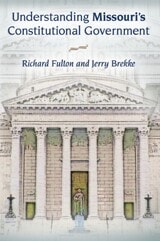
Understanding Missouri's Constitutional Government
Richard Fulton and Jerry Brekke
University of Missouri Press, 2010
Understanding Missouri’s Constitutional Government presents a case study in the foundations of state governments. The book provides a sweeping look at the constitutional foundations of the processes of Missouri government. Authors Richard Fulton and Jerry Brekke place Missouri within the context of our larger federal system while using the state’s constitution as a touchstone for the discussion of each element of state government.
Understanding Missouri’s Constitutional Government has a dual framework specifically designed to enhance the reader’s learning experience. First, the essential elements of government outlined in the constitution are introduced, and then analysis and interpretation of each of the document’s articles is covered. This organization permits readers to build an understanding of a particular element—for example, the legislature—by learning its fundamental organization, processes, and purposes in a straightforward manner. After gaining that primary perspective, the reader can use the formal analysis in the second section to explore interpretations of each article. Not only helpful to the general reader, this two-part structure makes the text especially useful in courses on American government, state and local governments, and particularly Missouri government and constitution.
In short, Understanding Missouri’s Constitutional Government is an approachable, valuable exposition on Missouri government as reflected in the day-to-day operations outlined in the Missouri constitution. It fills a significant gap in the literature on the interpretation, use, and operation of state constitutions. Since Missouri law dictates that all levels of education should teach government and constitution at the national and state levels, this book will be an indispensable resource for educators while serving as a valuable reference for journalists and public officials in the state.
Understanding the Arizona Constitution
Toni McClory
University of Arizona Press, 2010
Since the book’s first publication, significant constitutional changes have occurred, some even altering the very structure of state government itself. There have been dramatic veto battles, protracted budget wars, and other interbranch conflicts that have generated landmark constitutional rulings from the state courts. The new edition of this handy reference addresses many of the latest issues, including legislative term limits, Arizona’s new redistricting system, educational issues, like the controversial school voucher program, and the influence of special-interest money in the legislature. A total of 63 propositions have reached the ballot, spawning heated controversies over same-sex marriage, immigration, and other hot-button social issues.
This book is the definitive guide to Arizona government and serves as a solid introductory text for classes on the Arizona Constitution. Extensive endnotes make it a useful reference for professionals within the government. Finally, it serves as a tool for any engaged citizen looking for information about online government resources, administrative rules, and voter rights. Comprehensive and clearly written, this book belongs on every Arizonan’s bookshelf.

Unhappy Valley
Clan, Class & State In Colonial KenyaBruce Berman
Ohio University Press, 1991
Unlocking V.O. Key Jr.
"Southern Politics" for the Twenty-First CenturyAngie Maxwell
University of Arkansas Press, 2011
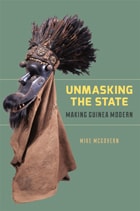
Unmasking the State
Making Guinea ModernMike McGovern
University of Chicago Press, 2012

Urban Reform and Its Consequences
A Study in RepresentationSusan Welch and Timothy Bledsoe
University of Chicago Press, 1988
Susan Welch and Timothy Bledsoe clarify a portion of the debate by investigating how election structures affect candidates and the nature of representation. They examine the different effects of district versus at-large elections and of partisan versus nonpartisan elections. Who gets elected? Are representatives' socioeconomic status and party affiliation related to election form? Are election structures related to how those who are elected approach their jobs? Do they see themselves as representatives concerned with the good of the city as a whole?
Urban Reform and Its Consequences reports an unprecedented wealth of data drawn from a sample of nearly 1,000 council members and communities with populations between 50,000 and 1 million across 42 states. The sample includes communities that use a variety of election procedures. This study is therefore the most comprehensive and accurate to date.
Welch and Bledsoe conclude that nonpartisan and at-large elections do give city councils a more middle- and upper-middle-class character and have changed the way representatives view their jobs. Reform measures have not, however, produced councils that are significantly more conservative or more prone to conflict. Overall, the authors conclude that partisan and district elections are more likely to represent the whole community and to make the council more accountable to the electorate.