428 books match the query 'Stories' and 6 start with u
cover of Undead Ends: Stories of Apocalypse

Undead Ends

Stories of Apocalypse

S. Trimble

Rutgers University Press, 2019
Undead Ends is about how we imagine humanness and survival in the aftermath of disaster. This book frames modern British and American apocalypse films as sites of interpretive struggle. It asks what, exactly, is ending? Whose dreams of starting over take center stage, and why? And how do these films, sometimes in spite of themselves, make room to dream of new beginnings that don’t just reboot the world we know? Trimble argues that contemporary apocalypse films aren’t so much envisioning The End of the world as the end of a particular world; not The End of humanness but, rather, the end of Man. Through readings of The Road, I Am Legend, 28 Days Later, 28 Weeks Later, Children of Men, and Beasts of the Southern Wild, this book demonstrates that popular stories of apocalypse can trouble, rather than reproduce, Man’s story of humanness. With some creative re-reading, they can even unfold towards unexpected futures. Mainstream apocalypse films are, in short, an occasion to imagine a world After Man.
[more]
cover of Under: Stories

Under

Stories

Glen Pourciau

Four Way Books, 2025

As wryly profound as ever, Glen Pourciau solidifies his reputation as a master of American short fiction with Under, a collection of brief yet meticulously elaborated stories that deconstruct daily living as his characters see it by diving beneath their skin and surveying the electric heat bristling below. He scours their interiors for the granular details of consciousness that accrue to a person's singular point of view, shape patterns of behavior, and culminate in consequential decisions (or equally meaningful inaction). Pourciau's writing thrums with claustrophobic intelligence, untangling the knots of eccentric personalities by observing the trajectory of his subjects' thoughts and tracing them back to the source. Rarely is the root an inciting incident or narrative catalyst, but rather the self-propagating algorithm of paranoia that proves to us we have something to fear precisely because we are afraid. Pourciau's titular story begins with the narrator confessing, "A voice from within is telling me this story. It rises like protruding lumps from nowhere." More often than not, plots that start inside one's head refuse to stay there; soon, psychological disruption asserts itself in the material world, determining a character's lived experience as tangibly as an external force or outside actor. "I've been watching a patch of ground in my backyard that has been upset by something moving up from below," the narrator continues. It's no comfort, actually, that what is emerging never actually emerges; a lack of conclusive evidence means never fully disproving the possibility of the thing, either. "Nothing is buried or rising from below in my backyard. My conscience is clear, guided only by its own instinct," the narrator assures himself to no avail. "This story should be rooted out, destroyed, but talking to it doesn't make it go away. Even when silent, something insidious gnaws within it." Pourciau's ability to illuminate that something insidious is what makes his writing something marvelous. No less instructive or revelatory for their internal accelerants, these stories spotlight the small conflagrations that punctuate even our most ordinary days. In delineating the invisible machinations of each person's mind, they reveal the flammable borders of personal boundaries and the conflicts with colleagues, neighbors, and long-time friends that cast off sparks and set our small lives ablaze.
[more]
cover of Unexpected Grace: Stories of Faith, Science, and Altruism

Unexpected Grace

Stories of Faith, Science, and Altruism

Bill Kramer

Templeton Press, 2007

In Unexpected Grace Bill Kramer offers a rare look into the human side of the world of scientific research. He goes behind the scenes of four scientific investigations on diverse aspects of the study of unlimited love and offers uplifting portraits of human beings struggling to understand and improve the complex issues facing them. He explores the dynamics between the researchers, the subjects they study, and the participants in the studies, and eloquently tells their personal stories. The stories touch on vastly different social and human issues, but all are connected by love.

The first is the story of Courtney Cowart, who was part of a group of theologians who met at Trinity Place in lower Manhattan on September 11, 2001, not knowing her experience would become the subject of a study. The story of how the group struggled to survive and the formation of a practical, effective altruistic community is heartrending and inspiring. This is followed by a description of a University of California Santa Cruz psychology department study on the dynamics of friendship and prejudice that completely changed the perceptions of those involved.

The third study, from Case Western Reserve University in Cleveland, focused on the benefits of religion on mental and physical health, which led its researcher to a greater understanding of forgiveness, humility, and grace. The final powerful story is about a physiology of love study conducted in Iowa City. Here, a functional MRI is the vehicle for measuring empathy and brings the researcher to wonder, "Is there a point at which empathy shuts down and we turn away?" Ultimately she comes to recognize that past experiences influences our ability to respond emphatically.

 
Each story candidly unveils the transformations the researchers and their subjects experienced in the course of their work. This illuminating book, with its unique insights, will appeal to educators, researchers, students, study participants, and everyone who wonders what goes on behind the scenes of investigative studies.


[more]
cover of Unmarried Women: Stories

Unmarried Women

Stories

Matilde Serao

Northwestern University Press, 2007

Matilde Serao is widely regarded as the most successful Italian woman journalist of the nineteenth century as well as being an important writer of fiction. A great observer of life, Serao focused her writing directly on the most pressing problems of a newly unified Italy, urban poverty, and the North/South divide. Historian and critic Benedetto Croce said of her that she had an "imagination that is limpid and alive"; Nobel Laureate Giosuè Carducci called her the greatest woman writer in Italy; and Gabriele D'Annunzio dedicated a novel to her. She was apparently on the short list for the Nobel Prize in 1926, which ultimately went to the Sardinian writer Grazia Deledda.

This collection, the first to make Serao’s short stories available in English translation, reflects this naturalistic writer’s interest in the everyday drama of the lives of women in the Italy of her day.  In Serao’s spare and simple prose, the young women of turn-of-the-century Naples come to life, negotiating the details of school and work, church and marriage, in a world circumscribed by fathers and chaperones, fiancés and bosses.  Infused with the writer’s deep sense of humanity, their quietly involving stories—at once so poetic and so ordinary—attest to the transformative power of literature, and to the promise that even the most humble life holds.
 
[more]
cover of Unruly Creatures: Stories

Unruly Creatures

Stories

Jennifer Caloyeras

West Virginia University Press, 2017

Independent Publisher’s Book Awards, Silver Medal, Short Story Fiction

In this collection rife with humor and pathos, alienated characters struggle to subvert, contain, control, and even escape their bodies. A teenage girl grapples with pubic hair grown wild, a biologist finds herself in love with a gorilla, a prisoner yearns to escape her biological destiny.
 
 In some stories, the bodies have surrogates: a high-school girl babysits an elderly woman’s plastic doll while negotiating her own sexual awakening, and a young man finds that he can only receive affection from his father when he is in costume. Dark humor and magical realism put in sharp relief the everyday trials of Americans in a story collection that asks, in what way are we more than the sum of our parts?  
 
[more]
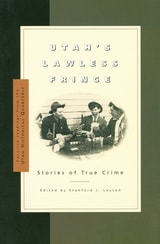
cover of Utah's Lawless Fringe: Stories of True Crime

Utah's Lawless Fringe

Stories of True Crime

Stanford J. Layton

Signature Books, 2001

 It was Sunday and worship service was in progress. One of the settlers who was not attending service eyed four known outlaws passing near town. He raced to church to spread the alarm, and parishioners leaped up, grabbed their guns, and galloped off in pursuit, joined by some neighboring cattlemen. Before it was over, one of the posse was dead.

So it went on the outskirts of Utah Territory. In this case it was the little town of Bluff where the Mormon bishop served for some ten years as de facto sheriff and his congregation as deputies. As elsewhere, law and order developed organically rather than by legislation.

In this anthology several aspects of the process are considered, including one of the worst manifestations of citizen action: vigilantism. Territorial Utah witnessed more lynchings than legal executions. Another citizen trait was an unexpected indifference to vice. In 1908 Salt Lake City had 148 registered prostitutes overseen by a madam who was recruited for the position by the mayor and city council. During Prohibition one of the largest distilleries in the West operated in a Salt Lake warehouse.

What is to be learned from this? The contributors to these fourteen articles leave moral considerations to the reader’s contemplation, while providing surprises along the way in an extremely engaging—dare we say arresting—read.

[more]