Results by title
967 books match the query 'Theater' and 8 start with u
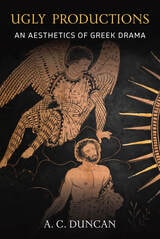
Ugly Productions
An Aesthetics of Greek DramaA. C. Duncan
University of Michigan Press, 2025
Through studies of the figures of Xerxes, Electra, Philoctetes, Ajax, Heracles, and other tragic figures, Ugly Productions offers detailed analyses of the various ways ugliness was produced in performance with each chapter serving as an in-depth guide for studying the aesthetics of these works. Duncan confronts the historical neglect of ugliness in critical discourses, calling for a revaluation of negative aesthetics and renewed interest in the uglier aspects of these canonical works of theater.

Unbridled
Studying Religion in PerformanceWilliam Robert
University of Chicago Press, 2022
In Unbridled, William Robert uses Equus, Peter Shaffer’s enigmatic play about a boy passionately devoted to horses, to think differently about religion. For several years, Robert has used Equus to introduce students to the study of religion, provoking them to conceive of religion in unfamiliar, even uncomfortable ways. In Unbridled, he is inviting readers to do the same.
A play like Equus tangles together text, performance, practice, embodiment, and reception. Studying a play involves us in playing different roles, as ourselves and others, and those roles, as well as the imaginative work they require, are critical to the study of religion. By approaching Equus with the reader, turning the play around and upside-down, Unbridled transforms standard approaches to the study of religion, engaging with themes including ritual, sacrifice, worship, power, desire, violence, and sexuality, as well as thinkers including Judith Butler, Sigmund Freud, Karl Marx, Friedrich Nietzsche, and Jonathan Z. Smith. As Unbridled shows, the way themes and theories play out in Equus challenges us to reimagine the study of religion through open questions, contrasting perspectives, and alternative modes of interpretation and appreciation.
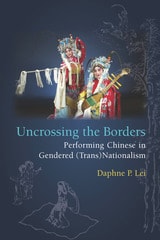
Uncrossing the Borders
Performing Chinese in Gendered (Trans)NationalismDaphne P. Lei
University of Michigan Press, 2019
Over many centuries, women on the Chinese stage committed suicide in beautiful and pathetic ways just before crossing the border for an interracial marriage. Uncrossing the Borders asks why this theatrical trope has remained so powerful and attractive. The book analyzes how national, cultural, and ethnic borders are inevitably gendered and incite violence against women in the name of the nation. The book surveys two millennia of historical, literary, dramatic texts, and sociopolitical references to reveal that this type of drama was especially popular when China was under foreign rule, such as in the Yuan (Mongol) and Qing (Manchu) dynasties, and when Chinese male literati felt desperate about their economic and political future, due to the dysfunctional imperial examination system. Daphne P. Lei covers border-crossing Chinese drama in major theatrical genres such as zaju and chuanqi, regional drama such as jingju (Beijing opera) and yueju (Cantonese opera), and modernized operatic and musical forms of such stories today.
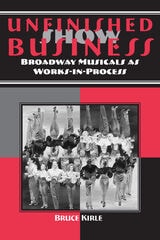
Unfinished Show Business
Broadway Musicals as Works-in-ProcessBruce Kirle
Southern Illinois University Press, 2005
In this fresh approach to musical theatre history, Bruce Kirle challenges the commonly understood trajectory of the genre. Drawing on the notion that the world of the author stays fixed while the world of the audience is ever-changing, Kirle suggests that musicals are open, fluid products of the particular cultural moment in which they are performed. Incomplete as printed texts and scores, musicals take on unpredictable lives of their own in the complex transformation from page to stage.
Using lenses borrowed from performance studies, cultural studies, queer studies, and ethnoracial studies, Unfinished Show Business: Broadway Musicals as Works-in-Process argues that musicals are as interesting for the provocative issues they raise about shifting attitudes toward American identity as for their show-stopping song-and-dance numbers and conveniently happy endings. Kirle illustrates how performers such as Ed Wynn, Fanny Brice, and the Marx Brothers used their charismatic personalities and quirkiness to provide insights into the struggle of marginalized ethnoracial groups to assimilate. Using examples from favorites including Oklahoma!, Fiddler on the Roof, A Chorus Line, and Les Misérables, Kirle demonstrates Broadway’s ability to bridge seemingly insoluble tensions in society, from economic and political anxiety surrounding World War II to generational conflict and youth counterculture to corporate America and the “me” generation. Enlivened by a gallery of some of Broadway’s most memorable moments—and some amusing, obscure ones as well—this study will appeal to students, scholars, and lifelong musical theatre enthusiasts.
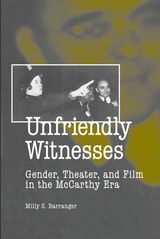
Unfriendly Witnesses
Gender, Theater, and Film in the McCarthy EraMilly S. Barranger
Southern Illinois University Press, 2008
Unfriendly Witnesses: Gender, Theater, and Film in the McCarthy Era examines the experiences of seven prominent women of stage and screen whose lives and careers were damaged by the McCarthy-era “witch hunts” for Communists and Communist sympathizers in the entertainment industry: Judy Holliday, Anne Revere, Lillian Hellman, Dorothy Parker, Margaret Webster, Mady Christians, and Kim Hunter.
The effects on women of the anti-Communist crusades that swept the nation between 1947 and 1962 have been largely overlooked by cultural critics and historians, who have instead focused their attention on the men of the period. Author Milly S. Barranger looks at the gender issues inherent in the investigations and at the destructive impact the investigations had on the lives and careers of these seven women—and on American film and theater and culture in general.
Issues of gender and politics surface in the women’s testimony before the committeemen, labeled “unfriendly” because the women refused to name names. Unfriendly Witnesses redresses the absence of women’s histories during this era of modern political history and identifies the enduring strains of McCarthyism in postmillennial America.
Barranger recreates the congressional and state hearings that addressed the alleged Communist influence in the entertainment industry and examines in detail the cases of these seven women, including the appearance of actress Judy Holliday before the committee of Senator Pat McCarran, who aimed to limit the immigration of Eastern Europeans; actress Anne Revere and playwright Lillian Hellman, appearing before the House Un-American Activities Committee, sought the protections of the Fifth Amendment with different outcomes; of writer Dorothy Parker, who testified before a New York state legislative committee investigating contributions to “front” groups; and of director Margaret Webster, before Senator Joseph McCarthy’s subcommittee, whose aim was the indictment of Senator J. William Fulbright and the U.S. State Department. None escaped subsequent blacklisting, denial of employment, and notations in FBI files that they were threats to national security.
Unfriendly Witnesses is enhanced by nine illustrations and extensive excerpts from Red Channels: The Report of Communist Influence in Radio and Television, originally published in 1950 at the height of the Red Scare, and which listed 151 allegedly subversive writers, directors, and performers. Barranger includes the complete entries from Red Channels for the seven women she discusses, which include the “subversive” affiliations that prompted the women’s interrogation by the government.
Unsettling Acts
Performing Transnational AdoptionJieun Lee
The Ohio State University Press, 2025
Analyzing contemporary theater and performance works about Korean transnational adoption, Jieun Lee’s Unsettling Acts: Performing Transnational Adoption challenges longstanding ideas about adoption. Lee contends that in staging adoptees’ birth family searches and reunions, theater and performance artists unsettle dominant discourses that have essentialized adoptees through ethnonationalist, gendered, and postwar humanitarian narratives in both birth and adoptive cultures. In doing so, Lee reveals how these performances engage in acts of disavowal of and resistance to mythologies of adoption and adoptee experience.
Lee examines twelve works—from South Korea, the United States, the United Kingdom, Belgium, and Denmark—including plays, musicals, solo performances, community-based theater, and performance art. Through her analysis, theater and performance become a means for reimagining adoptees’ identity, kinship, and sense of belonging. Further, these pieces encourage critical exploration of the history, politics, and social impacts of Korean transnational adoption. These works thus nurture a countermemory to engender redressive accountability and transpacific justice, pointing a way forward for remaking the transnational adoptee experience in the twenty-first century.
Upstaging Big Daddy
Directing Theater as if Gender and Race MatterEllen Donkin and Susan Clement, Editors
University of Michigan Press, 1993
What happens, then, when a feminist who directs for the theater decides that there is something called a feminist director, someone who sees her job as protesting and intervening in the existing system of representation? The contributors to this volume provide a wide range of answers, in original essays that disrupt traditional approaches of directing by showing how feminist theory might be applied in practice.
Essays and interviews by a wide variety of directors, scholars, and other theater specialists offer fresh new models for thinking about directing. The collection includes essays on African-American theater, feminist “classics,” and male directors working on feminist plays, as well as concrete suggestions for directing a variety of plays, from works by Shakespeare and Euripides to those by Caryl Churchill, Aishah Rahman, and Helene Cixous. The theoretical material, drawing from a wide range of contemporary critics and theorists, has been written with the director in mind, partly for the purpose of analyzing texts but also for inspiring creative directorial and design solutions.
Utopia in Performance
Finding Hope at the TheaterJill Dolan
University of Michigan Press, 2005
---David Román, University of Southern California
What is it about performance that draws people to sit and listen attentively in a theater, hoping to be moved and provoked, challenged and comforted? In Utopia in Performance, Jill Dolan traces the sense of visceral, emotional, and social connection that we experience at such times, connections that allow us to feel for a moment not what a better world might look like, but what it might feel like, and how that hopeful utopic sentiment might become motivation for social change.
She traces these "utopian performatives" in a range of performances, including the solo performances of feminist artists Holly Hughes, Deb Margolin, and Peggy Shaw; multicharacter solo performances by Lily Tomlin, Danny Hoch, and Anna Deavere Smith; the slam poetry event Def Poetry Jam; The Laramie Project; Blanket, a performance by postmodern choreographer Ann Carlson; Metamorphoses by Mary Zimmerman; and Deborah Warner's production of Medea starring Fiona Shaw. While the book richly captures moments of "feeling utopia" found within specific performances, it also celebrates the broad potential that performance has to provide a forum for being human together; for feeling love, hope, and commonality in particular and historical (rather than universal and transcendent) ways.