Results by title
97 books match the query 'Urbanization' and 7 start with u
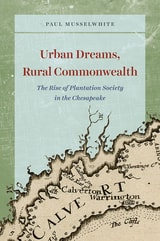
Urban Dreams, Rural Commonwealth
The Rise of Plantation Society in the ChesapeakePaul Musselwhite
University of Chicago Press, 2018
Paul Musselwhite details the unsuccessful urban development that defined the region from the seventeenth century through the Civil War, showing how places like Jamestown and Annapolis—despite their small size—were the products of ambitious and cutting-edge experiments in urbanization comparable to those in the largest port cities of the Atlantic world. These experiments, though, stoked ongoing debate about commerce, taxation, and self-government. Chesapeake planters responded to this debate by reinforcing the political, economic, and cultural authority of their private plantation estates, with profound consequences for the region’s laborers and the political ideology of the southern United States. As Musselwhite makes clear, the antebellum economy around this well-known waterway was built not in the absence of cities, but upon their aspirational wreckage.
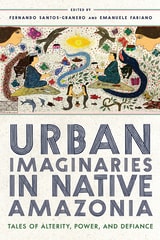
Urban Imaginaries in Native Amazonia
Tales of Alterity, Power, and DefianceFernando Santos-Granero
University of Arizona Press, 2023
Featuring analysis from historical, ethnological, and philosophical perspectives, contributors seek to explain the imaginaries’ widespread diffusion, as well as their influence in present-day migration and urbanization. Above all, it underscores how these urban imaginaries allow Indigenous Amazonians to express their concerns about power, alterity, domination, and defiance.
Contributors
Natalia Buitron
Philippe Erikson
Emanuele Fabiano
Fabiana Maizza
Daniela Peluso
Fernando Santos-Granero
Pirjo Kristiina Virtanen
Robin M. Wright

Urban Leviathan
Mexico City in the Twentieth CenturyDiane E. Davis
Temple University Press, 1994
Why, Diane Davis asks, has Mexico City, once known as the city of palaces, turned into a sea of people, poverty, and pollution? Through historical analysis of Mexico City, Davis identifies political actors responsible for the uncontrolled industrialization of Mexico's economic and social center, its capital city. This narrative biography takes a perspective rarely found in studies of third-world urban development: Davis demonstrates how and why local politics can run counter to rational politics, yet become enmeshed, spawning ineffective policies that are detrimental to the city and the nation.
The competing social and economic demand of the working poor and middle classes and the desires of Mexico's ruling Partido Revolucionario Institutional (PRI) have led to gravely diminished services, exorbitant infrastructural expenditures, and counter-productive use of geographic space. Though Mexico City's urban transport system has evolved over the past seven decades from trolley to bus to METRO (subway), it fails to meet the needs of the population, despite its costliness, and is indicative of the city's disastrous and ill-directed overdevelopment. Examining the political forces behind the thwarted attempts to provide transportation in the downtown and sprawling outer residential areas, Davis analyzes the maneuverings of local and national politicians, foreign investors, middle classes, agency bureaucrats, and various factions of the PRI.
Looking to Mexico's future, Davis concludes that growing popular dissatisfaction and frequent urban protests demanding both democratic reform and administrative autonomy in the capital city suggest an unstable future for corporatist politics and the PRI's centralized one-party government.
Urban Saniscapes
Slums, Housing and Everyday Sanitation in Accra and Nairobi, 1908–1963Waseem-Ahmed Bin-Kasim
Michigan State University Press, 2025
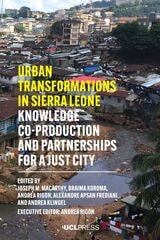
Urban Transformations in Sierra Leone
Knowledge Co-Production and Partnerships for a Just CityEdited by Joseph M. Macarthy, Braima Koroma, Andrea Rigon, Alexandre Apsan Frediani, and Andrea Klingel
University College London, 2024
With a population of over one million, Freetown, Sierra Leone faces serious challenges with service provisions, housing, infrastructure, employment, and climate change. In 2015, the Sierra Leone Urban Research Centre (SLURC) was established to address these challenges through research, capacity building, and advocacy. Urban Transformations in Sierra Leone shares SLURC’s progress, articulating its key findings and reflections on the partnerships it helped enable.
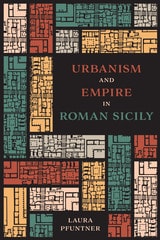
Urbanism and Empire in Roman Sicily
By Laura Pfuntner
University of Texas Press, 2019
Sicily has been the fulcrum of the Mediterranean throughout history. The island’s central geographical position and its status as ancient Rome’s first overseas province make it key to understanding the development of the Roman Empire. Yet Sicily’s crucial role in the empire has been largely overlooked by scholars of classical antiquity, apart from a small number of specialists in its archaeology and material culture.
Urbanism and Empire in Roman Sicily offers the first comprehensive English-language overview of the history and archaeology of Roman Sicily since R. J. A. Wilson’s Sicily under the Roman Empire (1990). Laura Pfuntner traces the development of cities and settlement networks in Sicily in order to understand the island’s political, economic, social, and cultural role in Rome’s evolving Mediterranean hegemony. She identifies and examines three main processes traceable in the archaeological record of settlement in Roman Sicily: urban disintegration, urban adaptation, and the development of alternatives to urban settlement. By expanding the scope of research on Roman Sicily beyond the bounds of the island itself, through comparative analysis of the settlement landscapes of Greece and southern Italy, and by utilizing exciting evidence from recent excavations and surveys, Pfuntner establishes a new empirical foundation for research on Roman Sicily and demonstrates the necessity of including Sicily in broader historical and archaeological studies of the Roman Empire.
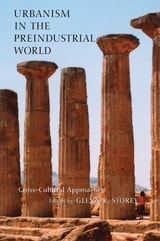
Urbanism in the Preindustrial World
Cross-Cultural ApproachesEdited by Glenn R. Storey
University of Alabama Press, 2006
This work employs a subset of preindustrial cities on many continents to answer questions archaeologists grapple with concerning the populating and growth of cities before industrialization. It further explores how scholars differently conceive and execute their research on the population of cities. The subject cities are in Greece, Mesoamerica, the Andes, Italy, Egypt, Africa, United States, Denmark, and China. This broad sample provides a useful framework for answers to such questions as “Why did people agglomerate into cities?” and “What population size and what age of endurance constitute a city?”
The study covers more than population magnitude and population makeup, the two major frameworks of urban demography. The contributors combine their archaeological and historical expertise to reveal commonalities, as well as theoretical extrapolations and methodological approaches, at work here and outside the sample.
Urbanism in the Preindustrial World is a unique study revealing the variety of factors involved in the coalescing and dispersal of populations in preindustrial times.