Results by title
441 books match the query 'Women and literature' and 3 start with u
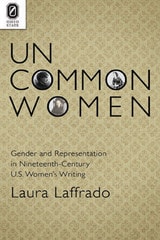
Uncommon Women
Gender and Representation in Nineteenth-Century U.S. Women's WritingLaura Laffrado
The Ohio State University Press, 2009
Uncommon Women discusses provocative, highly readable, nineteenth-century American texts that complicate notions of self-writing and female agency. This feminist study considers the generic forms, language, and illustrations of a group of complex and often daring texts, including Sarah Kemble Knight’s unconventional travel Journal (1825); Fanny Fern’s controversial newspaper essays (1851–72); Civil War nurse Louisa May Alcott’s Hospital Sketches (1863); and cross-dressed soldier’s S. Emma E. Edmonds’s Nurseand Spy in the Union Army (1865), along with later women’s war reminiscences. The study concludes with a fresh reading of neglected aspects of Harriet Jacobs’s Incidents in the Life of a Slave Girl (1861), the primary Black female autobiographical text of the century, which fundamentally displays what whiteness enabled.
Uncommon Women reveals attempts of white middle-class women to both violate and align themselves with gendered assumptions. In doing so, it makes visible the ways in which these texts disputed restrictive female constructions, tested boundaries of race and class, and anticipated reaction to their disruptive discourses. The resulting conflicted self-representations illuminate the vexed contours of women’s autobiography.
This study’s findings make plain the impact of white/male discourses of gender on women’s self-narrativeand illustrate how unconventional women were pressured to embrace domesticity, heterosexuality, marriage, motherhood, and political passivity.
[more]
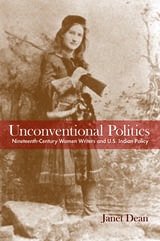
Unconventional Politics
Nineteenth-Century Women Writers and U.S. Indian PolicyJanet Dean
University of Massachusetts Press, 2016
Throughout the nineteenth century, Native and non-Native women writers protested U.S. government actions that threatened indigenous people's existence. The conventional genres they sometimes adopted—the sensationalistic captivity narrative, sentimental Indian lament poetry, didactic assimilation fiction, and the mass-circulated commercial magazine—typically had been used to reinforce the oppressive policies of removal, war, and allotment. But in Unconventional Politics Janet Dean explores how four authors, Sarah Wakefield, Lydia Huntley Sigourney, the Muscogee/Creek S. Alice Callahan, and the Cherokee Ora V. Eddleman, converted these frameworks to serve a politics of dissent. Intervening in current debates in feminist and Native American literary criticism, Dean shows how these women advocated for Native Americans by both politicizing conventional literature and employing literary skill to respond to national policy.
Dean argues that in protesting U.S. Indian policy through popular genres, Wakefield, Sigourney, Callahan, and Eddleman also critiqued cultural protocols and stretched the contours of accepted modes of feminine discourse. Their acts of improvisation and reinvention tell a new story about the development of American women's writing and political expression.
Dean argues that in protesting U.S. Indian policy through popular genres, Wakefield, Sigourney, Callahan, and Eddleman also critiqued cultural protocols and stretched the contours of accepted modes of feminine discourse. Their acts of improvisation and reinvention tell a new story about the development of American women's writing and political expression.
[more]
Unsettled Subjects
Restoring Feminist Politics to Poststructuralist CritiqueSusan Lurie
Duke University Press, 1997
During the 1980s much of the work of feminist theory aimed to fully account for issues of class, race, and sexuality that previously had been overlooked. Susan Lurie argues that this work tended to privilege questions of race and class at the expense of gender, and frequently, if inadvertently, left patriarchal power unquestioned. Developing a feminist model that keeps multiple political forces in view, Lurie returns to three literary feminists from earlier parts of the century: Ellen Glasgow, Zora Neale Hurston, and Elizabeth Bishop. As Lurie argues, each of these women shows that both resistance to male domination and alliances between different oppositional politics rely on recognizing how power regulates a subject’s multiple beliefs.
In her analysis, Lurie traces each author’s strategies for revealing and challenging the ways that patriarchal gender ideology profits from what is always plural and contested female subjectivity. Only such an inquiry, Lurie demonstrates, can explain the impasses that have steered poststructuralist feminism away from gender as a category of analysis and can point toward the models necessary for a more complete feminist critique of patriarchal power.
In her analysis, Lurie traces each author’s strategies for revealing and challenging the ways that patriarchal gender ideology profits from what is always plural and contested female subjectivity. Only such an inquiry, Lurie demonstrates, can explain the impasses that have steered poststructuralist feminism away from gender as a category of analysis and can point toward the models necessary for a more complete feminist critique of patriarchal power.
[more]