Results by title
8642 books match the query '20th Century' and 125 start with u

Undressed Toronto
From the Swimming Hole to Sunnyside, How a City Learned to Love the Beach, 1850–1935Dale Barbour
University of Manitoba Press, 2021
Unearthing the Nation
Modern Geology and Nationalism in Republican ChinaGrace Yen Shen
University of Chicago Press, 2014
The first major history of modern Chinese geology, Unearthing the Nation introduces the key figures in the rise of the field, as well as several key organizations, such as the Geological Society of China, and explains how they helped bring Chinese geology onto the world stage.
Uneasy Virtue
The Politics of Prostitution and the American Reform TraditionBarbara Meil Hobson
University of Chicago Press, 1990
Uneasy in Babylon
Southern Baptist Conservatives and American CultureBarry Hankins
University of Alabama Press, 2002
The definitive account of how conservative Southern Baptists came to dominate the nation's largest Protestant denomination
In 1979 a group of conservative members of the Southern Baptists Convention (SBC) initiated a campaign to reshape the denomination’s seminaries and organizations by installing new conservative leaders who made belief in the inerrancy of the Bible a condition of service. They succeeded. This book is a definitive account of that takeover.
Barry Hankins argues that the conservatives sought control of the SBC not or not only to secure the denomination's orthodoxy but to mobilize Southern Baptists for a war against secular culture. The best explanation of the beliefs and behavior of Southern Baptist conservatives, Hankins concludes, lies in their adoption of the culture war model of American society. Believing that "American culture has turned hostile to traditional forms of faith,” they sought to deploy the Southern Baptist Convention in a "full-scale culture war" against secularism in the United States. Hankins traces the roots of this movement to the ideas of such post-WWII northern evangelicals as Carl F. H. Henry and Francis Schaeffer. Henry and Schaeffer viewed America's secular culture as hostile to Christianity and called on evangelicals to develop a robust Christian opposition to secular culture. As the nation’s largest Protestant denomination, SBC positions on divisive cultural issues like abortion have remade the American political landscape, most notably in the reversal of Roe v. Wade.
Hankins also argues, however, that Southern Baptist conservatives sought more than orthodox adherence to Biblical inerrancy. They also sought an identity that was authentically Baptist and Southern. Hankin’s excellent and prescient work will fascinate readers interested in contemporary American religion, culture, and public policy, as well as in the American South.
Uneven Encounters
Making Race and Nation in Brazil and the United StatesMicol Seigel
Duke University Press, 2009
Seigel explores the circulation of images of Brazilian coffee and of maxixe in the United States during the period just after the imperial expansions of the early twentieth century. Exoticist interpretations structured North Americans’ paradoxical sense of themselves as productive “consumer citizens.” Some people, however, could not simply assume the privileges of citizenship. In their struggles against racism, Afro-descended citizens living in Rio de Janeiro, São Paulo, New York, and Chicago encountered images and notions of each other, and found them useful. Seigel introduces readers to cosmopolitan Afro-Brazilians and African Americans who rarely traveled far from home but who nonetheless absorbed ideas from abroad. She suggests that studies comparing U.S. and Brazilian racial identities as two distinct constructions are misconceived. Racial formation transcends national borders; attempts to understand it must do the same.
Unfinished Socialism
Pictures from the Kádár EraAndrás Gero
Central European University Press, 1999
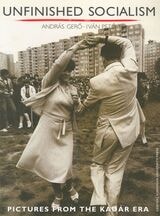
This extraordinary book provides a snapshot of socialism throughout the Kádár regime in Hungary (1956-1989) and captures the essence of the world behind the ‘iron curtain’ in a stunning, and often stark, collection of photographs.
Unfinished Socialism is a visually stunning anthropological study containing 450 photographs, many previously unpublished, which portray life in Hungary from every angle: from the May Day March to pop music and from the homeless to sport.
With an introduction that will help the reader understand and appreciate the true meaning of the photographs, this political, social and cultural study of the Kádár years transports the reader back to a time of great significance in Hungary’s long and turbulent history.
Unfixed
Photography and Decolonial Imagination in West AfricaJennifer Bajorek
Duke University Press, 2020
Unfolding the City
Women Write the City in Latin AmericaAnne Lambright
University of Minnesota Press, 2007
Unfriendly Witnesses
Gender, Theater, and Film in the McCarthy EraMilly S. Barranger
Southern Illinois University Press, 2008
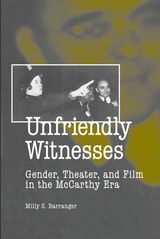
Unfriendly Witnesses: Gender, Theater, and Film in the McCarthy Era examines the experiences of seven prominent women of stage and screen whose lives and careers were damaged by the McCarthy-era “witch hunts” for Communists and Communist sympathizers in the entertainment industry: Judy Holliday, Anne Revere, Lillian Hellman, Dorothy Parker, Margaret Webster, Mady Christians, and Kim Hunter.
The effects on women of the anti-Communist crusades that swept the nation between 1947 and 1962 have been largely overlooked by cultural critics and historians, who have instead focused their attention on the men of the period. Author Milly S. Barranger looks at the gender issues inherent in the investigations and at the destructive impact the investigations had on the lives and careers of these seven women—and on American film and theater and culture in general.
Issues of gender and politics surface in the women’s testimony before the committeemen, labeled “unfriendly” because the women refused to name names. Unfriendly Witnesses redresses the absence of women’s histories during this era of modern political history and identifies the enduring strains of McCarthyism in postmillennial America.
Barranger recreates the congressional and state hearings that addressed the alleged Communist influence in the entertainment industry and examines in detail the cases of these seven women, including the appearance of actress Judy Holliday before the committee of Senator Pat McCarran, who aimed to limit the immigration of Eastern Europeans; actress Anne Revere and playwright Lillian Hellman, appearing before the House Un-American Activities Committee, sought the protections of the Fifth Amendment with different outcomes; of writer Dorothy Parker, who testified before a New York state legislative committee investigating contributions to “front” groups; and of director Margaret Webster, before Senator Joseph McCarthy’s subcommittee, whose aim was the indictment of Senator J. William Fulbright and the U.S. State Department. None escaped subsequent blacklisting, denial of employment, and notations in FBI files that they were threats to national security.
Unfriendly Witnesses is enhanced by nine illustrations and extensive excerpts from Red Channels: The Report of Communist Influence in Radio and Television, originally published in 1950 at the height of the Red Scare, and which listed 151 allegedly subversive writers, directors, and performers. Barranger includes the complete entries from Red Channels for the seven women she discusses, which include the “subversive” affiliations that prompted the women’s interrogation by the government.
Unguarded Border
American Émigrés in Canada during the Vietnam WarDonald W. Maxwell
Rutgers University Press, 2023
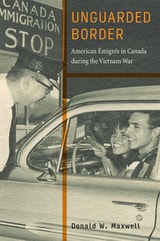
Unguarded Border tells their stories and, in the process, describes a migrant experience that does not fit the usual paradigms. Rather than treating these American refugees as unwelcome foreigners, Canada embraced them, refusing to extradite draft resisters or military deserters and not even requiring passports for the border crossing. And instead of forming close-knit migrant communities, most of these émigrés sought to integrate themselves within Canadian society.
Historian Donald W. Maxwell explores how these Americans in exile forged cosmopolitan identities, coming to regard themselves as global citizens, a status complicated by the Canadian government’s attempts to claim them and the U.S. government’s eventual efforts to reclaim them. Unguarded Border offers a new perspective on a movement that permanently changed perceptions of compulsory military service, migration, and national identity.
Unguessed Kinships
Naturalism and the Geography of Hope in Cormac McCarthySteven Frye
University of Alabama Press, 2023
Literary naturalism at play in one of America’s most visionary novelists: Cormac McCarthy
It took six novels and nearly thirty years for Cormac McCarthy to find commercial success with the National Book Award–winning All the Pretty Horses, followed by major prizes, more best sellers, and Hollywood adaptations of his work. Those successes, though, have obscured McCarthy’s commitment to an older form of literary expression: naturalism.
It is hardly a secret that McCarthy’s work tends to darker themes: violence, brutality, the cruel indifference of nature, themes which would not be out of place in the writing of Jack London or Stephen Crane. But literary naturalism is more than the oversimplified Darwinism that many think of. Nature may be red in tooth and claw, and humans are part of nature, but the humanity depicted in naturalist literature is capable of love, selflessness, and spirituality, as well.
In Unguessed Kinships, Steven Frye illuminates all these dimensions of McCarthy’s work. In his novels and plays, McCarthy engages both explicitly and obliquely with the project of manifest destiny, in the western drama Blood Meridian, the Tennessee Valley Authority-era Tennessee novels, and the atomic frontier of Alamogordo in Cities of the Plain. McCarthy’s concerns are deeply religious and philosophical, drawing on ancient Greek philosophy, Gnosticism, and Nietzsche, among other sources. Frye argues for McCarthy not merely as a naturalist writer but as a naturalist in the most expansive sense. Unguessed Kinships includes biographical and historical context in each chapter, widening the appeal of the text to not just naturalists or McCarthy scholars but anyone studying the literature of the South or the West.
Unintended Lessons of Revolution
Student Teachers and Political Radicalism in Twentieth-Century MexicoTanalís Padilla
Duke University Press, 2021
Union Divided
Black Musicians' Fight for Labor EqualityLeta E. Miller
University of Illinois Press, 2024
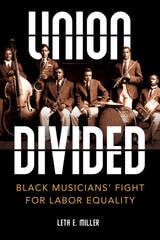
In the 1910s and 1920s, Black musicians organized more than fifty independent locals within the American Federation of Musicians (AFM) in an attempt to control audition criteria, set competitive wages, and secure a voice in national decision-making. Leta Miller follows the AFM’s history of Black locals, which competed directly with white locals in the same territories, from their origins and successes in the 1920s through Depression-era crises to the fraught process of dismantling segregated AFM organizations in the 1960s and 70s. Like any union, Black AFM locals sought to ensure employment and competitive wages for members with always-evolving solutions to problems. Miller’s account of these efforts includes the voices of the musicians themselves and interviews with former union members who took part in the difficult integration of Black and white locals. She also analyzes the fundamental question of how musicians benefitted from membership in a labor organization.
Broad in scope and rich in detail, Union Divided illuminates the complex working world of unionized Black musicians and the AFM’s journey to racial inclusion.
Union by Law
Filipino American Labor Activists, Rights Radicalism, and Racial CapitalismMichael W. McCann with George I. Lovell
University of Chicago Press, 2020
Union by Law analyzes the broader social and legal history of Filipino American workers’ rights-based struggles, culminating in the devastating landmark Supreme Court ruling, Wards Cove Packing Co. v. Atonio (1989). Organized chronologically, the book begins with the US invasion of the Philippines and the imposition of colonial rule at the dawn of the twentieth century. The narrative then follows the migration of Filipino workers to the United States, where they mobilized for many decades within and against the injustices of American racial capitalist empire that the Wards Cove majority willfully ignored in rejecting their longstanding claims. This racial innocence in turn rationalized judicial reconstruction of official civil rights law in ways that significantly increased the obstacles for all workers seeking remedies for institutionalized racism and sexism. A reclamation of a long legacy of racial capitalist domination over Filipinos and other low-wage or unpaid migrant workers, Union by Law also tells a story of noble aspirational struggles for human rights over several generations and of the many ways that law was mobilized both to enforce and to challenge race, class, and gender hierarchy at work.
Union-Free America
Workers and Antiunion CultureLawrence Richards
University of Illinois Press, 2008
Union-Free America: Workers and Antiunion Culture confronts one of the most vexing questions with which labor activists and labor academics struggle: why is there so much opposition to organized labor in the United States? Scholars often point to powerful obstacles from employers or governmental policies, but Lawrence Richards offers a more complete picture of the causes for union decline in the postwar period by examining the attitudes of the workers themselves. Large numbers of American workers in the 1970s and 1980s told pollsters that they would vote against a union if an election were held at their place of employment, and Richards provides a provocative explanation for this hostility: a pervasive strain of antiunionism in American culture that has made many workers distrustful of organized labor.
Weighing the arguments of previous historians and sociologists, Richards posits that this underlying antiunion culture in America has been remarkably consistent over the course of half a century. Assessing organizing efforts among blue-collar, white-collar, and pink-collar workers, Richards examines the tactics and countertactics of company and union representatives who sought to either exploit or neutralize workers' popular negative stereotypes of organized labor's insidious control over workers' autonomy. The book considers a number of case studies of organizing drives throughout recent history, from the failed attempt by District 65 to organize clerical workers at New York University in 1970, to a similarly fruitless drive by the Textile Workers Union in 1980 at a textile factory in Charlottesville, Virginia. In both of these particular cases and in many more, antiunion culture has operated to hinder unions' efforts to organize the unorganized. By examining the manifestations and motivations of antiunion culture in the United States, Richards helps explain why so many American workers seem to vote against their own self-interest and declare themselves "Union Free and Proud."

Unionizing the Jungles
Labor and Community in the Twentieth-Century Meat-packing IndustryShelton Stromquist
University of Iowa Press, 1997
After Upton Sinclair's powerful novel appeared in 1906, “the jungle” became a compelling metaphor for life and work in the nation's meatpacking industry. Harsh living and working conditions from the killing floor to the hide cellar to the packingtowns, cycles of overwork and underemployment, and the ever-present crowds of new and unskilled laborers characterized an often-violent industry in which the appetite of workers for the protection of unions was exceeded only by the zeal of their employers to prevent workers from organizing. Unionizing the Jungles—which originated in a seminar at the University of Iowa sponsored by the Center for Recent United States History—brings together historians and anthropologists whose studies of various phases of the meatpacking industry, its unions, and its impact on communities in the twentieth century both raise and answer important questions.
The rise and decline of industrial unionism in the packinghouse industry is a unique story that casts into bold relief the conflicts between labor and capital and the tensions based on race and gender in a perpetually changing workforce. The essayists in Unionizing the Jungles discuss the structurally distinctive features of the packinghouse industry—such as the fact that violence and extreme antiunionism were central elements of its culture—the primary actors in the union-building process, the roots of the distinctive interracialism of the United Packinghouse Workers of America and the explosion of industrial unionism in the 1930s, and the community-based militant unionism of the Independent Union of All Workers. Central themes throughout these essays include the role of African American workers, the constant battle for racial equality, and the eruption of gender conflict in the 1950s. Structural and technological changes in the corporate economy, the increased mobility of capital, and a more hostile political economy all contributed to the difficulties the labor movement faced in the 1980s and beyond.
Focusing on the workplace and the community as arenas of conflict and accommodation, the new labor historians in these vigorous essays consider the historical and contemporary problems posed by the development of the packinghouse industry and its unions and reflect on the implications of this dramatic history for the larger story of the changing relations between labor and capital in mass production.
Unite, Proletarian Brothers!
Radicalism and Revolution in the Spanish Second RepublicMatthew Kerry
University of London Press, 2020

Universal Grammar and Narrative Form
David Herman
Duke University Press, 1995
Following an extensive historical overview of theories about universal grammar, Herman examines Joyce’s Ulysses, Kafka’s The Trial, and Woolf’s Between the Acts as case studies of modernist literary narratives that encode grammatical principles which were (re)fashioned in logic, linguistics, and philosophy during the same period. Herman then uses the interpretation of universal grammar developed via these modernist texts to explore later twentieth-century cultural phenomena. The problem of citation in the discourses of postmodernism, for example, is discussed with reference to syntactic theory. An analysis of Peter Greenaway’s The Cook, The Thief, His Wife, and Her Lover raises the question of cinematic meaning and draws on semantic theory. In each case, Herman shows how postmodern narratives encode ideas at work in current theories about the nature and function of language.
Outlining new directions for the study of language in literature, Universal Grammar and Narrative Form provides a wealth of information about key literary, linguistic, and philosophical trends in the twentieth century.
Universal Prostitution and Modernist Abstraction
A CounterhistoryJaleh Mansoor
Duke University Press, 2025
Universal Women
Filmmaking and Institutional Change in Early HollywoodMark Garrett Cooper
University of Illinois Press, 2010
A Choice Outstanding Academic Title, 2011.
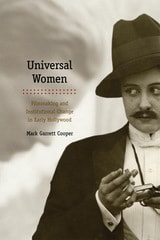
Between 1912 and 1919, the Universal Film Manufacturing Company credited eleven women with directing at least 170 films, but by the mid-1920s all of these directors had left Universal and only one still worked in the film industry at all. Two generations of cinema historians have either overlooked or been stymied by the mystery of why Universal first systematically supported and promoted women directors and then abruptly reversed that policy.
In this trailblazing study, Mark Garrett Cooper approaches the phenomenon as a case study in how corporate movie studios interpret and act on institutional culture in deciding what it means to work as a man or woman. In focusing on issues of institutional change, Cooper challenges interpretations that explain women's exile from the film industry as the inevitable result of a transhistorical sexism or as an effect of a broadly cultural revision of gendered work roles. Drawing on a range of historical and sociological approaches to studying corporate institutions, Cooper examines the relationship between institutional organization and aesthetic conventions during the formative years when women filmmakers such as Ruth Ann Baldwin, Cleo Madison, Ruth Stonehouse, Elise Jane Wilson, and Ida May Park directed films for Universal.
Universes without Us
Posthuman Cosmologies in American LiteratureMatthew A. Taylor
University of Minnesota Press, 2013
During the nineteenth and early twentieth centuries, a wide variety of American writers proposed the existence of energies connecting human beings to cosmic processes. From varying points of view—scientific, philosophical, religious, and literary—they suggested that such energies would eventually result in the perfection of individual and collective bodies, assuming that assimilation into larger networks of being meant the expansion of humanity’s powers and potentialities—a belief that continues to inform much posthumanist theory today.
Universes without Us explores a lesser-known countertradition in American literature. As Matthew A. Taylor’s incisive readings reveal, the heterodox cosmologies of Edgar Allan Poe, Henry Adams, Charles Chesnutt, and Zora Neale Hurston reject the anthropocentric fantasy that sees the universe as a kind of reservoir of self-realization. For these authors, the world can be made neither “other” nor “mirror.” Instead, humans are enmeshed with “alien” processes that are both constitutive and destructive of “us.” By envisioning universes no longer our own, these cosmologies picture a form of interconnectedness that denies any human ability to master it.
Universes without Us demonstrates how the questions, possibilities, and dangers raised by the posthuman appeared nearly two centuries ago. Taylor finds in these works an untimely engagement with posthumanism, particularly in their imagining of universes in which humans are only one category of heterogeneous thing in a vast array of species, objects, and forces. He shows how posthumanist theory can illuminate American literary texts and how those texts might, in turn, prompt a reassessment of posthumanist theory. By understanding the posthuman as a materialist cosmology rather than a technological innovation, Taylor extends the range of thinkers who can be included in contemporary conversations about the posthuman.
Unlearning Eugenics
Sexuality, Reproduction, and Disability in Post-Nazi EuropeDagmar Herzog
University of Wisconsin Press, 2020
Bringing together the latest findings in Holocaust studies, the history of religion, and the history of sexuality in postwar—and now also postcommunist—Europe, Unlearning Eugenics shows how central the controversies over sexuality, reproduction, and disability have been to broader processes of secularization and religious renewal. Herzog also restores to the historical record a revelatory array of activists: from Catholic and Protestant theologians who defended abortion rights in the 1960s–70s to historians in the 1980s–90s who uncovered the long-suppressed connections between the mass murder of the disabled and the Holocaust of European Jewry; from feminists involved in the militant "cripple movement" of the 1980s to lawyers working for right-wing NGOs in the 2000s; and from a handful of pioneers in the 1940s–60s committed to living in intentional community with individuals with cognitive disability to present-day disability self-advocates.
Unlearning the Hush
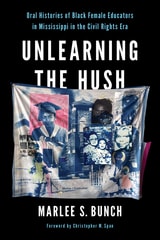
Oral Histories of Black Female Educators in Mississippi in the Civil Rights EraMarlee S. Bunch Foreword by Christopher M. Span
University of Illinois Press, 2025
Unloose My Heart
A Personal Reckoning with the Twisted Roots of My Southern Family TreeMarcia Edwina Herman-Giddens
University of Alabama Press, 2023
A deeply personal memoir that unearths a family history of racism, slaveholding, and trauma as well as love and sparks of delight.
Marcia Herman’s family moved to Birmingham in 1946, when she was five years old, and settled in the steel-making city dense with smog and a rigid apartheid system. Marcia, a shy only child, struggled to fit in and understand this world, shadowed as it was by her mother’s proud antebellum heritage. In 1966, weary of Alabama’s toxic culture, Marcia and her young family left Birmingham and built a life in North Carolina.
Later in life, Herman-Giddens resumed a search to find out what she did not know about her family history. Unloose My Heart interweaves the story of her youth and coming of age in Birmingham during the Civil Rights Movement together with this quest to understand exactly who and what her maternal ancestors were and her obligations as a white woman within a broader sense of American family.
More than a memoir set against the backdrop of Jim Crow and the civil rights struggle, this is the work of a woman of conscience writing in the twenty-first century. Haunted by the past, Unloose My Heart is a journey of exploration and discovery, full of angst, sorrow, and yearning. Unearthing her forebears’ centuries-long embrace of plantation slavery, Herman-Giddens dug deeply to parse the arrogance and cruelty necessary to be a slaveholder and the trauma and fear that ripple out in its wake. All this forced her to scrutinize the impact of this legacy in her life, as well as her debt to the enslaved people who suffered and were exploited at her ancestors’ hands. But she also discovers lost connections, new cousins and friends, unexpected joys, and, eventually, a measure of peace in the process. With heartbreak, moments of grace, and an enduring sense of love, Unloose My Heart shines a light in the darkness and provides a model for a heartfelt reckoning with American history.
Unmanning
How Humans, Machines and Media Perform Drone WarfareKatherine Fehr Chandler
Rutgers University Press, 2020
Unmasking the State
Making Guinea ModernMike McGovern
University of Chicago Press, 2012
Unnatural Ecopoetics
Unlikely Spaces in Contemporary PoetrySarah Nolan
University of Nevada Press, 2017
By approaching environments in a new way, Nolan closes this gap and recognizes how contemporary poets employ self-reflexive commentary and formal experimentation in order to create new natural/cultural environments on the page. She proposes a radical new direction for ecopoetics and deploys it in relation to four major American poets. Working from literal to textual spaces through the contemporary poetry of A.R. Ammons’s Garbage, Lyn Hejinian’s My Life, Susan Howe’s The Midnight, and Kenneth Goldsmith’s Seven American Deaths and Disasters, the book presents applications of unnatural ecopoetics in poetic environments, ones that do not engage with traditional ideas of nature and would otherwise remain outside the scope of ecocritical and ecopoetic studies.
Nolan proposes a new practical approach for reading poetic language. Ecocriticism is a very fluid and evolving discipline, and Nolan’s pioneering new book pushes the boundaries of second-wave ecopoetics—the fundamental issue being what is nature/natural, and how does poetic language, particularly self-conscious contemporary poetic agency, contribute to and complicate that question.
Unoriginal Genius
Poetry by Other Means in the New CenturyMarjorie Perloff
University of Chicago Press, 2010
What is the place of individual genius in a global world of hyper-information— a world in which, as Walter Benjamin predicted more than seventy years ago, everyone is potentially an author? For poets in such a climate, "originality" begins to take a back seat to what can be done with other people’s words—framing, citing, recycling, and otherwise mediating available words and sentences, and sometimes entire texts. Marjorie Perloff here explores this intriguing development in contemporary poetry: the embrace of "unoriginal" writing. Paradoxically, she argues, such citational and often constraint-based poetry is more accessible and, in a sense, "personal" than was the hermetic poetry of the 1980s and 90s.
Perloff traces this poetics of "unoriginal genius" from its paradigmatic work, Benjamin’s encyclopedic Arcades Project, a book largely made up of citations. She discusses the processes of choice, framing, and reconfiguration in the work of Brazilian Concretism and Oulipo, both movements now understood as precursors of such hybrid citational texts as Charles Bernstein’s opera libretto Shadowtime and Susan Howe’s documentary lyric sequence The Midnight. Perloff also finds that the new syncretism extends to language: for example, to the French-Norwegian Caroline Bergvall writing in English and the Japanese Yoko Tawada, in German. Unoriginal Genius concludes with a discussion of Kenneth Goldsmith’s conceptualist book Traffic—a seemingly "pure’" radio transcript of one holiday weekend’s worth of traffic reports. In these instances and many others, Perloff shows us "poetry by other means" of great ingenuity, wit, and complexity.
Unorthodox Beauty
Russian Modernism and Its New Religious AestheticMartha M. F. Kelly
Northwestern University Press, 2016
Unorthodox Beauty shows how Russian poets of the early twentieth century consciously adapted Russian Orthodox culture in order to create a distinctly religious modernism. Martha M. F. Kelly contends that, beyond mere themes, these writers developed an entire poetics that drew on liturgical tradition. Specifically, Russian Orthodoxy held out the possibility of unifying spirit and matter, as well as a host of other dichotomies—subject and object, empirical and irrational, noumena and phenomena. The artist could produce a work of transformative and regenerative power. Using a range of crossdisciplinary tools, Kelly reads key works by Blok, Kuzmin, Akhmatova, and Pasternak in ways that illustrate how profoundly religious traditions and ideas shaped Russian modernist literature.
Unpackaging Art of the 1980s
Alison Pearlman
University of Chicago Press, 2003
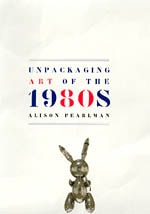
Pearlman reassesses the works and careers of six artists who became critics' biggest targets. In each of three chapters, she pairs two artists the critics viewed as emblematic of a given trend: Julian Schnabel and David Salle in association with Neo-Expressionism; Jean-Michel Basquiat and Keith Haring vis-à-vis Graffiti Art; and Peter Halley and Jeff Koons in relation to Simulationism. Pearlman shows how all these artists shared important but unrecognized influences and approaches: a crucial and overwhelming inheritance of 1960s and 1970s Conceptualism, a Warholian understanding of public identity, and a deliberate and nuanced use of past styles and media. Through in-depth discussions of works, from Haring's body-paintings of Grace Jones to Schnabel's movie Basquiat, Pearlman demonstrates how these artists' interests exemplified a broader, generational shift unrecognized by critics. She sees this shift as starting not in the 1980s but in the mid-1970s, when key developments in artistic style, art-world structures, and consumer culture converged to radically alter the course of American art.
Unpackaging Art of the 1980s offers an innovative approach to one of the most significant yet least understood episodes in twentieth-century art.
Unpacking My Father's Bookstore
Laurence Roth
Rutgers University Press, 2025
2026 Independent Publisher Book Awards (IPPY) Silver Medal in the West – Pacific Non-Fiction category
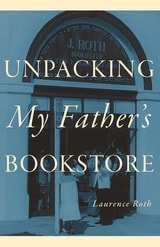
Unpacking My Father’s Bookstore brings to life the history of J. Roth / Bookseller of Fine & Scholarly Judaica, which was a microcosm of the Los Angeles Jewish community from 1966 to 1994 and one of the premier Jewish bookstores in the United States. Blending critical analysis with a personal account of growing up in his father’s bookstore, and connecting both to larger forces that helped shape Jewish and American book retailing in the twentieth-century, Laurence Roth crafts a richly felt narrative about his family’s Jewish experience in America. It is a reminder, too, that while most independent bookstores like J. Roth Bookseller disappear from history, these retailers often had outsized effects on their communities. Breaking with conventional modes of scholarship, Unpacking My Father’s Bookstore tells a unique and troubled story that rarely gets told, one that is both personal and analytical, theoretical but rooted in the everyday.
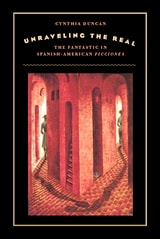
Unraveling the Real
The Fantastic in Spanish-American FiccionesAuthored by Cynthia Duncan
Temple University Press, 2010
In literary and cinematic fictions, the fantastic blurs the lines between reality and fantasy. Lacking a consensus on definition, critics often describe the fantastic as supernatural, or similar to, but quite different from fantasy, science fiction, and magical realism.
In Unraveling the Real Cynthia Duncan provides a new theoretical framework for discussing how the fantastic explores both metaphysical and socially relevant themes in Spanish American fictions. Duncan deftly shows how authors and artists have used this literary genre to convey marginalized voices as well as critique colonialism, racism, sexism, and classism. Selecting examples from the works of such noted writers as Jorge Luis Borges, Julio Cortázar, and Carlos Fuentes, among others, she shows how capacious the concept is, and why it eludes standard definition.
Challenging the notion that the fantastic is escapist in nature, Unraveling the Real shows how the fantastic has been politically engaged throughout the twentieth century, often questioning what is real or unreal. Presenting a mirror image of reality, the fantastic does not promoting a utopian parallel universe but rather challenges the way we think about the world around us and the cultural legacy of colonialism.
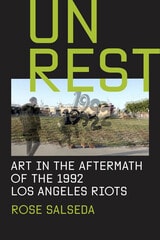
Unrest
Art in the Aftermath of the 1992 Los Angeles RiotsRose Salseda
University of Chicago Press, 2026
The first book to examine the visual art legacy of the 1992 Los Angeles Riots.
On April 29, 1992, a jury’s acquittal of four white Los Angeles police officers who had beaten Rodney King, a Black man, incited five days of intense protests. The 1992 Los Angeles Riots resulted in nearly four thousand fires, over $1 billion in property damage, fourteen thousand arrests, two thousand injuries, and sixty-three deaths. While many scholars have studied the period leading up to and following the riots, few have focused on how contemporary artists reacted to and continued to respond to this traumatic event.
In Unrest, Rose Salseda provides the first major art historical account of the 1992 Los Angeles Riots that chronicles the works of two generations of artists. Closely examining visual art that explores overlooked cross-racial, immigrant, and intergenerational experiences of the events, Salseda provocatively frames unrest as an act of the bereaved that makes visible the unrelenting experiences of injustice. She provides important insights into how we process violence through imagery; how the criminal justice system visualizes race and tolerates racial and xenophobic violence; and how we adapt racialized modes of viewing, normalize violence and oppression, and perhaps unwittingly contribute to these injustices. Ultimately, Unrest highlights how the experience of the 1992 Los Angeles Riots has driven artists to address the King beating and related episodes of racial violence for over thirty years—underscoring unrest as the inability to rest in the face of state-sanctioned violence, which persists to this day.
Unruly Cinema
History, Politics, and BollywoodRini Bhattacharya Mehta
University of Illinois Press, 2020
Rini Bhattacharya Mehta considers four aspects of Indian cinema's complicated history. She begins with the industry's surprising, market-driven triumph over imports from Hollywood and elsewhere in the 1930s. From there she explores how the nationalist social melodrama outwitted the government with its 1950s cinematic lyrical manifestoes. In the 1970s, an action cinema centered on the angry young male co-opted the voice of the oppressed. Finally, Mehta examines Indian film's discovery of the global neoliberal aesthetic that encouraged the emergence of Bollywood.
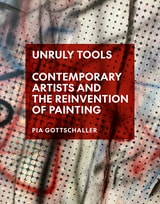
Unruly Tools
Contemporary Artists and the Reinvention of PaintingPia Gottschaller
J. Paul Getty Trust, The, 0
The first book to examine the role of unconventional tools in contemporary painting is required reading for anyone interested in painting’s recent past and future.
Painting, often regarded as the oldest of art forms, has been repeatedly declared “dead.” In this original and compelling study, technical art historian Pia Gottschaller thoroughly dismantles that notion, revealing how painters radically reimagined the medium in the years following World War II. No longer confined to the paintbrush, artists began to experiment with new methods, employing found, fabricated, and repurposed objects—as varied as an Afro comb, the human body, and a robotic airbrush—to create paintings unlike any seen before, revolutionizing the course of art history.
- Begins in 1945 with Jackson Pollock and the Gutai Art Association in Japan and traces the transformation of painting across the globe from the post-war period to the present.
- Explores the work of thirty-eight contemporary painters, including Amoako Boafo, Helen Frankenthaler, Yves Klein, Julie Mehretu, Beatriz Milhazes, Howardena Pindell, Kazuo Shiraga, and Andy Warhol.
- Richly illustrated with over 240 images of artists and their creations.
Unruly Tools is the first study of this kind and offers essential testimony to painting’s continued vitality and reinvention.

Unsafe Haven
The United States, the IRA and Political PrisonersKaren McElrath
Pluto Press, 2000
Karen McElrath questions US government attempts to portray an impartial role in the Irish conflict, arguing that historical and contemporary evidence reveals otherwise. She shows that, far from being a neutral process, the success of bids for political asylum often depends on the relationship between the US and the government of the applicant’s country of origin. Drawing on exclusive interviews with Irish Republicans who have faced deportation or extradition from the United States, or who have been prosecuted in the US for politically-motivated offences, McElrath explores the links between deportation and extradition outcomes and foreign policy issues. The tools of exclusion are defined in their historical context, and the history of US extradition law is described, with particular focus on the treaties with Britain. McElrath also examines the offences for which Irish and Irish-American Republicans have been charged, discusses the various levels of support for Irish political prisoners in the US, and summarises the findings by international human rights organisations.
Unsafe for Democracy
World War I and the U.S. Justice Department's Covert Campaign to Suppress DissentWilliam H. Thomas Jr.
University of Wisconsin Press, 2009
“Recommended for all libraries.”—Frederic Krome, Library Journal

Unsecular Media
MAKING NEWS OF RELIGION IN AMERICAMark Silk
University of Illinois Press, 1995
Mark Silk's book is the first to offer a comprehensive description and analysis of how American news media cover religion.
Unsettled Visions
Contemporary Asian American Artists and the Social ImaginaryMargo Machida
Duke University Press, 2008
Analyses of the work of individual artists are grouped around three major themes that Asian American artists engaged with during the 1990s: representations of the Other; social memory and trauma; and migration, diaspora, and sense of place. Machida considers the work of the photographers Pipo Nguyen-duy and Hanh Thi Pham, the printmaker and sculptor Zarina Hashmi, and installations by the artists Tomie Arai, Ming Fay, and Yong Soon Min. She examines the work of Marlon Fuentes, whose films and photographs play with the stereotyping conventions of visual anthropology, and prints in which Allan deSouza addresses the persistence of Orientalism in American popular culture. Machida reflects on Kristine Aono’s museum installations embodying the multigenerational effects of the internment of Japanese Americans during World War II and on Y. David Chung’s representations of urban spaces transformed by migration in works ranging from large-scale charcoal drawings to multimedia installations and an “electronic rap opera.”
Unspeakable Violence
Remapping U.S. and Mexican National ImaginariesNicole M. Guidotti-Hernández
Duke University Press, 2011
Unspeakable
A Life beyond Sexual MoralityRachel Hope Cleves
University of Chicago Press, 2020
Unspeakable approaches Douglas as neither monster nor literary hero, but as a man who participated in an exploitative sexual subculture that was tolerated in ways we may find hard to understand. Using letters, diaries, memoirs, police records, novels, and photographs—including sources by the children Douglas encountered—Cleves identifies the cultural practices that structured pedophilic behaviors in England, Italy, and other places Douglas favored. Her book delineates how approaches to adult-child sex have changed over time and offers insight into how society can confront similar scandals today, celebrity and otherwise.
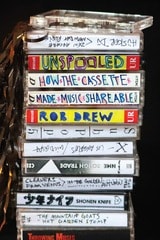
Unspooled
How the Cassette Made Music ShareableRob Drew
Duke University Press, 2024
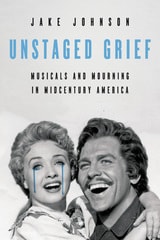
Unstaged Grief
Musicals and Mourning in Midcentury AmericaJake Johnson
University of Illinois Press, 2025
Often dismissed as escapism, screen musicals of the 1960s in fact tapped into unspoken sadness about an America that was slipping away. Jake Johnson delves into film and television musicals of the era to examine their place in networks of grieving in America, for America, and about America.
The Golden Age of musical theater ended just as Elisabeth Kübler-Ross’s On Death and Dying debuted, and Johnson uses Kübler-Ross’s five stages to frame the intertwining of musicals and grief. He analyzes films like Seven Brides for Seven Brothers and State Fair alongside paintings, poetry, and other images and texts to reveal how the musical theater engine built in the first half of the century broke down just as a new language emerged to describe the melancholy felt by people facing the end of the world they had known.
Nuanced and original, Unstaged Grief plumbs the grief, loss, and hope behind the Technicolor spectacle and rousing showstoppers.
Until Choice Do Us Part
Marriage Reform in the Progressive EraClare Virginia Eby
University of Chicago Press, 2013
For centuries, people have been thinking and writing—and fiercely debating—about the meaning of marriage. Just a hundred years ago, Progressive era reformers embraced marriage not as a time-honored repository for conservative values, but as a tool for social change.
In Until Choice Do Us Part, Clare Virginia Eby offers a new account of marriage as it appeared in fiction, journalism, legal decisions, scholarly work, and private correspondence at the turn into the twentieth century. She begins with reformers like sexologist Havelock Ellis, anthropologist Elsie Clews Parsons, and feminist Charlotte Perkins Gilman, who argued that spouses should be “class equals” joined by private affection, not public sanction. Then Eby guides us through the stories of three literary couples—Upton and Meta Fuller Sinclair, Theodore and Sara White Dreiser, and Neith Boyce and Hutchins Hapgood—who sought to reform marriage in their lives and in their writings, with mixed results. With this focus on the intimate side of married life, Eby views a historical moment that changed the nature of American marriage—and that continues to shape marital norms today.
Untimely Ruins
An Archaeology of American Urban Modernity, 1819-1919Nick Yablon
University of Chicago Press, 2009
American ruins have become increasingly prominent, whether in discussions of “urban blight” and home foreclosures, in commemorations of 9/11, or in postapocalyptic movies. In this highly original book, Nick Yablon argues that the association between American cities and ruins dates back to a much earlier period in the nation’s history. Recovering numerous scenes of urban desolation—from failed banks, abandoned towns, and dilapidated tenements to the crumbling skyscrapers and bridges envisioned in science fiction and cartoons—Untimely Ruins challenges the myth that ruins were absent or insignificant objects in nineteenth-century America.
The first book to document an American cult of the ruin, Untimely Ruins traces its deviations as well as derivations from European conventions. Unlike classical and Gothic ruins, which decayed gracefully over centuries and inspired philosophical meditations about the fate of civilizations, America’s ruins were often “untimely,” appearing unpredictably and disappearing before they could accrue an aura of age. As modern ruins of steel and iron, they stimulated critical reflections about contemporary cities, and the unfamiliar kinds of experience they enabled. Unearthing evocative sources everywhere from the archives of amateur photographers to the contents of time-capsules, Untimely Ruins exposes crucial debates about the economic, technological, and cultural transformations known as urban modernity. The result is a fascinating cultural history that uncovers fresh perspectives on the American city.
Untwisting the Serpent
Modernism in Music, Literature, and Other ArtsDaniel Albright
University of Chicago Press, 2000
Focusing on collaborations with a musical component, Albright views these works as either figures of dissonance that try to retain the distinctness of their various media (e.g. Guillaume Apollinaire's Les Mamelles de Tirésias) or figures of consonance that try to lose themselves in some total effect (e.g. Arnold Schoenberg's Erwartung). In so doing he offers a fresh picture of Modernism, and provides a compelling model for the analysis of all artistic collaborations.
Untwisting the Serpent is the recipient of the 2001 Susanne M. Glasscock Humanities Book Prize for Interdisciplinary Scholarship of the Center for Humanities Research at Texas A&M University.
Untying Things Together
Philosophy, Literature, and a Life in TheoryEric L. Santner
University of Chicago Press, 2022
In 1905, Freud published his Three Essays on the Theory of Sexuality, the book that established the core psychoanalytic thesis that sexuality is central to formations of the unconscious. With this book, Eric L. Santner inverts Freud’s title to take up the sexuality of theory—or, more exactly, the modes of enjoyment to be found in the kinds of critical thinking that, since the 1960s, have laid claim to that ancient word, “theory.” Santner unfolds his argument by tracking his own relationship with this tradition and the ways his intellectual and spiritual development has been informed by it.
Untying Things Together is both an intellectual history of major theoretical paradigms and a call for their reexamination and renewal. Revisiting many of the topics he has addressed in previous work, Santner proposes a new way of conceptualizing the eros of thinking, attuned to how our minds and bodies individually and collectively incorporate or “encyst” on a void at the heart of things. Rather than proposing a “return to theory,” Santner’s book simply employs theory as a way of further “(un)tying together” the resources of philosophy, art and literature, theology, psychoanalysis, political thought, and more.
Unveiling Secrets of War in the Peruvian Andes
Olga M. González
University of Chicago Press, 2011
The Maoist guerrilla group Shining Path launched its violent campaign against the government in Peru’s Ayacucho region in 1980. When the military and counterinsurgency police forces were dispatched to oppose the insurrection, the violence quickly escalated. The peasant community of Sarhua was at the epicenter of the conflict, and this small village is the focus of Unveiling Secrets of War in the Peruvian Andes. There, nearly a decade after the event, Olga M. González follows the tangled thread of a public secret: the disappearance of Narciso Huicho, the man blamed for plunging Sarhua into a conflict that would sunder the community for years.
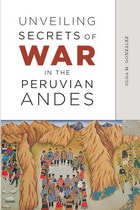
Drawing on extensive fieldwork and a novel use of a cycle of paintings, González examines the relationship between secrecy and memory. Her attention to the gaps and silences within both the Sarhuinos’ oral histories and the paintings reveals the pervasive reality of secrecy for people who have endured episodes of intense violence. González conveys how public secrets turn the process of unmasking into a complex mode of truth telling. Ultimately, public secrecy is an intricate way of “remembering to forget” that establishes a normative truth that makes life livable in the aftermath of a civil war.
Unveiling Traditions
Postcolonial Islam in a Polycentric WorldAnouar Majid
Duke University Press, 2000
Majid moves beyond Edward Said’s unmasking of orientalism in the West to examine the intellectual assumptions that have prevented a more nuanced understanding of Islam’s legacies. In addition to questioning the pervasive logic that assumes the “naturalness” of European social and political organizations, he argues that it is capitalism that has intensified cultural misunderstanding and created global tensions. Besides examining the resiliency of orientalism, the author critically examines the ideologies of nationalism and colonialist categories that have redefined the identity of Muslims (especially Arabs and Africans) in the modern age and totally remapped their cultural geographies. Majid is aware of the need for Muslims to rethink their own assumptions. Addressing the crisis in Arab-Muslim thought caused by a desire to simultaneously “catch up” with the West and also preserve Muslim cultural authenticity, he challenges Arab and Muslim intellectuals to imagine a post-capitalist, post-Eurocentric future. Critical of Islamic patriarchal practices and capitalist hegemony, Majid contends that Muslim feminists have come closest to theorizing a notion of emancipation that rescues Islam from patriarchal domination and resists Eurocentric prejudices.
Majid’s timely appeal for a progressive, multicultural dialogue that would pave the way to a polycentric world will interest students and scholars of postcolonial, cultural, Islamic, and Marxist studies.
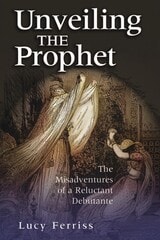
Unveiling the Prophet
The Misadventures of a Reluctant DebutanteLucy Ferriss
University of Missouri Press, 2005