Results by title
22279 books match the query 'Social Science' and 356 start with u
Unraveling the Garment Industry
Transnational Organizing and Women’s WorkEthel C. Brooks
University of Minnesota Press, 2007
Brooks analyzes a two-pronged problem in consumer boycott campaigns against labor abuse in the garment industry. First, how are we to understand the political necessities of local protest such as the right to unionize against the emphasis placed on consumer boycotts? Second, what and whose agency is privileged or obscured within the symbolic economies and the politics of information deployed by these campaigns? Tying both of these questions together is a commitment to seeing globalization as embedded in the everyday realities of the local.
Drawing attention to the race, class, and gender assumptions central to powerful consumer boycotts, Brooks reveals how these movements unintentionally reinforce the global economic forces they denounce.
Ethel C. Brooks is assistant professor of women’s and gender studies and sociology at Rutgers University.
Unraveling
Remaking Personhood in a Neurodiverse AgeMatthew J. Wolf-Meyer
University of Minnesota Press, 2020
Developing a cybernetic model of subjectivity and personhood that honors disability experiences to reconceptualize the category of the human
Twentieth-century neuroscience fixed the brain as the basis of consciousness, the self, identity, individuality, even life itself, obscuring the fundamental relationships between bodies and the worlds that they inhabit. In Unraveling, Matthew J. Wolf-Meyer draws on narratives of family and individual experiences with neurological disorders, paired with texts by neuroscientists and psychiatrists, to decenter the brain and expose the ableist biases in the dominant thinking about personhood.
Unraveling articulates a novel cybernetic theory of subjectivity in which the nervous system is connected to the world it inhabits rather than being walled off inside the body, moving beyond neuroscientific, symbolic, and materialist approaches to the self to focus instead on such concepts as animation, modularity, and facilitation. It does so through close readings of memoirs by individuals who lost their hearing or developed trauma-induced aphasia, as well as family members of people diagnosed as autistic—texts that rethink modes of subjectivity through experiences with communication, caregiving, and the demands of everyday life.
Arguing for a radical antinormative bioethics, Unraveling shifts the discourse on neurological disorders from such value-laden concepts as “quality of life” to develop an inclusive model of personhood that honors disability experiences and reconceptualizes the category of the human in all of its social, technological, and environmental contexts.
Unreasonable Doubt
Circumstantial Evidence and an Ordinary Murder in New HavenNorma Thompson
University of Missouri Press, 2006
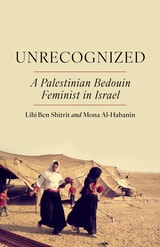
Unrecognized
A Palestinian Bedouin Feminist in IsraelLihi Ben Shitrit
Rutgers University Press, 2027
In 1998, when Mona Al-Habanin was twenty-eight years old and pregnant with her sixth child, she stood before a council of al-Naqab Bedouin shaykhs and faced the most difficult decision of her life: give up her children or be responsible for more killings in her tribe.
This book tells the extraordinary story of Mona Al-Habanin (b. 1970), the first Bedouin woman to run for elected office in Israel's Negev Desert. Through Mona's life, it illuminates Indigenous Bedouin women's traumas and resilience while documenting a genealogy of contemporary Palestinian Bedouin feminism. It traces her journey from desert tent dwelling through forced dislocation, her community's struggles with violence against women, and her battle for her children—against state-sanctioned tribal justice rooted in British colonial paradigms and Zionist settler-native relations—and to her turn to fierce and irreverent activism, taboo-breaking, and political trailblazing. This book tells the story of an unrecognized community under siege and of a new form of Indigenous feminism that bravely defies the violence of silencing.
Unreconciled
From Racial Reconciliation to Racial Justice in Christian EvangelicalismAndrea Smith
Duke University Press, 2019
Unrepayable Debt
Law, Redress, Reconciliation, and the Unmaking of EmpireYukiko Koga
University of Chicago Press, 2026
What does it mean, and take, to repay the unrepayable?
Unrepayable Debt explores belated attempts to reckon with the savage plundering of labor and life under the Japanese empire. Located within global conversations on reparations for colonialism and slavery, and centered on slave labor lawsuits brought by Chinese victims seeking overdue justice in Japanese courts, Yukiko Koga traces a sea change in the legal sphere propelled by an unprecedented transnational redress movement. The lawsuits exposed not only the original violence but also a structure of transitional injustice etched onto the unmaking of the Japanese empire, which left victims silenced and unredressable for decades.
Challenging the idea of reckoning as a discrete event that brings closure through settlements, apology, or compensation, Koga’s ethnography details the slow and messy intergenerational work of reconciliation on the ground. The book shows how the re-pairing of severed relations, separated by lineages of victimhood and perpetration, lies at the core of repair. By bringing to the surface the prolonged and entangled processes of decolonization and deimperialization, Unrepayable Debt compels a rethinking of what redress, repair, and reconciliation mean, how they are practiced, and where accountability lies.
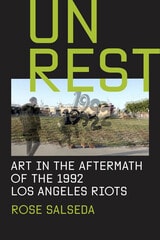
Unrest
Art in the Aftermath of the 1992 Los Angeles RiotsRose Salseda
University of Chicago Press, 2026
The first book to examine the visual art legacy of the 1992 Los Angeles Riots.
On April 29, 1992, a jury’s acquittal of four white Los Angeles police officers who had beaten Rodney King, a Black man, incited five days of intense protests. The 1992 Los Angeles Riots resulted in nearly four thousand fires, over $1 billion in property damage, fourteen thousand arrests, two thousand injuries, and sixty-three deaths. While many scholars have studied the period leading up to and following the riots, few have focused on how contemporary artists reacted to and continued to respond to this traumatic event.
In Unrest, Rose Salseda provides the first major art historical account of the 1992 Los Angeles Riots that chronicles the works of two generations of artists. Closely examining visual art that explores overlooked cross-racial, immigrant, and intergenerational experiences of the events, Salseda provocatively frames unrest as an act of the bereaved that makes visible the unrelenting experiences of injustice. She provides important insights into how we process violence through imagery; how the criminal justice system visualizes race and tolerates racial and xenophobic violence; and how we adapt racialized modes of viewing, normalize violence and oppression, and perhaps unwittingly contribute to these injustices. Ultimately, Unrest highlights how the experience of the 1992 Los Angeles Riots has driven artists to address the King beating and related episodes of racial violence for over thirty years—underscoring unrest as the inability to rest in the face of state-sanctioned violence, which persists to this day.
Unruly Audience
Folk Interventions in Popular MediaGreg Kelley
Utah State University Press, 2020
Greg Kelley examines how “folk interventions” challenge institutional media with active—often public—social engagement. Drawing on a diverse range of examples—popular music parodies of “The Colonel Bogey March,” jokes about Disney’s Snow White and the Seven Dwarfs, touristic performance at Jamaica’s haunted Rose Hall, internet memes about NBC’s The Office, children’s parodies of commercials, and jokes about joking—Kelley demonstrates how active audiences mobilize folklore to disrupt dominant modes of media discourse. With materials both historical and contemporary and compiled from print, internet archives, and original fieldwork, Kelley’s audience-centered analysis demonstrates that producers of media are not the sole arbiters of meaning. With folklore as an important tool, unruly audiences refashion mediated expression so that the material becomes more relevant to their own circumstances.
Unruly Audience foregrounds the fluid interplay between media production and audience reception and between forces of cultural domination and cultural resistance, bringing new analytical insights to familiar folk practices. This carefully crafted book will speak to students and scholars in folklore, popular culture, and media studies in multidisciplinary ways.
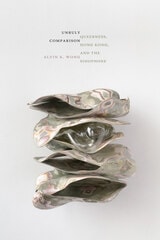
Unruly Comparison
Queerness, Hong Kong, and the SinophoneAlvin K. Wong
Duke University Press, 2025
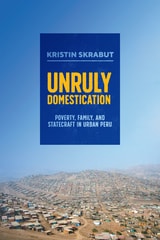
Unruly Domestication
Poverty, Family, and Statecraft in Urban PeruKristin Skrabut
University of Texas Press, 2024
2024 Flora Tristán Book Award, Sección Perú, Latin American Studies Association
How the international war on poverty shapes identities, relationships, politics, and urban space in Peru.
Unruly Domestication investigates how Peru’s ongoing, internationally endorsed "war on poverty" shapes politics, intimate identities, and urban space in Lima. Drawing on a decade of embedded, ethnographic research in Lima’s largest and most recently founded “extreme poverty zone,” Kristin Skrabut demonstrates how Peru’s efforts to fight poverty by formalizing property, identity, and family status perpetuate environmentally unsustainable urban sprawl, deepen discrimination against single mothers, and undermine Peruvians’ faith in public officials and in one another. In the process, Skrabut reveals myriad entanglements of poverty, statecraft, and private life, exploring how families are made and unmade through political practices, how gender inequalities are perpetuated through policy, and how Peruvians’ everyday pursuits of state-sanctioned domestic ideals reproduce informality and landscapes of poverty in the urban periphery.
The only full-length ethnography written about Lima’s iconic and policy-inspiring shantytowns in thirty years, Unruly Domestication provides valuable insight into the dynamics of housing and urban development in the Global South, elucidating the most intimate and profound effects of global efforts to do good.
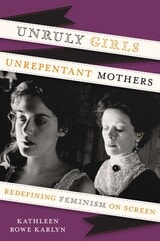
Unruly Girls, Unrepentant Mothers
Redefining Feminism on ScreenBy Kathleen Rowe Karlyn
University of Texas Press, 2010
Since the 1990s, when Reviving Ophelia became a best seller and "Girl Power" a familiar anthem, girls have assumed new visibility in the culture. Yet in asserting their new power, young women have redefined femininity in ways that have often mystified their mothers. They have also largely disavowed feminism, even though their new influence is a likely legacy of feminism's Second Wave. At the same time, popular culture has persisted in idealizing, demonizing, or simply erasing mothers, rarely depicting them in strong and loving relationships with their daughters.
Unruly Girls, Unrepentant Mothers, a companion to Kathleen Rowe Karlyn's groundbreaking work, The Unruly Woman, studies the ways popular culture and current debates within and about feminism inform each other. Surveying a range of films and television shows that have defined girls in the postfeminist era—from Titanic and My So-Called Life to Scream and The Devil Wears Prada, and from Love and Basketball to Ugly Betty—Karlyn explores the ways class, race, and generational conflicts have shaped both Girl Culture and feminism's Third Wave. Tying feminism's internal conflicts to negative attitudes toward mothers in the social world, she asks whether today's seemingly materialistic and apolitical girls, inspired by such real and fictional figures as the Spice Girls and Buffy the Vampire Slayer, have turned their backs on the feminism of their mothers or are redefining unruliness for a new age.
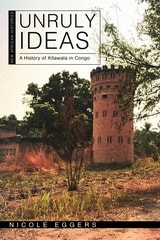
Unruly Ideas
A History of Kitawala in CongoNicole Eggers
Ohio University Press, 2023
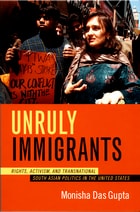
Unruly Immigrants
Rights, Activism, and Transnational South Asian Politics in the United StatesMonisha Das Gupta
Duke University Press, 2006
Das Gupta offers an ethnography of seven South Asian organizations in the northeastern United States, looking at their development and politics as well as the conflicts that have emerged within the groups over questions of sexual, class, and political identities. She examines the ways that women’s organizations have defined and responded to questions of domestic violence as they relate to women’s immigration status; she describes the construction of a transnational South Asian queer identity and culture by people often marginalized by both mainstream South Asian and queer communities in the United States; and she draws attention to the efforts of labor groups who have sought economic justice for taxi drivers and domestic workers by confronting local policies that exploit cheap immigrant labor. Responding to the shortcomings of the state, their communities, and the larger social movements of which they are a part, these groups challenge the assumption that citizenship is the necessary basis of rights claims.
Unruly Practices
Power, Discorse, and Gender in Contemporary Social TheoryFraser, Nancy
University of Minnesota Press, 1989
University of California, Berkeley
Unruly Practices brings together a series of widely discussed essays in feminism and social theory. Read together, they constitute a sustained critical encounter with leading European and American approaches to social theory. In addition, Nancy Fraser develops a new and original socialist-feminist critical theory that overcomes many of the limitations of current alternatives. First, in a series of critical essays, she deploys philosophical and literary techniques to sort the wheat from the chaff in the work of Michel Foucault, the French deconstructionists, Richard Rorty, and Jurgen Habermas. Then, in a group of constructive essays, she incorporates their respective strengths in a new critical theory of late-capitalist political culture.
Fraser breaks new ground methodologically by integrating the previously divergent insights of poststructuralism, critical social theory, feminist theory, and pragmatism. Thematically, she deals with varied forms of dominance and subordination in modern, industrial, late-capitalist societies - especially gender dominance and subordination; state-bureaucratic forms of organization; the institutional politics of knowledge and expertise; and the structure and function of social-welfare programs. In the last section of the book, these themes are integrated in an original theory of “the politics of need interpretation.” This concept becomes the linchpin of he socialist-feminist critical theory proposed in the last chapter.
Unruly Souls
The Digital Activism of Muslim and Christian FeministsKristin M. Peterson
Rutgers University Press, 2022
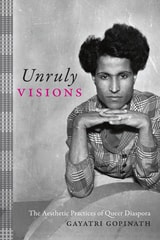
Unruly Visions
The Aesthetic Practices of Queer DiasporaGayatri Gopinath
Duke University Press, 2018

Unruly Women
200 Years of Philosophers, Romantics, and RevolutionariesKristin Gjesdal
University of Chicago Press, 0
A vivid account of the powerful ideas and remarkable lives of eleven women philosophers across two centuries.
When you think of modern philosophers, who comes to mind? Likely, they are popular figures such as Kant, Hegel, Marx, and Nietzsche. But what if the history of philosophy we know is missing some of its most vital voices?
As Kristin Gjesdal shows us in Unruly Women, there is an abundance of important thinkers who were famous in their time, helped shape philosophy as we know it, and yet have been pushed into oblivion. She introduces eleven iconic women philosophers, from Germaine de Staël in Paris during the French Revolution to Angela Davis during the Black freedom movement in the US, whose ideas challenged and revolutionized the intellectual orthodoxies of their time. Moving across centuries, traditions, and political contexts, Unruly Women illustrates how the work of these philosophers engaged with questions that remain urgent now: What does freedom imply? How are power and inequality produced and sustained? What roles do gender, race, and class play in shaping our lives? And who gets to define what counts as knowledge, reason, and philosophy?
More than just an act of historical recovery, this book places these forgotten thinkers in conversation with one another, revealing a new history of philosophy—one shaped not only by abstract systems and canonical texts, but also by struggles over justice, emancipation, and political change. The result is a vibrant and accessible account of philosophy as something lived, contested, and deeply connected to the world around us—with unruly ideas that still matter today.

Unsafe Haven
The United States, the IRA and Political PrisonersKaren McElrath
Pluto Press, 2000
Karen McElrath questions US government attempts to portray an impartial role in the Irish conflict, arguing that historical and contemporary evidence reveals otherwise. She shows that, far from being a neutral process, the success of bids for political asylum often depends on the relationship between the US and the government of the applicant’s country of origin. Drawing on exclusive interviews with Irish Republicans who have faced deportation or extradition from the United States, or who have been prosecuted in the US for politically-motivated offences, McElrath explores the links between deportation and extradition outcomes and foreign policy issues. The tools of exclusion are defined in their historical context, and the history of US extradition law is described, with particular focus on the treaties with Britain. McElrath also examines the offences for which Irish and Irish-American Republicans have been charged, discusses the various levels of support for Irish political prisoners in the US, and summarises the findings by international human rights organisations.
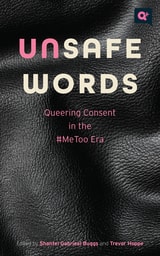
Unsafe Words
Queering Consent in the #MeToo EraShantel Gabrieal Buggs
Rutgers University Press, 2023
Telling a queerer side of the #MeToo story, Unsafe Words dares to challenge dogmatic assumptions about sex and consent while developing tools and language to promote more ethical and more pleasurable sex for everyone.
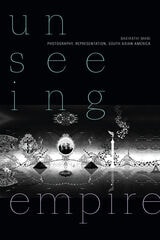
Unseeing Empire
Photography, Representation, South Asian AmericaBakirathi Mani
Duke University Press, 2020
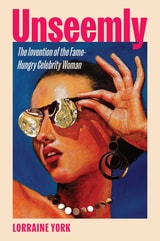
Unseemly
The Invention of the Fame-Hungry Celebrity WomanLorraine York
University of Delaware Press, 2027
Fame-shaming suggests that those who identify as women and openly pursue public recognition transgress the bounds of propriety and good taste. In Unseemly, Lorraine York analyzes fame-hunger accusations that have been directed at “fame whores” and “drama queens” from the seventeenth to the twenty-first centuries, showing how these women have creatively handled such accusations. From Margaret Cavendish, Aphra Behn, Barbara Strozzi, Eliza Haywood, and Sarah Bernhardt to Helen Frankenthaler, Yoko Ono, Madonna, Kim Kardashian, Hillary Rodham Clinton, and Alexandria Ocasio-Cortez, York shows how fame-shaming has been informed by expectations of gender, sexuality, race, and class.
The unease that gives rise to public shaming of women who desire fame, says York, is a reaction to their skillful use of emergent media, whether print, film, secular song, science fiction, reality television, political speech, or social media. Fame hunger is not, as some assume, the last refuge of the untalented. To the contrary, women who have been accused of an unseemly thirst for celebrity turn out to be especially adept at emergent and boundary-breaking forms of cultural expression.
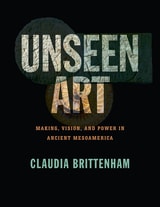
Unseen Art
Making, Vision, and Power in Ancient MesoamericaClaudia Brittenham
University of Texas Press, 2023
In Unseen Art, Claudia Brittenham unravels one of the most puzzling phenomena in Mesoamerican art history: why many of the objects that we view in museums today were once so difficult to see. She examines the importance that ancient Mesoamerican people assigned to the process of making and enlivening the things we now call art, as well as Mesoamerican understandings of sight as an especially godlike and elite power, in order to trace a gradual evolution in the uses of secrecy and concealment, from a communal practice that fostered social memory to a tool of imperial power.
Addressing some of the most charismatic of all Mesoamerican sculptures, such as Olmec buried offerings, Maya lintels, and carvings on the undersides of Aztec sculptures, Brittenham shows that the creation of unseen art has important implications both for understanding status in ancient Mesoamerica and for analyzing art in the present. Spanning nearly three thousand years of the Indigenous art of Mexico, Guatemala, Honduras, and Belize, Unseen Art connects the dots between vision, power, and inequality, providing a critical perspective on our own way of looking.
Unseen Flesh
Gynecology and Black Queer Worth-Making in BrazilNessette Falu
Duke University Press, 2023
Unsettled Belonging
Educating Palestinian American Youth after 9/11Thea Renda Abu El-Haj
University of Chicago Press, 2015
Abu El-Haj explores the school as the primary site where young people from immigrant communities encounter the central discourses about what it means to be American. She illustrates the complex ways social identities are bound up with questions of belonging and citizenship, and she details the processes through which immigrant youth are racialized via everyday nationalistic practices. Finally, she raises a series of crucial questions about how we educate for active citizenship in contemporary times, when more and more people’s lives are shaped within transnational contexts. A compelling account of post-9/11 immigrant life, Unsettled Belonging is a steadfast look at the disjunctures of modern citizenship.
Unsettled Borders
The Militarized Science of Surveillance on Sacred Indigenous LandFelicity Amaya Schaeffer
Duke University Press, 2022
Unsettled Futures
Carceral Circuits and Old Age in JapanJason Danely
Vanderbilt University Press, 2024
Elderly ex-offenders are some of the most vulnerable and marginalized groups in Japan today, with high levels of poverty and homelessness, disability, mental health problems, and social isolation. Those with a history of incarceration and, by extension, their family, face stigma and discrimination that further erodes their ability to reintegrate and puts them at greater risk of reoffending. Unlike in any other country in the world, older people in Japan have a higher rate of reoffending than other age groups. In Unsettled Futures, author Jason Danely argues that we cannot dismiss these individuals merely as deviants; rather, their circumstances reveal deep contradictions in the overlapping terrain of welfare and punishment, and the precarity that forecloses on possibilities for older people to build a good life.
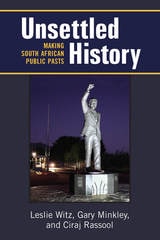
Unsettled History
Making South African Public PastsLeslie Witz, Gary Minkley, and Ciraj Rassool
University of Michigan Press, 2017
Leslie Witz, Gary Minkley, and Ciraj Rassool take the reader to sites of historical production in which complex ideas about pasts are invoked, and navigate a path toward understanding the agencies of image-making and memory production. This volume is the outcome of the authors’ intensive collaborative research and engagement over twenty-five years on questions including the production and performance of apartheid history; the cultural politics of social history; South Africa’s Truth and Reconciliation Commission and practices of orality; tourism as an arena of image-making and historical construction; museums as sites of heritage production for a new South Africa; photographs, archival meanings, and the construction of the social documentary; and the centenary commemorations of the South African War and the making of race. The authors not only witnessed many of these instances of history-making but were also participants in their constitution.
Unsettled Labors
Migrant Care Work in Palestine/IsraelRachel H. Brown
Duke University Press, 2024
Unsettled Solidarities
Asian and Indigenous Cross-Representations in the AméricasQuynh Nhu Le
Temple University Press, 2019
Unsettled Solidarities examines contemporary Asian and Indigenous cross-representations within different settler states in the Américas. Quynh Nhu Le looks at literary works by both groups alongside public apologies, interviews, and hemispheric race theories to trace cross-community tensions and possibilities for solidarities amidst the uneven imposition of racialization and settler colonization.
Contrasting texts such as Maxine Hong Kingston’s China Men with Gerald Vizenor’s Hiroshima Bugi, and Karen Tei Yamashita’s Through the Arc of the Rain Forest with Leslie Marmon Silko’s Almanac of the Dead, among others, Le reveals how settler colonialism persists through the liberal ideological structuring or incorporation of critical and political resistance. She illuminates the tense collisions of Asian and Indigenous movements from the heroic/warrior traditions, reparations and redress, and transnational/cross-racial mobilization against global capital to mixed-race narratives.
Reading these tensions as formed through the unstable grammatical and emotional economies of liberalism, Le frames settler colonialism as a process that is invoked and yet ruptured by Asian and Indigenous peoples. In analyzing Asian/Indigenous crossings in the United States, Canada, Mexico, and Brazil, Unsettled Solidarities conveys the logics and instabilities that connect these settler empires.
Unsettled Subjects
Restoring Feminist Politics to Poststructuralist CritiqueSusan Lurie
Duke University Press, 1997
In her analysis, Lurie traces each author’s strategies for revealing and challenging the ways that patriarchal gender ideology profits from what is always plural and contested female subjectivity. Only such an inquiry, Lurie demonstrates, can explain the impasses that have steered poststructuralist feminism away from gender as a category of analysis and can point toward the models necessary for a more complete feminist critique of patriarchal power.
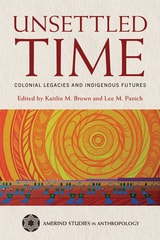
Unsettled Time
Colonial Legacies and Indigenous FuturesEdited by Kaitlin M. Brown and Lee M. Panich
University of Arizona Press, 2027
Time is at the core of how we think about colonialism in North America, with many seeing the first footfalls of newly arrived Europeans as indelibly marking the end of one era and the beginning of another. However, this understanding of time often serves to perpetuate outdated narratives about Indigenous people, normalizing colonial domination.
This volume unsettles conventional understandings of time in the study of Indigenous-colonial interactions in North America, acknowledging both the enduring nature of colonial legacies and the radical possibilities of Indigenous futures. The contributors largely approach this goal from the perspective of archaeology, with a particular concern for how we can effectively employ archaeological and related historical methods in collaboration with tribal nations and other descendant communities. The chapters engage with broader interdisciplinary questions about time, periodization, and temporality to build more nuanced and responsive understandings of Native-lived colonialism.
Contributors
Nathan Acebo
Kaitlin M. Brown
Wade Campbell
Emily Clark
Ruben Cu:k Ba’ak
Jacob Holland-Lulewicz
Nicholas V. Kessler
Nicholas C. Laluk
Koji Lau-Ozawa
Heather Law Pezzarossi
Lindsay Martel Montgomery
Lee M. Panich
Michelle M. Pigott
Robert W. Preucel
Christopher B. Rodning
Sarah Simeonoff
Unsettled Visions
Contemporary Asian American Artists and the Social ImaginaryMargo Machida
Duke University Press, 2008
Analyses of the work of individual artists are grouped around three major themes that Asian American artists engaged with during the 1990s: representations of the Other; social memory and trauma; and migration, diaspora, and sense of place. Machida considers the work of the photographers Pipo Nguyen-duy and Hanh Thi Pham, the printmaker and sculptor Zarina Hashmi, and installations by the artists Tomie Arai, Ming Fay, and Yong Soon Min. She examines the work of Marlon Fuentes, whose films and photographs play with the stereotyping conventions of visual anthropology, and prints in which Allan deSouza addresses the persistence of Orientalism in American popular culture. Machida reflects on Kristine Aono’s museum installations embodying the multigenerational effects of the internment of Japanese Americans during World War II and on Y. David Chung’s representations of urban spaces transformed by migration in works ranging from large-scale charcoal drawings to multimedia installations and an “electronic rap opera.”
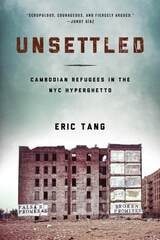
Unsettled
Cambodian Refugees in the New York City HyperghettoEric Tang
Temple University Press, 2015
After surviving the Khmer Rouge genocide, followed by years of confinement to international refugee camps, as many as 10,000 Southeast Asian refugees arrived in the Bronx during the 1980s and ‘90s. Unsettled chronicles the unfinished odyssey of Bronx Cambodians, closely following one woman and her family for several years as they survive yet resist their literal insertion into concentrated Bronx poverty.
Eric Tang tells the harrowing and inspiring stories of these refugees to make sense of how and why the displaced migrants have been resettled in the “hyperghetto.” He argues that refuge is never found, that rescue discourses mask a more profound urban reality characterized by racialized geographic enclosure, economic displacement and unrelenting poverty, and the criminalization of daily life.
Unsettled views the hyperghetto as a site of extreme isolation, punishment, and confinement. The refugees remain captives in late-capitalist urban America. Tang ultimately asks: What does it mean for these Cambodians to resettle into this distinct time and space of slavery’s afterlife?
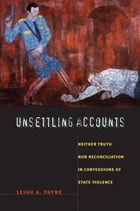
Unsettling Accounts
Neither Truth nor Reconciliation in Confessions of State ViolenceLeigh A. Payne
Duke University Press, 2008
Payne draws on interviews, unedited television film, newspaper archives, and books written by perpetrators to analyze confessions of state violence in Argentina, Chile, Brazil, and South Africa. Each of these four countries addressed its past through a different institutional form—from blanket amnesty, to conditional amnesty based on confessions, to judicial trials. Payne considers perpetrators’ confessions as performance, examining what they say and what they communicate nonverbally; the timing, setting, and reception of their confessions; and the different ways that they portray their pasts, whether in terms of remorse, heroism, denial, or sadism, or through lies or betrayal.
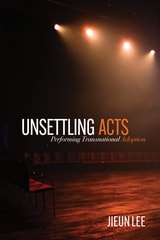
Unsettling Acts
Performing Transnational AdoptionJieun Lee
The Ohio State University Press, 2025
Analyzing contemporary theater and performance works about Korean transnational adoption, Jieun Lee’s Unsettling Acts: Performing Transnational Adoption challenges longstanding ideas about adoption. Lee contends that in staging adoptees’ birth family searches and reunions, theater and performance artists unsettle dominant discourses that have essentialized adoptees through ethnonationalist, gendered, and postwar humanitarian narratives in both birth and adoptive cultures. In doing so, Lee reveals how these performances engage in acts of disavowal of and resistance to mythologies of adoption and adoptee experience.
Lee examines twelve works—from South Korea, the United States, the United Kingdom, Belgium, and Denmark—including plays, musicals, solo performances, community-based theater, and performance art. Through her analysis, theater and performance become a means for reimagining adoptees’ identity, kinship, and sense of belonging. Further, these pieces encourage critical exploration of the history, politics, and social impacts of Korean transnational adoption. These works thus nurture a countermemory to engender redressive accountability and transpacific justice, pointing a way forward for remaking the transnational adoptee experience in the twenty-first century.
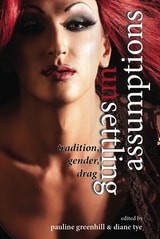
Unsettling Assumptions
Tradition, Gender, DragPauline Greenhill
Utah State University Press, 2014
In Unsettling Assumptions, editors Pauline Greenhill and Diane Tye examine how tradition and gender come together to unsettle assumptions about culture and its study.
Contributors explore the intersections of traditional expressive culture and sex/gender systems to question, investigate, or upset concepts like family, ethics, and authenticity. Individual essays consider myriad topics such as Thanksgiving turkeys, rockabilly and bar fights, Chinese tales of female ghosts, selkie stories, a noisy Mennonite New Year’s celebration, the Distaff Gospels, Kentucky tobacco farmers, international adoptions, and more.
In Unsettling Assumptions, folkloric forms express but also counteract negative aspects of culture like misogyny, homophobia, and racism. But expressive culture also emerges as fundamental to our sense of belonging to a family, an occupation, or friendship group and, most notably, to identity performativity and the construction and negotiation of power.
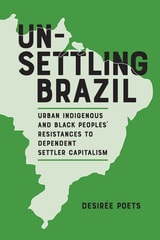
Unsettling Brazil
Urban Indigenous and Black Peoples' Resistances to Dependent Settler CapitalismDesirée Poets
University of Alabama Press, 0
Analyzes favela, quilombola, and indigenous communities’ responses to settler colonialism in urban Brazil. Based on ethnographic research and her experiences growing up in Brazil, the author tells the stories of communities in Rio de Janeiro, São Paulo, and Belo Horizonte
Unsettling Brazil offers a powerful account of five urban Indigenous and Black communities and movements in Brazil that illuminates their struggle for land, dignity, and their ways of life amid historic and ongoing settler colonialism, marked by militarization and dependent capitalist development. The in-depth case studies are the Indigenous movement Aldeia Maracanã and the quilombola community Sacopã in Rio, the Quilombo dos Luízes in Belo Horizonte, the Indigenous movement behind the Pindorama scholarship program in São Paulo, and the Complexo da Maré favela in Rio. For each, Poets vividly documents the intersectional and transnational structures of power that perpetuate the erasure, dispossession, and exploitation of nonwhite populations and the creative ways that Black and Indigenous communities have mobilized to unsettle these structures.
Drawing on the knowledge produced by Black and Indigenous organizers and thinkers, Poets argues for an interdisciplinary framework that prioritizes the voices and experiences of these communities. Addressing increasingly salient calls for decolonization, Poets ponders the paradoxical role of rights, citizenship, and the state in the fight for freedom and justice. Unsettling Brazil urges readers to confront the uncomfortable truths about the nation's history and stands in solidarity with those fighting to reclaim their heritage, identity, and land.

Unsettling Catan
Detached Design in EurogamesJ. Rey Lee
University of Michigan Press, 2025
Although peaceful revolutions are usually the best kind, it’s worth questioning how these games cultivate peaceful feelings. Today, peaceful-feeling eurogames often settle into detached design—a mindset of making conflict feel peaceful by dampening conflicted feelings. Unsettling Catan questions how peaceful-feeling eurogames can make implicitly imperialist themes palatable by cultivating a detached mindset that imagines power as peaceful, neutral, and abstract. To ask the hard questions that eurogames often look away from, the book walks through each aspect of Catan’s gameplay (placing hexes, rolling the dice, robbing and trading, collecting resources, building and scoring) to explore how simple design decisions can play out, or play with, cultural ideas and ideals. As the first entry in the Tabletop Games book series, Unsettling Catan introduces key concepts for thinking about board games as a medium and offers accessible game analyses and personal reflections to help players, creators, and scholars reimagine what board games can be and become.
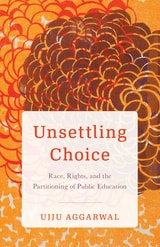
Unsettling Choice
Race, Rights, and the Partitioning of Public EducationUjju Aggarwal
University of Minnesota Press, 2024
How the Great Recession revealed a system of school choice built on crisis, precarity, and exclusion
What do universal rights to public goods like education mean when codified as individual, private choices? Is the “problem” of school choice actually not about better choices for all but, rather, about the competition and exclusion that choice engenders—guaranteeing a system of winners and losers? Unsettling Choice addresses such questions through a compelling ethnography that illuminates how one path of neoliberal restructuring in the United States emerged in tandem with, and in response to, the Civil Rights movement.
Drawing on ethnographic research in one New York City school district, Unsettling Choice traces the contestations that surfaced when, in the wake of the 2007–2009 Great Recession, public schools navigated austerity by expanding choice-based programs. Ujju Aggarwal argues that this strategy, positioned as “saving public schools,” mobilized mechanisms rooted in market logics to recruit families with economic capital on their side, thereby solidifying a public sphere that increasingly resembled the private—where contingency was anticipated and rights for some were marked by intensified precarity for poor and working-class Black and Latinx families.
As Unsettling Choice shows, these struggles over public schools—one of the last remaining universal public goods in the United States—were entrapped within neoliberal regimes that exceeded privatization and ensured exclusion even as they were couched in language of equity, diversity, care, and rights. And yet this richly detailed and engaging book also tracks an architecture of expansive rights, care, and belonging built among poor and working-class parents at a Head Start center, whose critique of choice helps us understand how we might struggle for—and reimagine—justice, and a public that remains to be won.
Retail e-book files for this title are screen-reader friendly with images accompanied by short alt text and/or extended descriptions.

Unsettling Geographies
Antiblackness, Gendered Violence, and Indigenous Dispossession in GuyanaShanya Cordis
Duke University Press, 2027
Unsettling India
Affect, Temporality, TransnationalityPurnima Mankekar
Duke University Press, 2015
Unsettling Land
Relational Practice for Contemporary PoliticsPreeti Sampat
University Press of Colorado, 2026
Unsettling Land brings together anthropologists and geographers examining land relations across South Asia, the Americas, Northeast Africa, Eastern Europe, and Oceania to show how land’s forms, affordances, and meanings shift across diverse historical contexts and uses. Land is not a fixed, passive surface or static resource but a dynamic entity with agency that is shaped by social, historical, and material relations. As such, land is crucial to understanding contemporary political challenges around climate change, capitalism, and conflict.
Unsettling Land offers vital conceptual and methodological tools that challenge the familiar sociomaterial binaries centered on nature/culture, Indigenous/capitalist, and land/water dichotomies. Scholars make land sensible across its diverse relational forms and by placing it at the center of contemporary politics. Land’s relationalities manifest in animal sanctuaries, wetlands, plantations, forests, conflict zones, urban settlements, and in extractive, infrastructural, and national frontiers. They emerge as identities mobilized through historical, social, and institutional relations of power, and through relationships tied to financialization, assetization, rentierism, and extractivism.
Accessible and theoretically ambitious, Unsettling Land investigates new and old political projects based on questions of care, solidarity, identity, rights, and power across the world. It is essential reading for students and scholars of anthropology, geography, political ecology and economy, and environmental, development, Indigenous, urban, and agrarian studies, as well as readers interested in climate justice and the future of land politics worldwide.
Unsettling Mobility
Mediating Mi’kmaw Sovereignty in Post-contact Nova ScotiaMichelle A. Lelièvre
University of Arizona Press, 2017
Since contact, attempts by institutions such as the British Crown and the Catholic Church to assimilate indigenous peoples have served to mark those people as “Other” than the settler majority. In Unsettling Mobility, Michelle A. Lelièvre examines how mobility has complicated, disrupted, and—at times—served this contradiction at the core of the settler colonial project.
Drawing on archaeological, ethnographic, and archival fieldwork conducted with the Pictou Landing First Nation—one of thirteen Mi’kmaw communities in Nova Scotia—Lelièvre argues that, for the British Crown and the Catholic Church, mobility has been required not only for the settlement of the colony but also for the management and conversion of the Mi’kmaq. For the Mi’kmaq, their continued mobility has served as a demonstration of sovereignty over their ancestral lands and waters despite the encroachment of European settlers.
Unsettling Mobility demonstrates the need for an anthropological theory of mobility that considers not only how people move from one place to another but also the values associated with such movements, and the sensual perceptions experienced by moving subjects. Unsettling Mobility argues that anthropologists, indigenous scholars, and policy makers must imagine settlement beyond sedentism. Rather, both mobile and sedentary practices, the narratives associated with those practices, and the embodied experiences of them contribute to how people make places—in other words, to how they settle.
Unsettling Mobility arrives at a moment when indigenous peoples in North America are increasingly using movement as a form of protest in ways that not only assert their political subjectivity but also remake the nature of that subjectivity.
Unsettling Queer Anthropology
Foundations, Reorientations, and DeparturesMargot Weiss, editor
Duke University Press, 2024
Contributors. Jafari Sinclair Allen, Tom Boellstorff, Erin L. Durban, Elijah Adiv Edelman, Lyndon K. Gill, K. Marshall Green, Brian A. Horton, Nikki Lane, Martin F. Manalansan IV, Shaka McGlotten, Scott L. Morgensen, Kwame Otu, Juno Salazar Parreñas, Lucinda Ramberg, Sima Shakhsari, Savannah Shange, Anne Spice, Margot Weiss, Ara Wilson

Unsettling Scripture
Iroquois and the Book of MormonThomas W Murphy
University of Utah Press, 2025
In Unsettling Scripture: Iroquois and the Book of Mormon, anthropologist Thomas W Murphy delves into the visions of Seneca prophet Handsome Lake, the epic narratives of the Iroquois Confederacy, and the origin story of the Book of Mormon, revealing surprising parallels between Indigenous and Mormon traditions.
Through ethnohistorical research and decolonizing methodologies, Murphy reexamines how both communities understand their origins, faith, and prophecy. From Handsome Lake’s revelations to Joseph Smith’s seer stone, from ancient sibling rivalries to the Great Peace, this book unsettles traditional narratives while opening new conversations on scripture, identity, and cultural exchange. Drawing from living Indigenous voices, Unsettling Scripture challenges readers to rethink sacred texts and the histories they tell.
Unsettling Sexuality
Queer Horizons in the Long Eighteenth CenturyJeremy Chow
University of Delaware Press, 2025
This book is also freely available online as an open access digital edition on Manifold, here: https://openpub.udel.edu/projects/unsettling-sexuality.
Unsettling Sexuality: Queer Horizons in the Long Eighteenth Century challenges the traditional ways that scholarship has approached sexuality, gender nonconformity, and sex (as well as its absence) in the long eighteenth century. Drawing from recent and emerging criticisms in Middle Eastern and Asian studies, Black studies, and Native American and Indigenous studies, the collected authors perform intersectional queer readings, reimagine queer historiographic methods, and spearhead new citational models that can invigorate the field. Contributors read with and against diverse European, transatlantic, and global archives to explore mutually informative frameworks of gender, sexuality, race, indigeneity, ability, and class. In charting multidirectional queer horizons, this collection locates new prospective desires and intimacies in the literature, culture, and media of the period to imagine new directions and simultaneously unsettle eighteenth-century studies.
Unsettling
Jews, Whiteness, and Incest in American Popular CultureEli Bromberg
Rutgers University Press, 2021
Unsilent Strangers
Music, Minorities, Co-existence, JapanEdited by Hugh de Ferranti, Michiyo Yoneno-Reyes, and Masaya Shishikura
National University of Singapore Press, 2023
This collection of essays on the music of migrant minorities in and from Japan examines the central role music plays in the ongoing adjustment, conciliation, and transformation of newcomers and “hosts” alike. It is the first academic text to address musical activities across a range of migrant groups in Japan––particularly those of Tokyo and its neighboring areas and the first to juxtapose such communities with those of Japanese emigrants as ethnic minorities elsewhere. It presents both archival and fieldwork-based case studies that highlight music in the dynamics of encounter and attempted identity-making, under a unifying framework of migration.
The 2019 introduction of a new “Specified Skilled Worker” visa category marked the beginning of Japan’s “new immigration era,” led by the slogan of tabunka kyosei, or “multicultural coexistence.” The contributors to this volume analyze the concept itself and the many problems around realizing this ideal through ethnographic accounts of current minorities, including South Indians, Brazilians, Nepalis, Filipinos, Iranians, and Ainu domestic migrants. This volume will be of interest to ethnomusicologists, students of the cultures of migrant communities, and those engaged with cultural change and diversity in Japan and East Asia.
Unspeakable Violence
Remapping U.S. and Mexican National ImaginariesNicole M. Guidotti-Hernández
Duke University Press, 2011
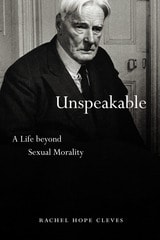
Unspeakable
A Life beyond Sexual MoralityRachel Hope Cleves
University of Chicago Press, 2020
Unspeakable approaches Douglas as neither monster nor literary hero, but as a man who participated in an exploitative sexual subculture that was tolerated in ways we may find hard to understand. Using letters, diaries, memoirs, police records, novels, and photographs—including sources by the children Douglas encountered—Cleves identifies the cultural practices that structured pedophilic behaviors in England, Italy, and other places Douglas favored. Her book delineates how approaches to adult-child sex have changed over time and offers insight into how society can confront similar scandals today, celebrity and otherwise.