Results by title
22279 books match the query 'Social Science' and 356 start with u

Utopia and Modernity in China
Contradictions in TransitionDavid Margolies
Pluto Press, 2022
The contradictions of modernization run through the whole of modern Chinese history. The abundance of manufactured goods being sold in the West attests to China's industrial revolution, but this capitalist vision of 'utopia' sits uneasily with traditional Chinese values. It is also in conflict with the socialism that has been the bedrock of Chinese society since the foundation of the People's Republic in 1949.
Utopia and Modernity in China examines the conflicts inherent in China's attempt to achieve a 'utopia' by advancing production and technology. Through the lenses of literature, arts, law, the press and the environment, the contributors interrogate the contradictions of modernization in Chinese society and its fundamental challenges.
By unpicking both China's vision of utopia and its realities and the increasing tension between traditional Chinese values and those of the West, this book offers a unique insight into the cultural forces that are part of reshaping today's China.
[more]
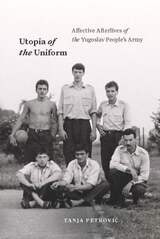
Utopia of the Uniform
Affective Afterlives of the Yugoslav People's ArmyTanja Petrovic
Duke University Press, 2024
The compulsory service for young men in the Yugoslav People’s Army (JNA) created bonds across ethnic, religious, and social lines. These bonds persisted even after the horrific violence of the 1990s, in which many of these men found themselves on opposite sides of the front lines. In Utopia of the Uniform, Tanja Petrović draws on memories and material effects of dozens of JNA conscripts to show how their experience of military service points to futures, forms of collectivity, and relations between the state and the individual different from those that prevailed in the post-Yugoslav reality. Petrović argues that the power of repetitive, ritualized, and performative practices that constituted military service in the JNA provided a framework for drastically different men to live together and befriend each other. While Petrović and her interlocutors do not idealize the JNA, they acknowledge its capacity to create interpersonal relationships and affective bonds that brought the key political ideas of collectivity, solidarity, egalitarianism, education, and comradeship into being.
[more]
Utopian Audiences
How Readers Locate NowhereKenneth M. Roemer
University of Massachusetts Press, 2009
How do readers transform Utopia? How do they manipulate imaginary worlds to gain new perceptions of their own worlds, perceptions that help them build desires to change reality into a somewhere resembling the author's nowhere? How do authors engage readers in this process? How do cultures, historical forces, and literary conventions create spaces enabling authors to invite and readers to engage? These are questions addressed in Utopian Audiences, the first study to employ a wide spectrum of reader-response approaches to define the nature and impact of utopian literature.
In the first part of the book, Kenneth M. Roemer establishes why utopian literature offers an attractive arena for reader-response criticism. He focuses on the literature's diversity, its provocative and multi-genre character, and the availability of documented responses as different as book illustrations and intentional communities. In the second part, he concentrates on late nineteenth-century America, which witnessed a grand outpouring of utopian literature, and in particular on Edward Bellamy's Looking Backward, the most popular and influential American utopian novel.
The study progresses from broad cultural constructs to specific modern responses; from the perceptual systems and reading conventions allowing readers to "see" utopias to text-based models of implied readers and to documented readings of actual people, including Bellamy himself, reviewers, and 733 late twentieth-century readers. A fictional gathering of all the readers concludes the book.
[more]
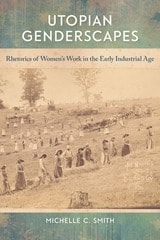
Utopian Genderscapes
Rhetorics of Women's Work in the Early Industrial AgeMichelle C. Smith
Southern Illinois University Press, 2021
2022 Winifred Bryan Horner Outstanding Book Award, Honorable Mention!
A necessary rhetorical history of women’s work in utopian communities
Utopian Genderscapes focuses on three prominent yet understudied intentional communities—Brook Farm, Harmony Society, and the Oneida Community—who in response to industrialization experimented with radical social reform in the antebellum United States. Foremost among the avenues of reform was the place and substance of women’s work. Author Michelle C. Smith seeks in the communities’ rhetorics of teleology, choice, and exceptionalism the lived consequences of the communities' lofty goals for women members.
This feminist history captures the utopian reconfiguration of women’s bodies, spaces, objects, and discourses and delivers a needed intervention into how rhetorical gendering interacts with other race and class identities. The attention to each community’s material practices reveals a gendered ecology, which in many ways squared unevenly with utopian claims. Nevertheless, this volume argues that this utopian moment inaugurated many of the norms and practices of labor that continue to structure women’s lives and opportunities today: the rise of the factory, the shift of labor from home spaces to workplaces, the invention of housework, the role of birth control and childcare, the question of wages, and the feminization of particular kinds of labor.
An impressive and diverse array of archival and material research grounds each chapter’s examination of women’s professional, domestic, or reproductive labor in a particular community. Fleeting though they may seem, the practices and lives of those intentional women, Smith argues, pattern contemporary divisions of work along the vibrant and contentious lines of gender, race, and class and stage the continued search for what is possible.
[more]
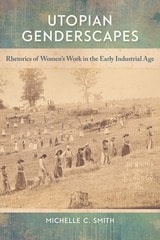
Utopian Genderscapes
Rhetorics of Women’s Work in the Early Industrial AgeMichelle C. Smith
Southern Illinois University Press, 2021
2022 Winifred Bryan Horner Outstanding Book Award, Honorable Mention!
A necessary rhetorical history of women’s work in utopian communities
Utopian Genderscapes focuses on three prominent yet understudied intentional communities—Brook Farm, Harmony Society, and the Oneida Community—who in response to industrialization experimented with radical social reform in the antebellum United States. Foremost among the avenues of reform was the place and substance of women’s work. Author Michelle C. Smith seeks in the communities’ rhetorics of teleology, choice, and exceptionalism the lived consequences of the communities' lofty goals for women members.
This feminist history captures the utopian reconfiguration of women’s bodies, spaces, objects, and discourses and delivers a needed intervention into how rhetorical gendering interacts with other race and class identities. The attention to each community’s material practices reveals a gendered ecology, which in many ways squared unevenly with utopian claims. Nevertheless, this volume argues that this utopian moment inaugurated many of the norms and practices of labor that continue to structure women’s lives and opportunities today: the rise of the factory, the shift of labor from home spaces to workplaces, the invention of housework, the role of birth control and childcare, the question of wages, and the feminization of particular kinds of labor.
An impressive and diverse array of archival and material research grounds each chapter’s examination of women’s professional, domestic, or reproductive labor in a particular community. Fleeting though they may seem, the practices and lives of those intentional women, Smith argues, pattern contemporary divisions of work along the vibrant and contentious lines of gender, race, and class and stage the continued search for what is possible.
A necessary rhetorical history of women’s work in utopian communities
Utopian Genderscapes focuses on three prominent yet understudied intentional communities—Brook Farm, Harmony Society, and the Oneida Community—who in response to industrialization experimented with radical social reform in the antebellum United States. Foremost among the avenues of reform was the place and substance of women’s work. Author Michelle C. Smith seeks in the communities’ rhetorics of teleology, choice, and exceptionalism the lived consequences of the communities' lofty goals for women members.
This feminist history captures the utopian reconfiguration of women’s bodies, spaces, objects, and discourses and delivers a needed intervention into how rhetorical gendering interacts with other race and class identities. The attention to each community’s material practices reveals a gendered ecology, which in many ways squared unevenly with utopian claims. Nevertheless, this volume argues that this utopian moment inaugurated many of the norms and practices of labor that continue to structure women’s lives and opportunities today: the rise of the factory, the shift of labor from home spaces to workplaces, the invention of housework, the role of birth control and childcare, the question of wages, and the feminization of particular kinds of labor.
An impressive and diverse array of archival and material research grounds each chapter’s examination of women’s professional, domestic, or reproductive labor in a particular community. Fleeting though they may seem, the practices and lives of those intentional women, Smith argues, pattern contemporary divisions of work along the vibrant and contentious lines of gender, race, and class and stage the continued search for what is possible.
[more]
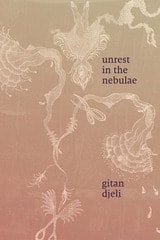
unrest in the nebulae
Gitan Djeli
Duke University Press, 2026
In unrest in the nebulae, Gitan Djeli wields prose poetry to archive five hundred years of exploitative colonization, ecocide, extinction, militarization and deportation, slavery, indenture, negotiated nationhood, postcolonial plantation structures, and apologist histories. Writing in a queer anticolonial poetics, and using lines of Kreol, Gitan Djeli mines the tension that emerges between colonialism and language, disarticulating the myth-making aesthetics of the colonial world. She tells the story of the ‘other slavery’ in the Indian Ocean and its histories of enslavement and indenture through a subversive, fragmented poetics, and often from the perspective of its geologic witnesses—a misnamed ocean or the range of mountains within it or the volcanic idea of islands. In a charge of resistance to the catastrophe of modernity, unrest in the nebulae takes seriously Sylvia Wynter’s invitation to engage “a new science of the word.”
[more]