Results by title
3703 books match the query '19th Century' and 56 start with v
VICTORIAN SENSATIONS
ESSAYS ON A SCANDALOUS GENREKIMBERLY HARRISON
The Ohio State University Press, 2006

VIOLENT DEATH IN THE CITY
SUICIDE, ACCIDENT, AND MURDER IN NINETEEROGER LANE
The Ohio State University Press, 1999
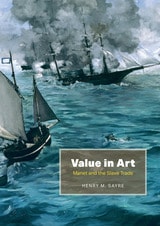
Value in Art
Manet and the Slave TradeHenry M. Sayre
University of Chicago Press, 2022
How did art critics come to speak of light and dark as, respectively, “high in value” and “low in value”? Henry M. Sayre traces the origin of this usage to one of art history’s most famous and racially charged paintings, Édouard Manet’s Olympia.
Art critics once described light and dark in painting in terms of musical metaphor—higher and lower tones, notes, and scales. Sayre shows that it was Émile Zola who introduced the new “law of values” in an 1867 essay on Manet. Unpacking the intricate contexts of Zola’s essay and of several related paintings by Manet, Sayre argues that Zola’s usage of value was intentionally double coded—an economic metaphor for the political economy of slavery. In Manet’s painting, Olympia and her maid represent objects of exchange, a commentary on the French Empire’s complicity in the ongoing slave trade in the Americas.
Expertly researched and argued, this bold study reveals the extraordinary weight of history and politics that Manet’s painting bears. Locating the presence of slavery at modernism’s roots, Value in Art is a surprising and necessary intervention in our understanding of art history.
Vanishing Moments
Class and American LiteratureEric Schocket
University of Michigan Press, 2010
Schocket offers careful readings of works by Herman Melville, Rebecca Harding Davis, William Dean Howells, Jack London, T. S. Eliot, Gertrude Stein, Muriel Rukeyser, and Langston Hughes, among others, and explores how these authors worked to try to heal the rift between the classes. He considers the challenges writers faced before the Civil War in developing a language of class amidst the predominant concerns about race and slavery; how early literary realists dealt with the threat of class insurrection; how writers at the turn of the century attempted to span the divide between the classes by going undercover as workers; how early modernists used working-class characters and idioms to shape their aesthetic experiments; and how leftists in the 1930s struggled to develop an adequate model to connect class and literature. Vanishing Moments’ unique combination of a broad historical scope and in-depth readings makes it an essential book for scholars and students of American literature and culture, as well as for political scientists, economists, and humanists.
“An important book containing many brilliant arguments—hard-hitting and original. Schocket demonstrates a sophisticated acquaintance with issues within the working-class studies movement.”
--Barbara Foley, Rutgers University
Vasily Zhukovsky's Romanticism and the Emotional History of Russia
Ilya Vinitsky
Northwestern University Press, 2015
The first major study in English of Vasily Zhukovsky (1783–1852)—poet, translator of German romantic verse, and mentor of Pushkin—this book brings overdue attention to an important figure in Russian literary and cultural history. Vinitsky’s “psychological biography” argues that Zhukovsky very consciously set out to create for himself an emotional life reflecting his unique brand of romanticism, different from what we associate with Pushkin or poets such as Byron or Wordsworth. For Zhukovsky, ideal love was harmonious, built on a mystical foundation of spiritual kinship. Vinitsky shows how Zhukovksy played a pivotal role in the evolution of ideas central to Russia’s literary and cultural identity from the end of the eighteenth century into the decades following the Napoleonic Wars.
Vaudeville Melodies
Popular Musicians and Mass Entertainment in American Culture, 1870-1929Nicholas Gebhardt
University of Chicago Press, 2017
In Vaudeville Melodies, Nicholas Gebhardt introduces us to the performers, managers, and audiences who turned disjointed variety show acts into a phenomenally successful business. First introduced in the late nineteenth century, by 1915 vaudeville was being performed across the globe, incorporating thousands of performers from every branch of show business. Its astronomical success relied on a huge network of theatres, each part of a circuit and administered from centralized booking offices. Gebhardt shows us how vaudeville transformed relationships among performers, managers, and audiences, and argues that these changes affected popular music culture in ways we are still seeing today. Drawing on firsthand accounts, Gebhardt explores the practices by which vaudeville performers came to understand what it meant to entertain an audience, the conditions in which they worked, the institutions they relied upon, and the values they imagined were essential to their success.
Velocipedomania
A Cultural History of the Velocipede in FranceCorry Cropper
Bucknell University Press, 2023
Velocipedomania is the first in-depth study of the velocipede fad and the popular culture it inspired. It explores how the device was hailed as a symbol of France’s cutting-edge technological advancements, yet also marketed as an invention with a noble pedigree, born from the nation’s cultural and literary heritage. Giving readers a window into the material culture and enthusiasms of Second Empire France, it provides the first English translations of 1869’s Manual of the Velocipede, 1868’s Note on Monsieur Michaux’s Velocipede, and the 1869 operetta Dagobert and his Velocipede. It also reprints scores of rare images from newspapers and advertisements, analyzing how these magnificent machines captured the era’s visual imagination. By looking at how it influenced French attitudes towards politics, national identity, technology, fashion, fitness, and gender roles, this book shows how the short-lived craze of velocipedomania had a big impact.
Ventures into Childland
Victorians, Fairy Tales, and FemininityU. C. Knoepflmacher
University of Chicago Press, 1998
"Ventures into Childland is acute, well written and stimulating. It also has a political purpose, to insist on the importance of protecting and nurturing children, imaginatively and physically."—Jan Marsh, Times Literary Supplement
"A provocative and interesting book about Victorian culture."—Library Journal
Venus in Exile
The Rejection of Beauty in Twentieth-Century ArtWendy Steiner
University of Chicago Press, 2002
Vernon Lee
Aesthetics, History, and the Victorian Female IntellectualChrista Zorn
Ohio University Press, 2003
The subject of renewed interest among literary and cultural scholars, Vernon Lee wrote more than forty books, in a broad range of genres, including fiction, history, aesthetics, and travel literature. Early on, Lee established her reputation as a public critic whose unconventional viewpoints stood out among those of her contemporaries.
To feminist and cultural critics, she is a fascinating model of the independent female intellectual who, as Desmond MacCarthy once put it, provides a rare combination of intellectual curiosity and imaginative sensibility.
A startlingly original critical study, Vernon Lee adds new dimensions to the legacy of this woman of letters whose career spans the transition from the late Victorian to the modernist period. Zorn draws on archival materials to discuss Lee’s work in terms of British aestheticism and in the context of the Western European history of ideas.
Zorn contends that Lee’s fiction and nonfiction represent a literary position that bridges and surpasses both the Victorian sage and the modernist aesthetic critic.
Through Professor Zorn’s approach, which combines theoretical framings of texts in terms of recent feminist and cultural criticism with passages of close reading, Vernon Lee emerges as an influential figure in late-nineteenth-century British and continental European thinking on history, art, culture, and gender.
Veteran Americans
Literature and Citizenship from Revolution to ReconstructionBenjamin Cooper
University of Massachusetts Press, 2018
“I may dare to speak, and I intend to speak and write what I think,” wrote a New York volunteer serving in the Mexican War in 1848. Such sentiments of resistance and confrontation run throughout the literature produced by veteran Americans in the nineteenth century—from prisoner-of-war narratives and memoirs to periodicals, adventure pamphlets, and novels. Military men and women were active participants in early American print culture, yet they struggled against civilian prejudice about their character, against shifting collective memories that removed military experience from the nation's self-definition, and against a variety of headwinds in the uneven development of antebellum print culture.
In this new literary history of early American veterans, Benjamin Cooper reveals how soldiers and sailors from the Revolutionary War through the Civil War demanded, through their writing, that their value as American citizens and authors be recognized. Relying on an archive of largely understudied veteran authors, Cooper situates their perspective against a civilian monopoly in defining American citizenship and literature that endures to this day.
Vicious Infants
Dangerous Childhoods in Antebellum U.S. LiteratureLaura Soderberg
University of Massachusetts Press, 2021
Vicious Infants offers a counterhistory of literary childhood as both perceived social threat and site of resistance, revealing that many children were not only cut off from family and society, they were also preemptively excluded from the rewards of citizenship and adulthood. Turning to prison documents, medical journals, overlooked periodical fiction, and literary works from William Apess, Harriet Wilson, Herman Melville, Susan Paul, and Harriet Beecher Stowe, Laura Soderberg recovers alternate narratives of childhood and provides an important window into the cultural links between race, reproduction, and childhood in the antebellum period.
Vicksburg Besieged
Edited by Steven E. Woodworth and Charles D. Grear
Southern Illinois University Press, 2020
Vicksburg, Mississippi, held strong through a bitter, hard-fought, months-long Civil War campaign, but General Ulysses S. Grant’s forty-day siege ended the stalemate and, on July 4, 1863, destroyed Confederate control of the Mississippi River. In the first anthology to examine the Vicksburg Campaign’s final phase, nine prominent historians and emerging scholars provide in-depth analysis of previously unexamined aspects of the historic siege.
Ranging in scope from military to social history, the contributors’ invitingly written essays examine the role of Grant’s staff, the critical contributions of African American troops to the Union Army of the Tennessee, both sides’ use of sharpshooters and soldiers’ opinions about them, unusual nighttime activities between the Union siege lines and Confederate defensive positions, the use of West Point siege theory and the ingenuity of Midwestern soldiers in mining tunnels under the city’s defenses, the horrific experiences of civilians trapped in Vicksburg, the Louisiana soldier's defense of Jackson amid the strains of piano music, and the effect of the campaign on Confederate soldiers from the Trans-Mississippi region.
The contributors explore how the Confederate Army of Mississippi and residents of Vicksburg faced food and supply shortages as well as constant danger from Union cannons and sharpshooters. Rebel troops under the leadership of General John C. Pemberton sought to stave off the Union soldiers, and though their morale plummeted, the besieged soldiers held their ground until starvation set in. Their surrender meant that Grant’s forces succeeded in splitting in half the Confederate States of America.
Editors Steven E. Woodworth and Charles D. Grear, along with their contributors—Andrew S. Bledsoe, John J. Gaines, Martin J. Hershock, Richard H. Holloway, Justin S. Solonick, Scott L. Stabler, and Jonathan M. Steplyk—give a rare glimpse into the often overlooked operations at the end of the most important campaign of the Civil War.
Victorian Afterlife
Postmodern Culture Rewrites the Nineteenth CenturyJohn Kucich
University of Minnesota Press, 2000
A foundational look at contemporary uses of the Victorian and the presence of the past in postmodern culture.
Celebrated films by Francis Ford Coppola, Jane Campion, and Ang Lee; best-selling novels by A. S. Byatt and William Gibson; revivals of Oscar Wilde, Lewis Carroll’s Alice, and nostalgic photography; computer graphics and cyberpunk performances: contemporary culture, high and low, has fallen in love with the nineteenth century. Major critical thinkers have found in the period the origins of contemporary consumerism, sexual science, gay culture, and feminism. And postmodern theory, which once drove a wedge between contemporary interpretation and its historical objects, has lately displayed a new self-consciousness about its own appropriations of the past. This diverse collection of essays begins a long-overdue discussion of how postmodernism understands the Victorian as its historical predecessor.
Contributors: Nancy Armstrong, Brown U; Ian Baucom, Duke U; Jay Clayton, Vanderbilt U; Mary A. Favret, Indiana U; Simon Gikandi, U of Michigan; Jennifer Green-Lewis, George Washington U; Kali Israel, U of Michigan; Laurie Langbauer, U of North Carolina; Susan Lurie, Rice U; John McGowan, U of North Carolina; Judith Roof, Indiana U; Hilary M. Schor, USC; Ronald R. Thomas, Trinity College; and Shelton Waldrep, U of Southern Maine.
Victorian Alchemy
Science, Magic and Ancient EgyptEleanor Dobson
University College London, 2022
With its material remnants paradoxically symbolizing both antiquity and modernity to Victorian audiences, ancient Egypt was at once evocative of ancient magical power and of cutting-edge science, a tension that might be productively conceived of as “alchemical.” Examining literature and other cultural forms including art, photography, and early film, Eleanor Dobson herein traces the myriad ways in which the Victorian fascination with ancient Egypt evoked the entwined forces of magic and science, providing more than a mere setting for Orientalist fantasies and nightmares. From imaging technologies and astronomy to investigations into the electromagnetic spectrum and the human mind itself, this book demonstrates how conceptions of modernity were inextricably bound up in the contemporary reception of the ancient world, illustrating how such ideas took root and flourished in the Victorian era and persist to this day.
Victorian Art Criticism and the Woman Writer
John Paul M. Kanwit
The Ohio State University Press, 2013
Victorian Bestseller
The Life of Dinah CraikKaren Bourrier
University of Michigan Press, 2019
Victorian Bestseller is the first book to relate the story of Dinah Craik’s remarkable life. Combining extensive archival work with theoretical work in disability studies and the professionalization of women’s authorship, Karen Bourrier engagingly traces the contours of this author’s life. Craik, who wrote extensively about disability in her work, was no stranger to it in her personal and professional life, marked by experiences of mental and physical disability, and the ebb and flow of health. Following scholarship in the ethics of care and disability studies, the book posits Craik as an interdependent subject, placing her within a network of writers, publishers, editors and artists, friends, and family members. Victorian Bestseller also traces the conditions in the material history of the book that allowed Victorian women writers’ careers to flourish. In doing so, the biography connects corporeality, gender, and the material history of the book to the professionalization of Victorian women’s authorship.
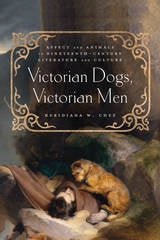
Victorian Dogs, Victorian Men
Affect and Animals in Nineteenth-Century Literature and CultureKeridiana W. Chez
The Ohio State University Press, 2017
Chez traces the evolution of the human-dog relationship as it developed parallel to an increasingly imperialist national discourse. The dog began as the affective mediator of the family, then addressed the emotional needs of its individual members, and finally evolved into both “man’s best friend” and worst enemy. By the last decades of the nineteenth century, the porous human-animal boundary served to produce the “humane” man: a liberal subject enabled to engage in aggressive imperial projects. Reading the work of Charles Dickens, George Eliot, Margaret Marshall Saunders, Bram Stoker, and Jack London, Victorian Dogs, Victorian Men charts the mobilization of affect through transatlantic narratives, demonstrating the deep interconnections between animals, affect, and gender.
Victorian Domesticity
Families in the Life and Art of Louisa May AlcottCharles Strickland
University of Alabama Press, 1985
The subject of Victorian Domesticity is family life in America. The life and works of Louisa May Alcott served as the vehicle for exploring and analyzing this subject. Although Alcott was deeply influenced by popular currents of sentimentality, her own experience exposed her to the confusions and contradictions generated when sentiment confronted the reality of life in 19th-century America.
In the first chapter Strickland outlines the ways in which sentimentality colored the perception of 19th-century Americans about such issues as courtship, marriage, the relationship between the sexes, generational relationships, and the relationship between the nuclear family and the community outside the family. Chapters two and three trace Alcott’s childhood and adolescent experiences, exploring the tensions that developed between Louisa and her father, and detailing the ways in which she carried the double burden of being both poor and female as she sought her identity as a writer.
The following six chapters treat the varieties of family life that appear in Alcott’s stories, the impact of feminism on her life, and her emphasis on the importance of child nurture. In the final two chapters the author treats the relationships that Alcott perceived between the family and the world around it and assesses the legacy of the Victorian family idea.
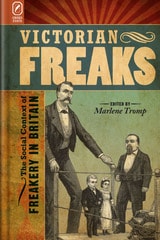
Victorian Freaks
The Social Context of Freakery in BritainMarlene Tromp
The Ohio State University Press, 2008
While “freaks” have captivated our imagination since well before the nineteenth century, the Victorians flocked to shows featuring dancing dwarves, bearded ladies, “missing links,” and six-legged sheep. Indeed, this period has been described by Rosemarie Garland-Thomson as the epoch of “consolidation” for freakery: an era of social change, enormously popular freak shows, and taxonomic frenzy. Victorian Freaks: The Social Context of Freakery in Britain, edited by Marlene Tromp, turns to that rich nexus, examining the struggle over definitions of “freakery” and the unstable and sometimes conflicting ways in which freakery was understood and deployed. As the first study centralizing British culture, this collection discusses figures as varied as Joseph Merrick, “The Elephant Man”; Daniel Lambert, “King of the Fat Men”; Julia Pastrana, “The Bear Woman”; and Laloo “The Marvellous Indian Boy” and his embedded, parasitic twin. The Victorian Freaks contributors examine Victorian culture through the lens of freakery, reading the production of the freak against the landscape of capitalist consumption, the medical community, and the politics of empire, sexuality, and art. Collectively, these essays ask how freakery engaged with notions of normalcy and with its Victorian cultural context.
Victorian Ghosts in the Noontide
Women Writers and the SupernaturalVanessa D. Dickerson
University of Missouri Press, 1996
During the nineteenth century, British society was making rapid advancements in science and technology. While the men became materially productive, women were expected to be the fulcrums of society's changes. As one means of adjusting to these changes, many women focused on supernaturalism and spirituality.
In Victorian Ghosts in the Noontide, Vanessa D. Dickerson analyzes women's spirituality in a materialistic age by examining the supernatural fiction of Charlotte and Emily Brontë, Elizabeth Gaskell, and George Eliot and provides interpretive readings of familiar texts like Jane Eyre and Wuthering Heights. Other works by lesser-known authors are also examined.
Technological advances eliminated many of the jobs women were accustomed to doing. This left women looking for their place in society. A sense of "in-betweenness" developed in these women who were now expected to attend not only to the physical but also to the moral and spiritual needs of the family. As an answer to this "in-betweenness" some channeled their power toward the art of writing. Because people in the mid-1800s were so thoroughly engaged in scientific thought and advancements, supernatural folklore and spirituality were disreputable ideas for anyone, especially women, to explore. Ghosts and spirits were tied to old-wives' tales, superstitions, and legends. However, by focusing on these concepts and using fiction as an outlet, women were able to make great strides in being seen and heard. The art of writing functioned as an exploration of their spiritualism in which women discovered expression, freedom, and power.
This perceptive, well-written book will add a new dimension to our understanding of women's supernatural writings of the Victorian era. Scholars of Victorian literature, women's studies, and popular culture will benefit from its insights.
Victorian Hands
The Manual Turn in Nineteenth-Century Body StudiesEdited by Peter J. Capuano and Sue Zemka
The Ohio State University Press, 2020
Contributors
James Eli Adams, Karen Bourrier, Aviva Briefel, Peter J. Capuano, Jonathan Cheng, Kate Flint, Pamela K. Gilbert, Tamara Ketabgian, J. Hillis Miller, Deborah Denenholz Morse, Daniel A. Novak, Julianne Smith, Herbert F. Tucker, and Sue Zemka
Victorian Jamaica
Timothy Barringer and Wayne Modest, editors
Duke University Press, 2018
Contributors. Anna Arabindan-Kesson, Tim Barringer, Anthony Bogues, David Boxer, Patrick Bryan, Steeve O. Buckridge, Julian Cresser, John M. Cross, Petrina Dacres, Belinda Edmondson, Nadia Ellis, Gillian Forrester, Catherine Hall, Gad Heuman, Rivke Jaffe, O'Neil Lawrence, Erica Moiah James, Jan Marsh, Wayne Modest, Daniel T. Neely, Mark Nesbitt, Diana Paton, Elizabeth Pigou-Dennis, Veerle Poupeye, Jennifer Raab, James Robertson, Shani Roper, Faith Smith, Nicole Smythe-Johnson, Dianne M. Stewart, Krista A. Thompson
Victorian Lessons in Empathy and Difference
Rebecca N. Mitchell
The Ohio State University Press, 2011
Victorian People
A Reassessment of Persons and Themes, 1851-67Asa Briggs
University of Chicago Press, 1975
"For expounding this theme, this interaction of event and personality, Mr. Briggs is abundantly and happily endowed. He is always readable, often amusing, never facetious. He is widely read and widely interested. He has a sound historic judgment, and an unfailing sense for what is significant in the historic sequence and what is merely topical. . . . Above all, he is in sympathy with the age of which he is writing."—Times Literary Supplement
Victorian Poetry, Europe, and the Challenge of Cosmopolitanism
Christopher M. Keirstead
The Ohio State University Press, 2011
The scope and complexity of the encounter with Europe in Victorian poetry remains largely underappreciated despite recent critical attention to the genre’s global and transnational contexts. Providing much more than colorful settings or a convenient place of self-exile from England, Europe—as destination and idea—formed the basis of a dynamic, evolving form of critical cosmopolitanism much in tune with attempts to theorize the concept today. Christopher M. Keirstead’s Victorian Poetry, Europe, and the Challenge of Cosmopolitanism synthesizes the complex relationship between several notable Victorian poets, including Elizabeth Barrett Browning, Robert Browning, Matthew Arnold, and A. C. Swinburne, and their respective attitudes toward Europe as a cosmopolitan whole. Examining their international relationships and experiences, the monograph explores the ways in which these poets worked to reconcile their emotional and intellectual affinity for world citizenship with their British identity.
Victorian Popularizers of Science
Designing Nature for New AudiencesBernard Lightman
University of Chicago Press, 2007
Bernard Lightman examines more than thirty of the most prolific, influential, and interesting popularizers of the day, investigating the dramatic lecturing techniques, vivid illustrations, and accessible literary styles they used to communicate with their audience. By focusing on a forgotten coterie of science writers, their publishers, and their public, Lightman offers new insights into the role of women in scientific inquiry, the market for scientific knowledge, tensions between religion and science, and the complexities of scientific authority in nineteenth-century Britain.
Victorian Relativity
Radical Thought and Scientific DiscoveryChristopher Herbert
University of Chicago Press, 2001
Christopher Herbert shows that the idea of relativity produced revolutionary changes in one field after another in the nineteenth century. Surveying a long line of thinkers including Herbert Spencer, Charles Darwin, Alexander Bain, W. K. Clifford, W. S. Jevons, Karl Pearson, James Frazer, and Einstein himself, Victorian Relativity argues that the early relativity movement was bound closely to motives of political and cultural reform and, in particular, to radical critiques of the ideology of authoritarianism. Recuperating relativity from those who treat it as synonymous with nihilism, Herbert portrays it as the basis of some of our crucial intellectual and ethical traditions.
Victorian Sacrifice
Ilana M. Blumberg
The Ohio State University Press, 2013
Victorian Science in Context
Edited by Bernard Lightman
University of Chicago Press, 1997
Victorian Science in Context captures the essence of this fascination, charting the many ways in which science influenced and was influenced by the larger Victorian culture. Contributions from leading scholars in history, literature, and the history of science explore questions such as: What did science mean to the Victorians? For whom was Victorian science written? What ideological messages did it convey? The contributors show how practical concerns interacted with contextual issues to mold Victorian science—which in turn shaped much of the relationship between modern science and culture.
Victorian Scientific Naturalism
Community, Identity, ContinuityEdited by Gowan Dawson and Bernard Lightman
University of Chicago Press, 2014
Victorian Sexual Dissidence
Edited by Richard Dellamora
University of Chicago Press, 1999
One essay, for example, traces the remarkable feminist appropriation of male-identified fields of study, such as Classical philology. Others address the validation of male bodies as objects of desire in writing, painting, and emergent modernist choreography. The writings shed light on the diverse interests served by a range of cultural practitioners and on the complex ways in which the late Victorians invented themselves as modern subjects.
This volume will be essential reading for students of British literary and cultural history as well as for those interested in feminist, gay, and lesbian studies.
Contributors are: Oliver Buckton, Richard Dellamora, Dennis Denisoff, Regenia Gagnier, Eric Haralson, Andrew Hewitt, Christopher Lane, Thaïs Morgan, Yopie Prins, Kathy Alexis Psomiades, Julia Saville, Robert Sulcer, Jr., Martha Vicinus.

Victorian Subjects
J. Hillis Miller
Duke University Press, 1991
Miller defines the term “Victorian subjects” in more than one sense. The phrase identifies an historical time but also names a concern throughout with subjectivity, consciousness, and selfhood in Victorian literature. The essays show various Victorian subjectivities seeking to ground themselves in their own underlying substance or in some self beneath or beyond the self. But “Victorian subjects” also discusses those who were subject to Queen Victoria, to the reigning ideologies of the time, to historical, social, and material conditions, including the conditions under which literature was written, published, distributed, and consumed.
These essays, taken together, sketch the outlines of ideological assumptions within the period about the self, interpersonal relations, nature, literary form, the social function of literature, and other Victorian subjects.
Victorian Travelers and the Opening of China 1842–1907
Susan Shoenbauer Thurin
Ohio University Press, 1999
Three men and three women: a plant collector, a merchant and his novelist wife, a military officer, and two famous women travelers went to China between the Opium War and the formal end of the opium trade, 1842–1907. Their range of perspectives, their acquaintance with one another and their similar scope of travel to Hong Kong, the treaty ports, and Sichuan lend intensity to their picture of China and the Western presence there.
What the travelers record reveals is a continuity in the response of the West and China to each other. Susan Schoenbauer Thurin’s study of these writings presents a rich tapestry of impressions, biases, and cultural perspectives that inform our own understanding of the Victorians and their views of the world outside their own.
The strange mix of opium and missionaries, the aura of fabled “Cathay” and its valuable trade items, the attraction and repulsion of the exotic otherness the travelers experience, reflect the political, religious, and racial views of their era, and explain the allure of the Orient that, in part, characterized their age. Victorian Travelers and the Opening of China, 1842–1907 is a remarkable look into the cultural past.

Victorian Vogue
British Novels on ScreenDianne F. Sadoff
University of Minnesota Press, 2009
Ranging from cinematic images of Jane Austen's estates to Oscar Wilde's drawing rooms, Dianne F. Sadoff looks at popular heritage films, often featuring Hollywood stars, that have been adapted from nineteenth-century novels.
Victorian Vogue argues that heritage films perform different cultural functions at key historical moments in the twentieth century. According to Sadoff, they are characterized by a double historical consciousness-one that is as attentive to the concerns of the time of production as to those of the Victorian period. If James Whale's Frankenstein and Tod Browning's Dracula exploited post-Depression fear in the 1930s, the horror films of the 1950s used the genre to explore homosexual panic, 1970s movies elaborated the sexuality only hinted at in the thirties, and films of the 1990s indulged the pleasures of consumption.
Taking a broad view of the relationships among film, literature, and current events, Sadoff contrasts films not merely with their nineteenth-century source novels but with crucial historical moments in the twentieth century, showing their cultural use in interpreting the present, not just the past.
Victorian Women Writers, Radical Grandmothers, and the Gendering of God
Gail Turley Houston
The Ohio State University Press, 2013
Victorian and Modern Poetics
Carol T. Christ
University of Chicago Press, 1984
Victorians Reading the Romantics
Essays by U. C. KnoepflmacherEssays by U. C. Knoepflmacher, edited by Linda M. Shires
The Ohio State University Press, 2016
Victorians Reading the Romantics: Essays by U. C. Knoepflmacher, edited by LindaM. Shires, offers a compelling new perspective on the long and influential publishing career and thought of Knoepflmacher, a leading critic of the novel and Victorian poetry. This volume draws together essays on nineteenth-century literature written between 1963 and 2012.An introductory essay and new scaffolding emphasize the interrelations among the essays, which together form a consistent approach to literary criticism.
Knoepflmacher’s vision of texts and readersstressesthe emotional knowledge afforded by reading, writing about, and teaching literary texts.Each chapter links Romantic texts to those of later writers. Shelley and Keats try to revise Wordsworth, but they are themselves recast by Browning and Hardy. Similarly, George Eliot and Virginia Woolf’s reliance on Romantic tropes are fruitfully examined. Above all, however, these chapters stress the impact of Wordsworth on his many contemporaries and successors. Knoepflmacher probes into their texts to find, as Wordsworth did, a momentaryfusionof opposites.He posits a reader who is flexible—able to move in multiple directions by paying attention to spatial, verbal, and imagistic coordinates, across and down a page.Given the attention paid tothe translation of affect into thought,this collectionwillcontribute to Victorian studiesas well as enhance our understanding of the affective dynamics of nineteenth-century literature.
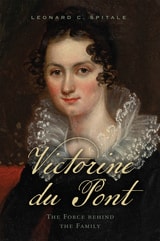
Victorine du Pont
The Force behind the FamilyLeonard C. Spitale
University of Delaware Press, 2023

Vida Zoo-cial
The Buenos Aires Zoo and the Making of Argentine Society, 1875–1924Ashley Elizabeth Kerr
Vanderbilt University Press, 2025
Premio al Mejor Libro en Humanidades, Latin American Studies Association, Nineteenth-Century Section, 2026
In late nineteenth- and early twentieth‑century Buenos Aires, elites attempted to tackle growing poverty and social problems with a suite of social, educational, and medical reforms, hoping to make the city and larger nation more “modern” and “progressive” on the world stage. Known as the “social question,” this turn-of-the-century preoccupation with the future of the city and nation was undergirded by a larger set of social Darwinist beliefs about the biological and racial inferiority of immigrants and the working class, linking them to higher susceptibility to alcoholism, sexual deviancy, insanity, and disease.
In Vida Zoo-cial, Ashley Elizabeth Kerr argues that the Buenos Aires Zoo and its many animal species were an important tool in attempts to remake Argentinian society. Elites used the zoo’s physical spaces, programming, and visual and literary representations of its animals to try to educate and “improve” the masses, especially immigrants and the poor, but stopped short of supporting more radical social transformations. Drawing upon extensive archival research from the zoo’s archive, including correspondence, municipal reports, receipts, and employment records, as well as a range of literary and popular culture sources, Kerr records these efforts, which included enlisting lionesses as object lessons in proper motherhood and elephants as model immigrants. Although some projects were successful, Kerr also documents the many ways others went awry when the zoo's animals and the humans who came to see them failed to cooperate.
Vida Zoo-cial is not only a story about how the poor and working class resisted elite efforts for social reform founded upon racialized beliefs and pseudoscience, but also one that challenges readers to rethink the relationship between humans and non‑humans.
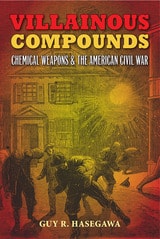
Villainous Compounds
Chemical Weapons and the American Civil WarGuy R. Hasegawa
Southern Illinois University Press, 2015
In chilling detail, Hasegawa describes the weapons proposed and prepared for use during the war and introduces the people behind the concepts. Although many of the ideas for chemical weapons had a historical precedent, most of the suggested agents were used in industry or medicine, and their toxicity was common knowledge. Proponents, including a surprisingly high number of civilian physicians, suggested a wide variety of potential chemical weapons—from liquid chlorine in artillery shells to cayenne pepper solution sprayed from fire engines. Some weapons advocates expressed ethical qualms, while others were silent on the matter or justified their suggestions as necessary under current circumstances.
As Hasegawa explains, bureaucrats in the war departments of both armies either delayed or rejected outright most of these unusual weapons, viewing them as unneeded or unworkable. Nevertheless, many of the proposed armaments presaged the widespread use of chemical weapons in the twentieth and twenty-first centuries. For example, while Civil War munitions technology was not advanced enough to deliver poison gas in artillery shells as some advocates suggested, the same idea saw extensive use during World War I. Similarly, forms of an ancient incendiary weapon, Greek fire, were used sparingly during the Civil War and appeared in later conflicts as napalm bombs and flamethrowers.
Especially timely with today’s increased chemical threats from terrorists and the alleged use of chemical agents in the Syrian Civil War, Villainous Compounds: Chemical Weapons and the American Civil War reveals the seldom-explored chemical side of Civil War armaments and illuminates an underappreciated stage in the origins of modern chemical warfare.
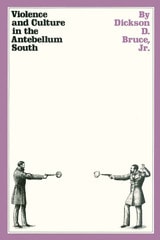
Violence and Culture in the Antebellum South
By Dickson D. Bruce, Jr.
University of Texas Press, 1979
This provocative book draws from a variety of sources—literature, politics, folklore, social history—to attempt to set Southern beliefs about violence in a cultural context. According to Dickson D. Bruce, the control of violence was a central concern of antebellum Southerners.
Using contemporary sources, Bruce describes Southerners’ attitudes as illustrated in their duels, hunting, and the rhetoric of their politicians. He views antebellum Southerners as pessimistic and deeply distrustful of social relationships and demonstrates how this world view impelled their reliance on formal controls to regularize human interaction.
The attitudes toward violence of masters, slaves, and “plain-folk”—the three major social groups of the period—are differentiated, and letters and family papers are used to illustrate how Southern child-rearing practices contributed to attitudes toward violence in the region. The final chapter treats Edgar Allan Poe as a writer who epitomized the attitudes of many Southerners before the Civil War.
Violence in Rural South Africa, 1880–1963
Sean Redding
University of Wisconsin Press, 2023
Many violent acts attempted to reestablish and reinforce a moral, social, and political order among Africans. However, what constituted a moral order changed as white governance became more intrusive, land became scarcer, and people reconstructed their notions of “traditional” culture. State policies became obstacles around which Africans had to navigate by invoking the idea of tradition, using the state’s court system, alleging the use of witchcraft, or engaging in violent threats and acts. Redding’s use of multiple court cases and documents to discuss several types of violence provides a richer context for the scholarly conversation about the legitimation of violence in traditions, family life, and political protest.
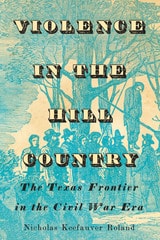
Violence in the Hill Country
The Texas Frontier in the Civil War EraBy Nicholas Keefauver Roland
University of Texas Press, 2021
2022 Ramirez Family Award for Most Significant Scholarly Book, Texas Institute of Letters
An in-depth history of the Civil War in the Texas Hill Country, this book examines patterns of violence on the Texas frontier to illuminate white Americans’ cultural and political priorities in the nineteenth century.
In the nineteenth century, Texas’s advancing western frontier was the site of one of America’s longest conflicts between white settlers and native peoples. The Texas Hill Country functioned as a kind of borderland within the larger borderland of Texas itself, a vast and fluid area where, during the Civil War, the slaveholding South and the nominally free-labor West collided. As in many borderlands, Nicholas Roland argues, the Hill Country was marked by violence, as one set of peoples, states, and systems eventually displaced others.
In this painstakingly researched book, Roland analyzes patterns of violence in the Texas Hill Country to examine the cultural and political priorities of white settlers and their interaction with the century-defining process of national integration and state-building in the Civil War era. He traces the role of violence in the region from the eve of the Civil War, through secession and the Indian wars, and into Reconstruction. Revealing a bitter history of warfare, criminality, divided communities, political violence, vengeance killings, and economic struggle, Roland positions the Texas Hill Country as emblematic of the Southwest of its time.
Violent Sensations
Sex, Crime, and Utopia in Vienna and Berlin, 1860-1914Scott Spector
University of Chicago Press, 2016
In Violent Sensations, Scott Spector explores how the protagonists of these stories—people at society’s margins—were given new identities defined by the groundbreaking sciences of psychiatry, sexology, and criminology, and how this expert knowledge was then transmitted to an eager public by journalists covering court cases and police investigations. The book analyzes these sexual and criminal subjects on three levels: first, the expertise of scientists, doctors, lawyers, and scholars; second, the sensationalism of newspaper scandal and pulp fiction; and, third, the subjective ways that the figures themselves came to understand who they were. Throughout, Spector answers important questions about how fantasies of extreme depravity and bestiality figure into the central European self-image of cities as centers of progressive civilization, as well as the ways in which the sciences of social control emerged alongside the burgeoning emancipation of women and homosexuals.
Virtual Modernism
Writing and Technology in the Progressive EraKatherine Biers
University of Minnesota Press, 2013
In Virtual Modernism, Katherine Biers offers a fresh view of the emergence of American literary modernism from the eruption of popular culture in the early twentieth century. Employing dynamic readings of the works of Stephen Crane, Henry James, James Weldon Johnson, Djuna Barnes, and Gertrude Stein, she argues that American modernist writers developed a “poetics of the virtual” in response to the rise of mass communications technologies before World War I. These authors’ modernist formal experimentation was provoked by the immediate, individualistic pleasures and thrills of mass culture. But they also retained a faith in the representational power of language—and the worth of common experience—more characteristic of realism and naturalism. In competition with new media experiences such as movies and recorded music, they simultaneously rejected and embraced modernity.
Biers establishes the virtual poetics of these five writers as part of a larger “virtual turn” in the United States, when a fascination with the writings of Henri Bergson, William James, and vitalist philosophy—and the idea of virtual experience—swept the nation. Virtual Modernism contends that a turn to the virtual experience of language was a way for each of these authors to carve out a value for the literary, both with and against the growth of mass entertainments. This technologically inspired reengagement with experience was formative for American modernism.
Situated at the crossing points of literary criticism, philosophy, media studies, and history, Virtual Modernism provides an examination of Progressive Era preoccupations with the cognitive and corporeal effects of new media technologies that traces an important genealogy of present-day concerns with virtuality.
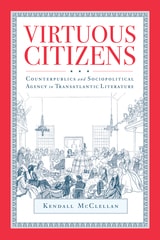
Virtuous Citizens
Counterpublics and Sociopolitical Agency in Transatlantic LiteratureKendall McClellan
University of Alabama Press, 2021
Transatlantic Perspectives on Civic Identity and Political Participation.
The rise of the bourgeois public sphere and the contemporaneous appearance of counterpublics in the eighteenth century deeply influenced not only how politicians and philosophers understood the relationships among citizens, disenfranchised subjects, and the state but also how members of the polity understood themselves. In Virtuous Citizens: Counterpublics and Sociopolitical Agency in Transatlantic Literature, Kendall McClellan uncovers a fundamental and still redolent transformation in conceptions of civic identity that occurred over the course of the eighteenth and nineteenth centuries. Literature of this period exposes an emotional investment in questions of civic selfhood born out of concern for national stability and power, which were considered products of both economic strength and a nation’s moral fiber. McClellan shows how these debates traversed the Atlantic to become a prominent component of early American literature, evident in works by James Fenimore Cooper, Catharine Maria Sedgwick, Sarah Josepha Hale, and Harriet Beecher Stowe, among others.
Underlying popular opinion about who could participate in the political public, McClellan argues, was an impassioned rhetorical wrestling match over the right and wrong ways to demonstrate civic virtue. Relying on long-established tropes of republican virtue that lauded self-sacrifice and disregard for personal safety, abolitionist writers represented loyalty to an ideals-based community as the surest safeguard of both private and public virtue. This evolution in civic virtue sanctioned acts of protest against the state, offered disenfranchised citizens a role in politics, and helped usher in the modern transnational public sphere.
Virtuous Citizens shows that the modern public sphere has always constituted a vital and powerful space for those invested in addressing injustice and expanding democracy. To illuminate some of the fundamental issues underlying today’s sociopolitical unrest, McClellan traces the transatlantic origins of questions still central to the representation of movements like Black Lives Matter, the Women’s March, and the Alt-Right: What is the primary loyalty of a virtuous citizen? Are patriots those who defend the current government against attacks, external and internal, or those who challenge the government to fulfill sociopolitical ideals?
Visible Histories, Disappearing Women
Producing Muslim Womanhood in Late Colonial BengalMahua Sarkar
Duke University Press, 2008
Drawing on extensive archival research and oral histories of Muslim women who lived in Calcutta and Dhaka in the first half of the twentieth century, Sarkar traces Muslim women as they surface and disappear in colonial, Hindu nationalist, and liberal Muslim writings, as well as in the memories of Muslim women themselves. The oral accounts provide both a rich source of information about the social fabric of urban Bengal during the final years of colonial rule and a glimpse of the kind of negotiations with stereotypes that even relatively privileged, middle-class Muslim women are still frequently obliged to make in India today. Sarkar concludes with some reflections on the complex links between past constructions of Muslim women, current representations, and the violence against them in contemporary India.
Visionary of the Word
Melville and ReligionEdited by Jonathan A. Cook and Brian Yothers
Northwestern University Press, 2017
Visions of Science
Books and Readers at the Dawn of the Victorian AgeJames A. Secord
University of Chicago Press, 2015
In Visions of Science, James A. Secord offers a new way to capture this unique moment of change. He explores seven key books—among them Charles Babbage’s Reflections on the Decline of Science, Charles Lyell’s Principles ofGeology, Mary Somerville’s Connexion of the Physical Sciences, and Thomas Carlyle’s Sartor Resartus—and shows how literature that reflects on the wider meaning of science can be revelatory when granted the kind of close reading usually reserved for fiction and poetry. These books considered the meanings of science and its place in modern life, looking to the future, coordinating and connecting the sciences, and forging knowledge that would be appropriate for the new age. Their aim was often philosophical, but Secord shows it was just as often imaginative, projective, and practical: to suggest not only how to think about the natural world but also to indicate modes of action and potential consequences in an era of unparalleled change.
Visions of Science opens our eyes to how genteel ladies, working men, and the literary elite responded to these remarkable works. It reveals the importance of understanding the physical qualities of books and the key role of printers and publishers, from factories pouring out cheap compendia to fashionable publishing houses in London’s West End. Secord’s vivid account takes us to the heart of an information revolution that was to have profound consequences for the making of the modern world.