210 books match the query 'African Studies' and 4 start with v

cover of Violence and Memory: The Mulele Rebellion in Postcolonial Congo

Violence and Memory

The Mulele Rebellion in Postcolonial Congo

Emery Kalema

Duke University Press, 2027
Between 1963 and 1968, as the promises of Congolese independence unraveled in the shadow of early postcolonial fractures, Kwilu, a region in southwestern Congo, entered an unstable period marked by flight, silence, and wounded flesh. There, Pierre Mulele, the former minister of education in Patrice Lumumba’s government, led a revolt against the US-backed Congolese state. Together, the Mulele rebellion and the government’s far more devastating counterinsurgency campaign redefined the thresholds of the livable and the thinkable, inflicting suffering on the living, the dead, and the land. In Violence and Memory, Emery Kalema confronts the suffering born of this historical moment and its long afterlife in postcolonial Congo. Drawing on archives of the events and oral histories of survivors of the conflict, he examines the entanglement of suffering, memory, and power, revealing how each continually reconfigures the others and how, together, they reshape what it means to live after violence in Congo.
[more]
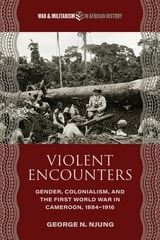
cover of Violent Encounters: Gender, Colonialism, and the First World War in Cameroon, 1884–1916

Violent Encounters

Gender, Colonialism, and the First World War in Cameroon, 1884–1916

George N. Njung

Ohio University Press, 2027

Violent Encounters offers a powerful and original gendered history of colonial rule and warfare in Cameroon from the advent of German imperialism to the end of the First World War. Centering German Cameroon as an understudied but pivotal site of empire and global conflict, George N. Njung demonstrates that violence was a calculated instrument of colonial governance, which was systematically organized along racial and gendered lines to conquer territory, discipline African communities, and suppress resistance.

Drawing on extensive archival research in Africa and Europe, oral traditions, and interdisciplinary gender analysis, Njung reconstructs how empire and war were lived differently by African men and women. He shows that gender-based violence—especially sexual abuse—functioned as a deliberate political strategy embedded in military campaigns, forced labor regimes, and systems of punishment. African women bore disproportionate burdens at the intersection of gender, race, and militarization, even as they acted as resisters, mobilizers, and negotiators. African men, meanwhile, experienced forced recruitment, battlefield violence, and profound challenges to social authority under colonial rule.

Reinterpreting the First World War in Africa as an escalation rather than a rupture, Violent Encounters situates wartime atrocities, mass displacement, and one of the twentieth century’s earliest refugee crises within a longer continuum of imperial violence. By foregrounding gender, the book repositions Cameroon—and Africa more broadly—as central to understanding the global dynamics of empire, militarization, and resistance in the early twentieth century.
[more]
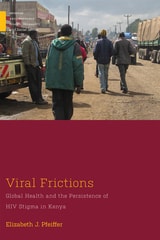
cover of Viral Frictions: Global Health and the Persistence of HIV Stigma in Kenya

Viral Frictions

Global Health and the Persistence of HIV Stigma in Kenya

Elizabeth J. Pfeiffer

Rutgers University Press, 2022

Viral Frictions takes the reader along a trail of intersecting narratives to uncover how and why it is that HIV-related stigma persists in the age of treatment. Pfeiffer convincingly argues that stigma is a socially constructed process co-produced at the nexus of local, national, and global relationships and storytelling about and practices associated with HIV. Based on a decade of fieldwork in one highway trading center in Kenya, Viral Frictions offers compelling stories of stigma and discrimination as a lens for understanding broader social processes, the complexities of globalization and health, and their profound impact on the everyday social lives and relationships of people living through the ongoing HIV epidemic in sub-Saharan Africa. This highly engaging book is ideal reading for those interested in teaching and learning about intersectionality, as Pfeiffer meticulously demonstrates how HIV stigma interacts with issues of treatment, race, ethnicity, class, gender, sexuality, social change, and international aid systems.
[more]
cover of Voices from Madagascar Voix de Madagascar: An Anthology of Contemporary Francophone Literature/Anthologie de littérature francophone contemporaine

Voices from Madagascar Voix de Madagascar

An Anthology of Contemporary Francophone Literature/Anthologie de littérature francophone contemporaine

Jacques Bourgeacq

Ohio University Press, 2001

There is currently in Madagascar a rich literary production (short stories, poetry, novels, plays) that has not yet reached the United States for lack of diffusion outside the country. Until recently, Madagascar suffered from political isolation resulting from its breakup with France in the 1970s and the eighteen years of Marxism that followed. With little hope that their voices would be heard outside the island, writers nevertheless have continued to express themselves in French (alongside a literature written in the Malagasy language). Malagasy literature in French had begun in the colonial era with three poets: Jean–Joseph Rabearivelo, Jacques Rabemananjara, and Flavien Ranaivo, all three presented in Léopold Senghor’s celebrated Anthologie de la nouvelle poésie nègre et malgache (1948). More recently, although a few Malagasy writers living outside the country have been published in France, the bulk of Malagasy literature today has remained largely unpublished, circulating locally mostly in manuscript form. Voices from Madagascar will bring a wide selection of these texts, both in French and in English, to the North American public.
[more]