Results by title
336 books match the query 'Age' and 7 start with v

Vienna in the Age of Uncertainty
Science, Liberalism, and Private LifeDeborah R. Coen
University of Chicago Press, 2007
Vienna in the Age of Uncertainty traces the vital and varied roles of science through the story of three generations of the eminent Exner family, whose members included Nobel Prize–winning biologist Karl Frisch, the teachers of Freud and of physicist Erwin Schrödinger, artists of the Vienna Secession, and a leader of Vienna’s women’s movement. Training her critical eye on the Exners through the rise and fall of Austrian liberalism and into the rise of the Third Reich, Deborah R. Coen demonstrates the interdependence of the family’s scientific and domestic lives, exploring the ways in which public notions of rationality, objectivity, and autonomy were formed in the private sphere. Vienna in the Age of Uncertainty presents the story of the Exners as a microcosm of the larger achievements and tragedies of Austrian political and scientific life in the late nineteenth and early twentieth centuries.
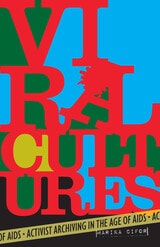
Viral Cultures
Activist Archiving in the Age of AIDSMarika Cifor
University of Minnesota Press, 2022
Delves deep into the archives that keep the history and work of AIDS activism alive
Serving as a vital supplement to the existing scholarship on AIDS activism of the 1980s and 1990s, ViralCultures is the first book to critically examine the archives that have helped preserve and create the legacy of those radical activities. Marika Cifor charts the efforts activists, archivists, and curators have made to document the work of AIDS activism in the United States and the infrastructure developed to maintain it, safeguarding the material for future generations to remember these social movements and to revitalize the epidemic’s past in order to remake the present and future of AIDS.
Drawing on large institutional archives such as the New York Public Library, as well as those developed by small, community-based organizations, this work of archival ethnography details how contemporary activists, artists, and curators use these records to build on the cultural legacy of AIDS activism to challenge the conditions of injustice that continue to undergird current AIDS crises. Cifor analyzes the various power structures through which these archives are mediated, demonstrating how ideology shapes the nature of archival material and how it is accessed and used. Positioning vital nostalgia as both a critical faculty and a generative practice, this book explores the act of saving this activist past and reanimating it in the digital age.
While many books, popular films, and major exhibitions have contributed to a necessary awareness of HIV and AIDS activism, Viral Cultures provides a crucial missing link by highlighting the powerful role of archives in making those cultural moments possible.

Viral Mothers
Breastfeeding in the Age of HIV/AIDSBernice L. Hausman
University of Michigan Press, 2010
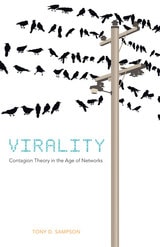
Virality
Contagion Theory in the Age of NetworksTony D. Sampson
University of Minnesota Press, 2012
In this thought-provoking work, Tony D. Sampson presents a contagion theory fit for the age of networks. Unlike memes and microbial contagions, Virality does not restrict itself to biological analogies and medical metaphors. It instead points toward a theory of contagious assemblages, events, and affects. For Sampson, contagion is not necessarily a positive or negative force of encounter; it is how society comes together and relates.
Sampson argues that a biological knowledge of contagion has been universally distributed by way of the rhetoric of fear used in the antivirus industry and other popular discourses surrounding network culture. This awareness is also detectable in concerns over too much connectivity, such as problems of global financial crisis and terrorism. Sampson’s “virality” is as established as that of the biological meme and microbe but is not understood through representational thinking expressed in metaphors and analogies. Rather, Sampson interprets contagion theory through the social relationalities first established in Gabriel Tarde’s microsociology and subsequently recognized in Gilles Deleuze’s ontological worldview.
According to Sampson, the reliance on representational thinking to explain the social behavior of networking—including that engaged in by nonhumans such as computers—allows language to overcategorize and limit analysis by imposing identities, oppositions, and resemblances on contagious phenomena. It is the power of these categories that impinges on social and cultural domains. Assemblage theory, on the other hand, is all about relationality and encounter, helping us to understand the viral as a positively sociological event, building from the molecular outward, long before it becomes biological.
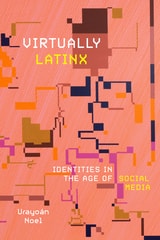
Virtually Latinx
Identities in the Age of Social MediaUrayoán Noel
University of Texas Press, 2026
Examining how Latinx identity reimagines and connects communities through social media.
The very idea of Latinidad flattens identities, subsuming diverse peoples under a single racialized framework useful for corporate and political marketing. But it is not only ethnic identity that Latinidad tends to erase. In the first-ever study of Latinx social media, Urayoán Noel shows how historically marginalized Latinxs—including Black, Trans, undocumented, and disabled people—have used digital platforms to challenge hegemonic Latinidad and to build alternatives communities.
Incorporating elements of history, ethnography, and performance studies, Virtually Latinx traces the evolution of Latinx social media and blogging since the early 1990s, focusing on creative movements and vocabularies emerging and consolidating online. From Chicano/LatinoNet, Latina Lista, and Remezcla, to activists and performers on TikTok, online creators and platforms have spurred modes of art and activism that counter both Latinidad’s essentialized body politics and Big Tech’s domination of the information sphere. In dialogue with scholars of media, virtuality, and identity, Noel theorizes how hashtags like #Afrolatina, #Latinx, and #Latine have not only facilitated online exchange but also nurtured new knowledge formations surrounding Black, feminist, undocuqueer, Trans, and disability poetics and politics.
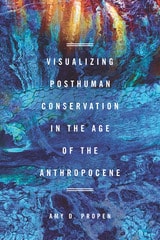
Visualizing Posthuman Conservation in the Age of the Anthropocene
Amy D. Propen
The Ohio State University Press, 2018
Through case studies in which visual technologies and science play a prominent role in arguments to protect threatened marine species—from photographs showing the impact of ocean plastics on vulnerable sea birds, to debates about seismic testing and its impact on marine species, to maps created from GPS tracking projects—Propen advances a notion of posthuman environmental conservation that decenters the human enough to consider ideas about the material world from the vantage point of the nonhuman animal. In so bringing together work in environmental humanities, animal studies, human geography, and visual-material rhetoric, Propen further shows how interdisciplinary ways of knowing can further shape and illuminate our various lived and embodied experiences.
Visualizing the Text
From Manuscript Culture to the Age of CaricatureLauren Beck
University of Delaware Press, 2017