Results by title
399 books match the query 'American fiction' and 3 start with v
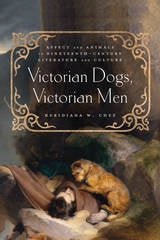
Victorian Dogs, Victorian Men
Affect and Animals in Nineteenth-Century Literature and CultureKeridiana W. Chez
The Ohio State University Press, 2017
Victorian Dogs, Victorian Men: Affect and Animals in Nineteenth-Century Literature and Culture by Keridiana W. Chez is the first monograph located at the intersection of animal and affect studies to examine how gender is produced via the regulation of interspecies relationships. Looking specifically at the development of the human-dog relationship, Chez argues that the bourgeoisie fostered connections with canine companions in order to mediate and regulate gender dynamics in the family. As Chez shows, the aim of these new practices was not to use animals as surrogates to fill emotional vacancies but rather to incorporate them as “emotional prostheses.”
Chez traces the evolution of the human-dog relationship as it developed parallel to an increasingly imperialist national discourse. The dog began as the affective mediator of the family, then addressed the emotional needs of its individual members, and finally evolved into both “man’s best friend” and worst enemy. By the last decades of the nineteenth century, the porous human-animal boundary served to produce the “humane” man: a liberal subject enabled to engage in aggressive imperial projects. Reading the work of Charles Dickens, George Eliot, Margaret Marshall Saunders, Bram Stoker, and Jack London, Victorian Dogs, Victorian Men charts the mobilization of affect through transatlantic narratives, demonstrating the deep interconnections between animals, affect, and gender.
Chez traces the evolution of the human-dog relationship as it developed parallel to an increasingly imperialist national discourse. The dog began as the affective mediator of the family, then addressed the emotional needs of its individual members, and finally evolved into both “man’s best friend” and worst enemy. By the last decades of the nineteenth century, the porous human-animal boundary served to produce the “humane” man: a liberal subject enabled to engage in aggressive imperial projects. Reading the work of Charles Dickens, George Eliot, Margaret Marshall Saunders, Bram Stoker, and Jack London, Victorian Dogs, Victorian Men charts the mobilization of affect through transatlantic narratives, demonstrating the deep interconnections between animals, affect, and gender.
[more]
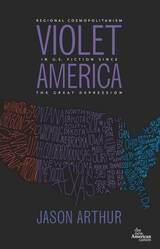
Violet America
Regional Cosmopolitanism in U.S. FictionJason Arthur
University of Iowa Press, 2013
Violet America takes on the long habit among literary historians and critics of thinking about large segments of American literary production in terms of regionalism. Jason Arthur argues that classifying broad swaths of American literature as regionalist or “local color” writing brings with it a set of assumptions, informed by longstanding habits of thought about American culture, that marginalize important literary works and deform our understanding of them. Moreover, these assumptions reinforce our ideas about the divisions between city and country, coast and center, cosmopolitan and provincial that lie behind not only our literature, but our politics.
Against this common view, Violet America demonstrates just how cosmopolitan the regional impulse can be. In the works of James Agee, Jack Kerouac, Maxine Hong Kingston, Russell Banks, and Jonathan Franzen, the regional impulse yields narratives about the interdependence between privilege and poverty, mainstream and margin, urban and rural. These narratives counteract the polarizing cultural lens that, when unquestioned, sees the red-state/blue-state geography of twenty-first-century America as natural. Tracking the evolution of this impulse to depolarize, Violet America develops a literary history of “regional cosmopolitanism,” a key urge of which is to represent the interconnectedness of the local, the national, and the global. Writers incorporating this perspective redress the blight of America’s neglected places and peoples without also falling victim to the stigmas of being purely regional in their scope and interest. Rather than simply celebrating regional difference, the regional cosmopolitan fiction that Arthur discusses blends the nation’s cultural polarities into a connected, interdependent America. [more]

Vision/Re-Vision
Adapting Contemporary American Fiction To FilmBarbara Tepa Lupack
University of Wisconsin Press, 1996
The essays in Vision/Re-Vision analyze in detail ten popular and important films adapted from contemporary American fiction by women, addressing the ways in which the writers' latent or overt feminist messages are reinterpreted by the filmmakers who bring them to the screen, demonstrating that there is much to praise as well as much to fault in the adaptations and that the process of adaptation itself is instructive rather than destructive, since it enriches understanding about both media.
[more]