Results by title
653 books match the query 'Animals' and 5 start with v
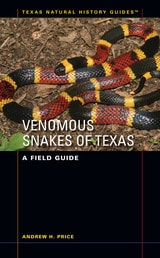
Venomous Snakes of Texas
A Field GuideBy Andrew H. Price
University of Texas Press, 2009
Texas has about one hundred twenty native species and subspecies of snakes, fifteen of which are venomous. Since 1950, Texans have turned to the Poisonous Snakes of Texas pamphlet series published by the Texas Parks and Wildlife Department for help in identifying these snakes and for expert advice on preventing and treating snakebite. Venomous Snakes of Texas, a thoroughly revised and updated edition of Poisonous Snakes, carries on this tradition as a one-stop, all-you-need-to-know guide to Texas's rattlesnakes, copperheads, cottonmouths, and coral snakes.
In this authoritative field guide, you'll find:
- Full-color photographs and a county-by-county distribution map for each species.
- Each species' common and scientific name, description, look-alikes, and a summary sketch of its habitat, behavior, reproduction, venom characteristics, predator-prey relationships, and fossil record.
- Up-to-date advice on recognizing venomous snakes and preventing and treating snakebite, both at home and in the field.
- A glossary of terms and an extensive bibliography.
A special feature of this guide is an expanded treatment of the ecological and evolutionary context in which venomous snakes live, which supports Price's goal "to lessen the hatred and fear and to increase the understanding, the respect, and even the appreciation with which venomous snakes should be regarded."
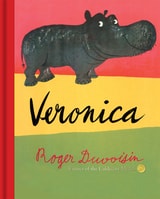
Veronica
Roger Duvoisin
Bodleian Library Publishing, 2016
Many miles from the cool, muddy riverbank, the men and women of the pink-and-white city stare at Veronica, bump into her with their cars, and shout angrily when she steps on their toes. In the city, Veronica is not only conspicuous—she is very much in the way! Mishaps befall her at every turn. While taking a curbside nap, she is issued a warning for stopping traffic. When she bathes in the public fountain, the townspeople cluck unsympathetically. At the farmers’ market, Veronica is unused to city manners and helps herself happily to an entire cart of fresh, delicious vegetables—including the paper bags. When a policeman is called to capture the hungry hippo, Veronica decides that the city is not the place for a hippopotamus. But the hustle and bustle of city life is not the only surprise to come from Veronica’s big journey. When she returns home to the riverbank, she finds her dream has come true after all. From that day forward, Veronica is famous among the hippopotamuses, who gather each day at sunset to hear about her adventures in the pink-and-white city.
Originally published in the 1960s, Veronica by Caldecott Medal–winning author and illustrator Roger Duvoisin is the most recent addition to the Bodleian Library’s newly minted children’s book imprint. For little readers with big dreams, it offers a timeless tale of the surprising places those dreams may take us.
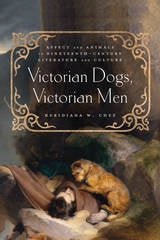
Victorian Dogs, Victorian Men
Affect and Animals in Nineteenth-Century Literature and CultureKeridiana W. Chez
The Ohio State University Press, 2017
Chez traces the evolution of the human-dog relationship as it developed parallel to an increasingly imperialist national discourse. The dog began as the affective mediator of the family, then addressed the emotional needs of its individual members, and finally evolved into both “man’s best friend” and worst enemy. By the last decades of the nineteenth century, the porous human-animal boundary served to produce the “humane” man: a liberal subject enabled to engage in aggressive imperial projects. Reading the work of Charles Dickens, George Eliot, Margaret Marshall Saunders, Bram Stoker, and Jack London, Victorian Dogs, Victorian Men charts the mobilization of affect through transatlantic narratives, demonstrating the deep interconnections between animals, affect, and gender.
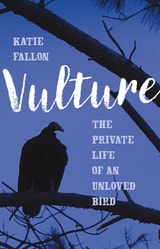
Vulture
The Private Life of an Unloved BirdKatie Fallon
University Press of New England, 2018
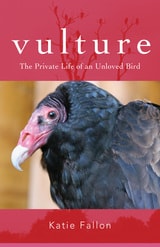
Vulture
The Private Life of an Unloved BirdKatie Fallon
Brandeis University Press, 2020
Few animals have a worse reputation than the vulture. But is it deserved? With Vulture, Katie Fallon offers an irresistible argument to the contrary, tracing a year in the life of a typical North American turkey vulture. Turkey vultures, also known as buzzards, are the most widely distributed and abundant scavenging birds of prey on the planet, found from central Canada to the southern tip of Argentina and nearly everywhere in between. Deftly drawing on the most up-to-date scientific papers and articles and weaving those in with interviews with world-renowned raptor and vulture experts and her own compelling natural history writing, Fallon examines all aspects of the bird’s natural history: breeding, incubating eggs, raising chicks, migrating, and roosting. The result is an intimate portrait of an underappreciated bird—one you’ll never look at in the same way again.