Results by title
490 books match the query 'Asian' and 5 start with v
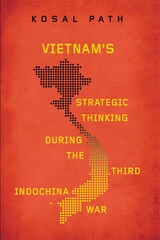
Vietnam's Strategic Thinking during the Third Indochina War
Kosal Path
University of Wisconsin Press, 2023
When costly efforts to cement a strategic partnership with the Soviet Union failed, the combined political pressure of economic crisis at home and imminent external threats posed by a Sino-Cambodian alliance compelled Hanoi to reverse course. Moving away from the Marxist-Leninist ideology that had prevailed during the last decade of the Cold War era, the Vietnamese government implemented broad doi moi ("renovation") reforms intended to create a peaceful regional environment for the country's integration into the global economy.
In contrast to earlier studies, Path traces the moving target of these changing policy priorities, providing a vital addition to existing scholarship on asymmetric wartime decision-making and alliance formation among small states. The result uncovers how this critical period had lasting implications for the ways Vietnam continues to conduct itself on the global stage.
In contrast to earlier studies, Path traces the moving target of these changing policy priorities, providing a vital addition to existing scholarship on asymmetric wartime decision-making and alliance formation among small states. The result uncovers how this critical period had lasting implications for the ways Vietnam continues to conduct itself on the global stage.
[more]
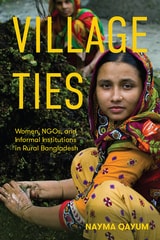
Village Ties
Women, NGOs, and Informal Institutions in Rural BangladeshNayma Qayum
Rutgers University Press, 2022
Across the global South, poor women’s lives are embedded in their social relationships and governed not just by formal institutions – rules that exist on paper – but by informal norms and practices. Village Ties takes the reader to Bangladesh, a country that has risen from the ashes of war, natural disaster, and decades of resource drain to become a development miracle. The book argues that grassroots women’s mobilization programs can empower women to challenge informal institutions when such programs are anti-oppression, deliberative, and embedded in their communities. Qayum dives into the work of Polli Shomaj (PS), a program of the development organization BRAC to show how the women of PS negotiate with state and society to alter the rules of the game, changing how poor people access resources including safety nets, the law, and governing spaces. These women create a complex and rapidly transforming world where multiple overlapping institutions exist – formal and informal, old and new, desirable and undesirable. In actively challenging power structures around them, these women defy stereotypes of poor Muslim women as backward, subservient, oppressed, and in need of saving.
[more]
Violence of Democracy
Interparty Conflict in South IndiaRuchi Chaturvedi
Duke University Press, 2023
In Violence of Democracy Ruchi Chaturvedi tracks the rise of India’s divisive politics through close examination of decades-long confrontations in Kerala between members of the Communist Party of India (Marxist) and supporters of the Hindu nationalist Rashtriya Swayam Sevak Sangh and the Bharatiya Janata Party. Drawing on ethnographic fieldwork and extensive archival research, Chaturvedi investigates the unique character of the conflict between the party left and the Hindu right. This conflict, she shows, defies explanations centering religious, caste, or ideological differences. It offers instead new ways of understanding how quotidian political competition can produce antagonistic majoritarian communities. Rival political parties mobilize practices of disbursing care and aggressive masculinity in their struggle for electoral and popular power, a process intensified by a criminal justice system that reproduces rather than mitigating violence. Chaturvedi traces these dynamics from the late colonial period to the early 2000s, illuminating the broader relationships between democratic life, divisiveness, and majoritarianism.
[more]
Violent Belongings
Partition, Gender, and National Culture in Postcolonial IndiaKavita Daiya
Temple University Press, 2008
Focusing on the historical and contemporary narration of the Partition of India, Violent Belongings examines transnational South Asian culture from 1947 onwards. Spanning the Indian subcontinent and its diasporas in the United Kingdom and the United States, it asks how postcolonial/diasporic literature (eg., Rushdie, Mistry, Sidwa and Lahiri), Bollywood film, personal testimonies and journalism represent the violence, migration and questions of national belonging unleashed by that pivotal event during which two million people died and sixteen million were displaced.
In addition to challenging the official narratives of independence and Partition, these narratives challenge our contemporary understanding of gender and ethnicity in history and politics. Violent Belongings argues that both male and female bodies, and heterosexual coupledom, became symbols of the nation in public life. In the newly independent Indian nation both men and women were transformed into ideal citizens or troubling bodies, immigrants or refugees, depending on whether they were ethnically Hindu, Muslim, Jewish or Sikh. The divisions set in motion during Partition continue into our own time and account for ethnic violence in South Asia.
In addition to challenging the official narratives of independence and Partition, these narratives challenge our contemporary understanding of gender and ethnicity in history and politics. Violent Belongings argues that both male and female bodies, and heterosexual coupledom, became symbols of the nation in public life. In the newly independent Indian nation both men and women were transformed into ideal citizens or troubling bodies, immigrants or refugees, depending on whether they were ethnically Hindu, Muslim, Jewish or Sikh. The divisions set in motion during Partition continue into our own time and account for ethnic violence in South Asia.
[more]

Voices from the Thai Countryside
Samruam Singh
University of Wisconsin Press, 2008
Glimpses of village life during a tumultuous period of Thai history
Set in northern Thailand during the mid-1970s, the stories in this collection capture a period of dramatic social and economic change. Amidst a setting of marketplaces and paddyfields, lemon trees and leaf-roofed houses, these vignettes offer revealing insights into the daily lives of ordinary villagers and hillspeople struggling to survive.
[more]