Results by title
264 books match the query 'Asian Studies' and 2 start with v
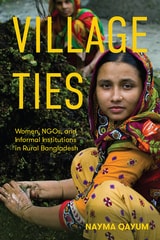
Village Ties
Women, NGOs, and Informal Institutions in Rural BangladeshNayma Qayum
Rutgers University Press, 2022
Across the global South, poor women’s lives are embedded in their social relationships and governed not just by formal institutions – rules that exist on paper – but by informal norms and practices. Village Ties takes the reader to Bangladesh, a country that has risen from the ashes of war, natural disaster, and decades of resource drain to become a development miracle. The book argues that grassroots women’s mobilization programs can empower women to challenge informal institutions when such programs are anti-oppression, deliberative, and embedded in their communities. Qayum dives into the work of Polli Shomaj (PS), a program of the development organization BRAC to show how the women of PS negotiate with state and society to alter the rules of the game, changing how poor people access resources including safety nets, the law, and governing spaces. These women create a complex and rapidly transforming world where multiple overlapping institutions exist – formal and informal, old and new, desirable and undesirable. In actively challenging power structures around them, these women defy stereotypes of poor Muslim women as backward, subservient, oppressed, and in need of saving.
[more]

Village and Family in Contemporary China
William L. Parish and Martin King Whyte
University of Chicago Press, 1978
After 1949 the Chinese Communists carried out land reform, the collectivization of agriculture, and the formation of people's communes. The new economic and political organizations that emerged have made peasant life more comfortable and secure, but many economic and status differentials and traditional customs remain resistant to change. Focusing on rural Kwangtung province, William L. Parish and Martin King Whyte examine the rural work-incentive system, village equality and inequality, rural health care and education, marriage customs, and the position of women, among other topics, to determine what and how much of the traditional Chinese ways of life is left in Communist China.
[more]