Results by title
379 books match the query 'Botany' and 7 start with v
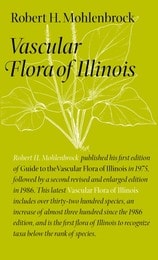
Vascular Flora of Illinois
Robert H. Mohlenbrock
Southern Illinois University Press, 2002
This latest Vascular Flora of Illinois includes over thirty-two hundred species, an increase of almost three hundred since 1986. In addition, for the first time, taxa below the rank of species are recognized and may be identified by keys. Investigating seldom-visited patches of prairies, wetlands, and forested canyons, Mohlenbrock has added several native species to this flora. And while there has been extensive exploration for plants, Mohlenbrock has also researched the herbaria in an attempt to verify previous reports of records of Illinois plants.
Because of a reinterpretation of existing genera, the number of genera of Illinois plants has increased markedly. Recent biosystematic techniques have begun to substantiate the genera that botanists such as John Kunkel Small, Per Axel Rydberg, and Edmund C. Greene proposed nearly a century ago.
The sequence of groups in this book is ferns, conifers, and flowering plants, with dicotyledons given before monocotyledons. Within each group, the families are arranged alphabetically, as are the genera within each family and the species within each genus.
For each taxon recognized in this book, Mohlenbrock gives a common name if one is generally used in Illinois. He follows this by an indication of flowering time for flowering plants and of spore-production time for ferns and their relatives. He also provides a habitat statement and a general comment on distribution in Illinois for each taxon. Synonyms for some other scientific names used previously for a taxon appear in italics. This book contains indexes both for common names and for family and genus names.
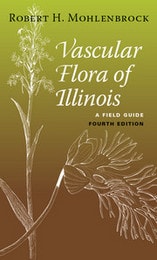
Vascular Flora of Illinois
A Field Guide, Fourth EditionRobert H. Mohlenbrock
Southern Illinois University Press, 2013
This latest edition of Vascular Flora of Illinois includes over thirty-four hundred species of flora from Illinois, adding more than 250 newly-recognized plants to this definitive collection. Because cataloguing our heritage is foremost in importance among naturalists, this book compiles essential information about plants in Illinois. Mohlenbrock includes all known taxa native to Illinois either at present or in the past and all non-native vascular plants that grow spontaneously and appear able to maintain themselves year after year without cultivation. The sequence of groups in the guide is ferns, conifers, and flowering plants, with cotyledons given before monocotyledons. Within each group, the families are arranged alphabetically, as are the genera within each family and the species within each genus. For each taxon recognized in this book, Mohlenbrock gives us a common name if one is generally used in Illinois. He follows this with an indication of flowering time for flowering plants, and of spore-production time in the case of ferns and their relatives. He also provides a habitat statement and a general comment on distribution in Illinois for each taxon.
Containing information on Illinois flora not available anywhere else, this fourth edition of Vascular Flora of Illinois is essential for ecologists, environmentalists, and land developers. Those interested in wildflower identification will also find this guide helpful.
Vascular Plant Families and Genera
R. K. Brummitt
Royal Botanic Gardens, Kew, 2000
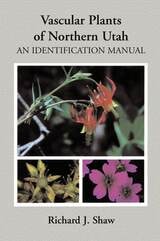
Vascular Plants of Northern Utah
An Identification ManualRichard Shaw
Utah State University Press, 1989

Vascular Plants of Texas
A Comprehensive Checklist Including Synonymy, Bibliography, and IndexBy Stanley D. Jones, Joseph K. Wipff, and Paul M. Montgomery
University of Texas Press, 1997
Everyone with a professional interest in the flora of Texas will welcome this checklist of the vascular plants. This comprehensive list also includes crops, persistent perennials, and naturalized plants and encompasses over 1,000 changes to the previous (Hatch, 1990) checklist. The authors have arranged this checklist phylogenetically by classes following the Cronquist system.
Several features make this checklist especially useful. Chief among them is the relative synonymy (name history). An extensive index makes current classification and correct nomenclature readily accessible, while the botanical bibliography is the most extensive ever compiled for Texas. The authors also note which plants have been listed as threatened or endangered by the Texas Organization of Endangered Species, which are designated as Federal Noxious Weeds, and which have been chosen as state tree, flower, fruit, etc. by the Texas Legislature.
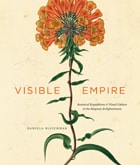
Visible Empire
Botanical Expeditions and Visual Culture in the Hispanic EnlightenmentDaniela Bleichmar
University of Chicago Press, 2012
Between 1777 and 1816, botanical expeditions crisscrossed the vast Spanish empire in an ambitious project to survey the flora of much of the Americas, the Caribbean, and the Philippines. While these voyages produced written texts and compiled collections of specimens, they dedicated an overwhelming proportion of their resources and energy to the creation of visual materials. European and American naturalists and artists collaborated to manufacture a staggering total of more than 12,000 botanical illustrations. Yet these images have remained largely overlooked—until now.
In this lavishly illustrated volume, Daniela Bleichmar gives this archive its due, finding in these botanical images a window into the worlds of Enlightenment science, visual culture, and empire. Through innovative interdisciplinary scholarship that bridges the histories of science, visual culture, and the Hispanic world, Bleichmar uses these images to trace two related histories: the little-known history of scientific expeditions in the Hispanic Enlightenment and the history of visual evidence in both science and administration in the early modern Spanish empire. As Bleichmar shows, in the Spanish empire visual epistemology operated not only in scientific contexts but also as part of an imperial apparatus that had a long-established tradition of deploying visual evidence for administrative purposes.
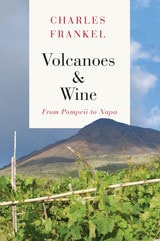
Volcanoes and Wine
From Pompeii to NapaCharles Frankel
University of Chicago Press, 2019
Traveling across regions wellknown to wine lovers like Sicily, Oregon, and California, as well as the less familiar places, such as the Canary Islands, Frankel gives an in-depth account of famous volcanoes and the wines that spring from their idiosyncratic soils. From Santorini’s vineyards of rocky pumice dating back to a four-thousand-year-old eruption to grapes growing in craters dug in the earth of the Canary Islands, from Vesuvius’s famous Lacryma Christi to the ambitious new generation of wine growers reviving the traditional grapes of Mount Etna, Frankel takes us across the stunning and dangerous world of volcanic wines. He details each volcano’s most famous eruptions, the grapes that grow in its soils, and the people who make their homes on its slopes, adapting to an ever-menacing landscape. In addition to introducing the history and geology of these volcanoes, Frankel's book serves as a travel guide, offering a host of tips ranging from prominent vineyards to visit to scenic hikes in each location.
This illuminating guide will be indispensable for wine lovers looking to learn more about volcanic terroirs, as well as anyone curious about how cultural heritage can survive and thrive in the shadow of geological danger.