335 books match the query 'Caribbean & Latin American Studies' and 6 start with v

cover of Violence and Indigenous Communities: Confronting the Past and Engaging the Present

Violence and Indigenous Communities

Confronting the Past and Engaging the Present

Edited by Susan Sleeper-Smith, Jeffrey Ostler, and Joshua L. Reid

Northwestern University Press, 2021

In contrast to past studies that focus narrowly on war and massacre, treat Native peoples as victims, and consign violence safely to the past, this interdisciplinary collection of essays opens up important new perspectives. While recognizing the long history of genocidal violence against Indigenous peoples, the contributors emphasize the agency of individuals and communities in genocide’s aftermath and provide historical and contemporary examples of activism, resistance, identity formation, historical memory, resilience, and healing. The collection also expands the scope of violence by examining the eyewitness testimony of women and children who survived violence, the role of Indigenous self-determination and governance in inciting violence against women, and settler colonialism’s promotion of cultural erasure and environmental destruction.

By including contributions on Indigenous peoples in the United States, Canada, the Pacific, Greenland, Sápmi, and Latin America, the volume breaks down nation-state and European imperial boundaries to show the value of global Indigenous frameworks. Connecting the past to the present, this book confronts violence as an ongoing problem and identifies projects that mitigate and push back against it.

[more]
cover of Viscous Performances: The Persistence of Creative Resistances in Neoliberal Chile

Viscous Performances

The Persistence of Creative Resistances in Neoliberal Chile

María José Contreras Lorenzini

Duke University Press, 2026

Viscous Performances examines the endurance of creative protest performances in Chile from the 2011 student mobilizations to the aftermath of the 2019 social revolt. Drawing from performance theory, feminist new materialisms, affect studies, and decolonial perspectives, María José Contreras Lorenzini situates Chilean practices of resistance within a global conversation about the politics of performance while attending closely to the historical and material specificities of the Chilean context. Case studies include student interventions, feminist mobilizations, and commemorative actions that unfolded along a two-kilometer stretch of Santiago’s main avenue, La Alameda. Contreras Lorenzini argues that repeated creative resistances that insistently occupied this same urban corridor generated a sticky, persistent, and affectively charged antidote to neoliberalism’s slow violence. These temporally dispersed acts territorialized the urban space as a site of resistance where echoes and reverberations of repertoires accumulated, thickened, and remained available for reenactment. By theorizing resistance as viscous rather than fleeting, Viscous Performances challenges neoliberal framings of dissent that privilege visibility and spectacle and highlights the quieter, less visible practices of care, collaboration, and imagination through which communities sustain long-term struggles.
[more]
cover of Visual Disobedience: Art and Decoloniality in Central America

Visual Disobedience

Art and Decoloniality in Central America

Kency Cornejo

Duke University Press, 2024
In Visual Disobedience, Kency Cornejo traces the emergence of new artistic strategies for Indigenous, feminist, and anticarceral resistance in the wake of torture, disappearance, killings, and US-funded civil wars in Central America. Cornejo reveals a direct line from US intervention to current forms of racial, economic, and gender injustice in the isthmus, connecting this to the criminalization and incarceration of migrants at the US-Mexico border today. Drawing on interviews with Central American artists and curators, she theorizes a form of “visual disobedience” in which art operates in opposition to nation-states, colonialism, and visual coloniality. She counters historical erasure by examining over eighty artworks and highlighting forty artists across the region. Cornejo also rejects the normalized image of the suffering Central American individual by repositioning artists as creative agents of their own realities. With this comprehensive exploration of contemporary Central American art, Cornejo highlights the role of visual disobedience as a strategy of decolonial aesthetics to expose and combat coloniality, heteropatriarchy, white supremacy, empire, and other systems of oppression.
[more]
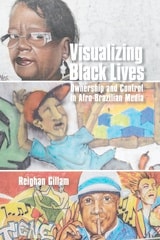
cover of Visualizing Black Lives: Ownership and Control in Afro-Brazilian Media

Visualizing Black Lives

Ownership and Control in Afro-Brazilian Media

Reighan Gillam

University of Illinois Press, 2022

A new generation of Afro-Brazilian media producers have emerged to challenge a mainstream that frequently excludes them. Reighan Gillam delves into the dynamic alternative media landscape developed by Afro-Brazilians in the twenty-first century. With works that confront racism and focus on Black characters, these artists and the visual media they create identify, challenge, or break with entrenched racist practices, ideologies, and structures. Gillam looks at a cross-section of media to show the ways Afro-Brazilians assert control over various means of representation in order to present a complex Black humanity. These images--so at odds with the mainstream--contribute to an anti-racist visual politics fighting to change how Brazilian media depicts Black people while highlighting the importance of media in the movement for Black inclusion.

An eye-opening union of analysis and fieldwork, Visualizing Black Lives examines the alternative and activist Black media and the people creating it in today's Brazil.

[more]
cover of Visualizing Latinx: Creative Practices in Fashion, Film, and Beyond

Visualizing Latinx

Creative Practices in Fashion, Film, and Beyond

Arlene Dávila

Duke University Press, 2026
Visualizing Latinx elevates the stories of contemporary Latinx creators working in fashion, independent filmmaking, and public art who confront the systemic erasure of Latinx creativity. Arlene Dávila documents how these creatives strive to visualize their communities as a means of transforming society and asserting inclusion on their own terms. She highlights how these artists approach their work with purpose, intention, style, and ingenuity to showcase the value, joy, and complexity of Latinx identities. Looking to the academic sector as a sanctioning and uplifting force, Dávila also explores academia’s role in making Latinx histories and creative communities visible. By focusing on the inventive, transformative, and decolonial practices of Latinx artists and creatives, she argues that seeing and appreciating Latinx culture through visual media can be revolutionary in creating a more equitable and vibrant society for all.
[more]
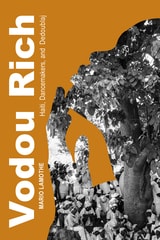
cover of Vodou Rich: Haiti, Dancemakers, and Dedoublaj

Vodou Rich

Haiti, Dancemakers, and Dedoublaj

Mario LaMothe

University of Illinois Press, 2026

Contemporary dance in Haiti challenges global stereotypes of its people, their country, and their worldmaking. Mario LaMothe profiles four celebrated Haitian choreographers to examine the influences that nurtured the generative and transgressive dance practices found today in the Caribbean nation.

LaMothe weaves Vodou teaching practices with humanist and social science theory to shed light on how choreographers move among ideas of Haitian bodies as vessels, producers, and traffickers of Vodou economies. As he shows, the dancemakers’ work maneuvers through national uncertainties and international caricatures of Haiti’s challenges. At the same time, it pivots between these phenomena via dedoublaj—the act of doubling, self-doubling, transformation, and soulful travel. LaMothe’s analysis of dedoublaj reveals how dancemakers reimagine Haitian bodies as self-possessed human beings remedying unjust practices, envisioning chances for solidarity and being, and setting a course for queerly paced futures.

Powerful and multidisciplinary, Vodou Rich explores Haitian dancemaking at home and its reception around the world.
[more]